
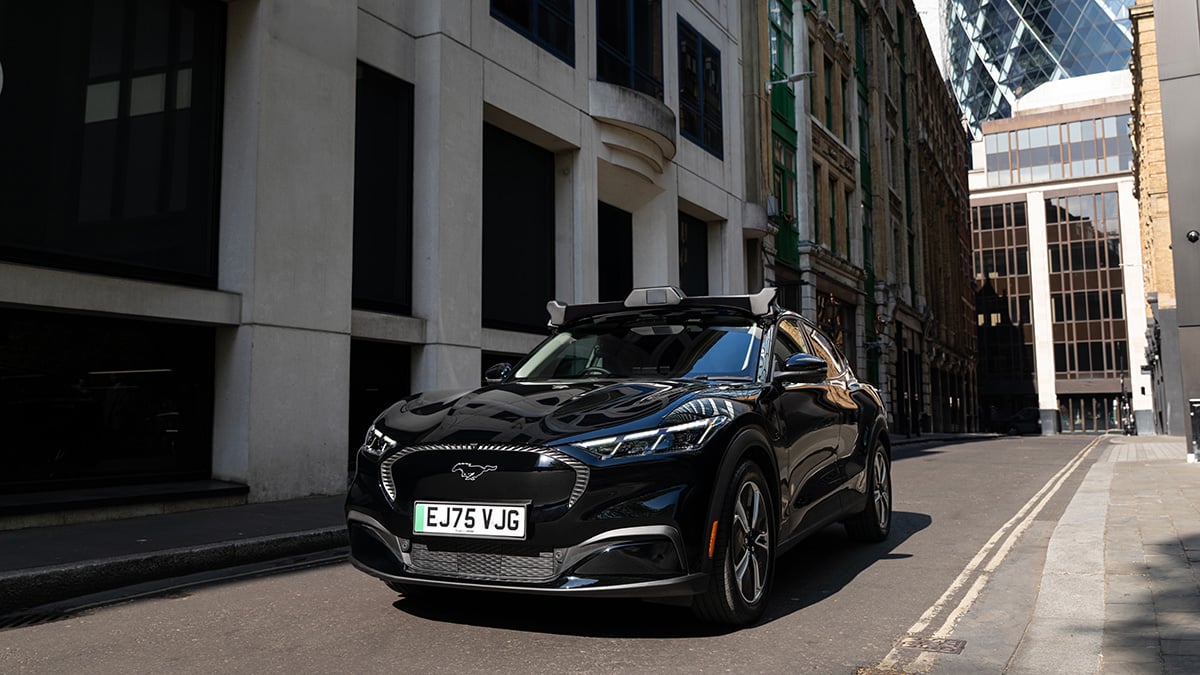
As the first robotaxis take to the streets, Britain is at a pivotal moment for automated and assisted driving.
With applications now open for operators to run self-driving taxi services, the Government hopes it will unlock billions in benefits for the economy by 2035 and enhance safety, with 88% of collisions currently caused by human error.
This has thrown light onto what’s really required to be ready for autonomous driving, both in ‘robotaxis’ and in assisted and autonomous vehicles, and why the answer does not lie in autonomous vehicles themselves.
While much of the attention has focused on autonomous vehicles, the real story is the connected digital infrastructure that enables them. Robotaxis rely on a constant flow of location, sensor, and mapping data between vehicles, Cloud platforms, and roadside infrastructure, making them one of the most demanding real-world IoT applications.
The next phase of autonomous mobility will not go to the smartest vehicle, but to the vehicle armed with the most trusted and continuously updated view of the road. Autonomous vehicles need more than AI models and sensors. They need access to live, machine-readable location intelligence that grounds AI in the real world.
As cars are now acting as ‘software-defined vehicles’, constantly upgraded by computer software like the smartphones in our pockets, mapping software and continuously updated data will only grow in importance.
The ground-truth Layer
For AI-powered cars, sensors and AI models are not enough. Vehicles need a ground-truth layer built on connected location intelligence. This combines data from onboard sensors with Cloud services and other connected vehicles, creating a continuously updated digital representation of the road network.
Autonomous and highly assisted vehicles need live maps to ‘ground’ the AI in the real world, offering intelligence on everything from lane layouts and speed limits to rapidly changing factors such as traffic conditions and hazards. This ground-truth layer also offers transparency into why decisions are made, helping drivers to trust their vehicles.
High-quality map data offers information not just on the visible road, but on non-observable information such as road rules and regulations. As a result, maps become much more than a simple navigation tool, growing into a dynamic canvas that holds the collective knowledge of the road network. Cars can understand the world around them in a way that would not be possible with the car’s perception stack alone, composed of the sensors the vehicle ‘sees’ through, such as radar, LiDAR and cameras. For instance, a connected vehicle that detects an accident can upload that information to the cloud in near real time, allowing mapping platforms and other connected vehicles to reroute traffic. As vehicle-to-Cloud and vehicle-to-everything (V2X) connectivity develops, this shared intelligence becomes increasingly valuable.
Automated vehicles that rely solely on their own perception stack are distinctly limited. They can only ‘see’ what their sensors are able to perceive, just like a human driver is limited by sight. Not beyond the vehicles surrounding you in traffic, not beyond a corner or a hill. However, a new generation of location intelligence is helping vehicles to break through these limitations.
Many of these decisions must be made at the Edge, inside the vehicle, while continuously synchronising with Cloud-based mapping and location services.
Beyond fragmented road data
This makes autonomous vehicles part of a much wider IoT ecosystem. Vehicles are becoming connected endpoints that continuously consume and generate data, interacting with Cloud platforms, roadside infrastructure and other vehicles in real time. As with industrial IoT, the value comes not from individual devices but from the intelligence created across the connected network.
Rather than operating as isolated systems, autonomous vehicles are becoming connected nodes within a wider mobility ecosystem, continuously exchanging data with Cloud platforms, digital maps, roadside infrastructure, and other vehicles.
Where previous assisted driving systems operated in isolation, the latest map intelligence systems integrate with car sensors to work to give a vehicle a ‘sixth sense’. Map data works like an extra sensor to the cameras and LiDAR on modern cars, creating an electronic horizon that allows cars to prepare for the road ahead, adjusting speed and trajectory far before sensors detect a change that tells the car to change route. This extended awareness is a powerful boost to safety in cars, improving driving predictability, comfort and enhancing features such as speed assistance and lane-level guidance.
And even beyond the role of AI in assisted and autonomous driving, large language models (LLMs) are becoming standard to the in-car experience, with users expecting more conversational interactions. But LLMs alone are not enough: while they can interpret what a user wants, answering specific route requests requires geographic data, not inference from text. Chatbots can also hallucinate, which is something a car should never be allowed to do. Live maps are an essential way for vehicles to operate and respond to their environments with precision.
What industrial IoT can learn from connected vehicles
There are important lessons here for other ‘physical AI’ industries. From construction to shipping to manufacturing. AI-driven analytics can power predictive insights at scale, around tyre and brake wear, for example, enabling earlier maintenance. Human feedback also plays a vital role. By tracking where humans prefer to take over controls, car makers can identify situations where the systems may need additional training, an insight which could have important applications in other industries.
By map-matching these scenarios, manufacturers can identify ‘problem’ situations and redefine the vehicle’s operational design domain (ODD) to determine the level of support drivers get. Digital twin technology, with AI creating real-time virtual replicas of vehicles in their environment, will also help automakers to train and validate against any edge case imaginable in the safe simulation environment. These environments can again be generated from the ground truth of the map, so they accurately depict realistic scenes and scenarios that correspond with where the OEM aims to operate their driving function.
The same combination of sensors, Edge AI, connectivity, and digital twins is already transforming industrial IoT deployments in factories, logistics hubs, and energy infrastructure.
Success will depend as much on resilient connectivity, trusted location data, and Cloud infrastructure as advances in autonomous driving software itself.
Towards smarter streets
This year’s ‘robotaxi moment’ is clearly a pivotal moment for self-driving in Britain, and a moment for consumers, manufacturers, and politicians to reflect on the challenges facing this emerging market.
As more connected vehicles join the network, the value of shared data increases. Every journey contributes fresh information about road conditions, hazards, and traffic flows, creating a continuously improving feedback loop between vehicles, Cloud platforms, and digital maps. This network effect is a defining characteristic of large-scale IoT deployments.
There are very high hopes for both mobility and the economy but what’s clear is that Britain’s robotaxi rollout demonstrates that autonomous driving is fundamentally a connected IoT challenge. The vehicles may capture the headlines, but it is the combination of location intelligence, real-time connectivity, Edge computing, and continuously updated digital maps that will ultimately determine whether autonomous mobility succeeds at scale.
This technology will offer important lessons to other industries and, as we enter the era of truly software-defined vehicles, the mapping layer will be the vital element that helps true self-driving become a reality in this country.
This technology also offers valuable lessons for other connected industries. As we enter the era of software-defined vehicles, it will be the combination of location intelligence, resilient connectivity, and shared digital infrastructure, not the vehicle alone, that enables autonomous mobility to become a practical reality.
This article originally appeared in the September issue of IoT Insider.