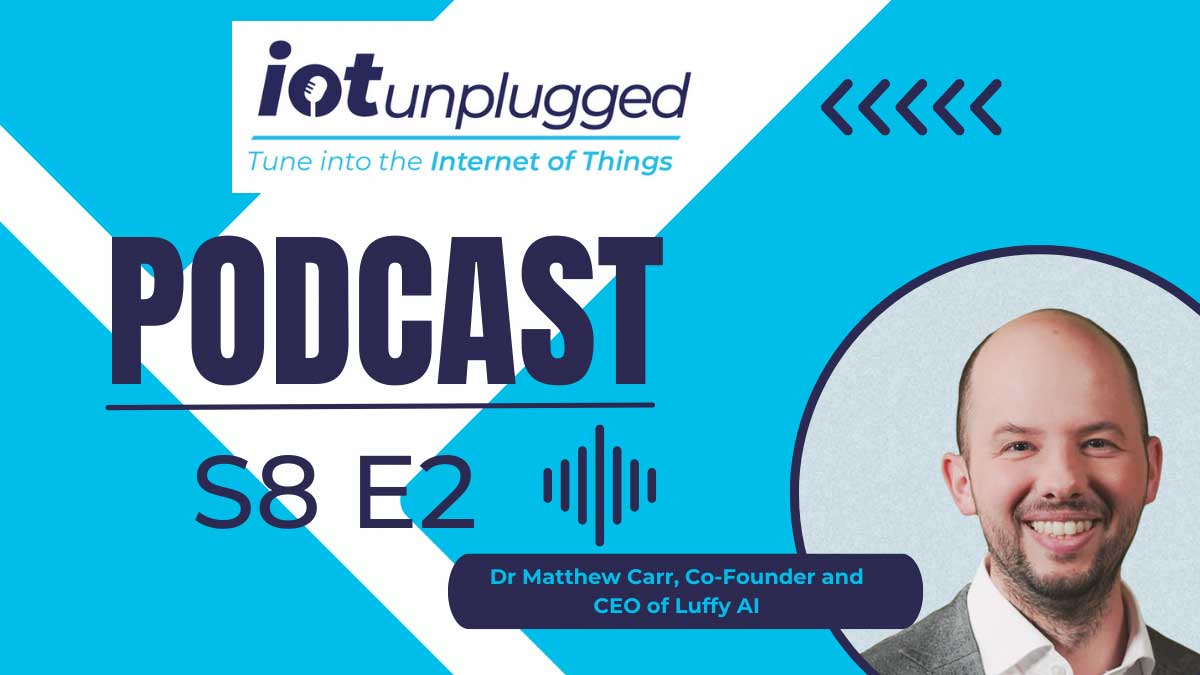
In this episode of IoT Unplugged, Dr Matthew Carr, Co-founder of Luffy, explains neuroplastic AI, a new generation of artificial intelligence designed to learn with minimal data and run on tiny devices.
Carr says neuroplastic AI is beginning to make its way from research labs into factories, warehouses, and industrial systems where it could reshape the economics of industrial automation by embedding adaptive intelligence directly into machinery.
Carr’s route into AI is unconventional. Originally trained in engineering and physics, he worked on renewable energy systems before moving into nuclear fusion research at the Joint European Torus (JET), one of the world’s most complex experimental reactors.
There, amid tens of thousands of sensors and extreme operating conditions, he began exploring the intersection of control systems and advanced data science.
That experience helped inform Luffy’s central premise: that most modern AI systems are ill-suited to the constraints of industrial environments.
“Mainstream deep learning relies on large datasets and significant compute,” Carr said. “But when you move to IoT and Edge devices, you often have neither.”
Instead, Luffy’s approach borrows from biology. Neuroplastic AI systems are designed to adapt in real time, adjusting their internal parameters as conditions change, rather than relying on vast pre-trained datasets.
Carr likens the concept to how animals learn: a deer can walk within an hour of birth not because it has learned from data, but because its brain is primed to adapt quickly to its body.
Applied to industrial equipment, this means a motor, pump, or ventilation system could “learn” its own operating characteristics after installation, tuning itself for efficiency and performance.
The implications could be significant. Estimates from McKinsey & Co suggest that embedding AI into industrial Edge devices could unlock around $100bn in value, while the International Energy Agency (IEA) has said such systems could deliver energy savings of between 2% and 6% across sectors such as heating, ventilation, and pumping.
Although such percentages may appear modest, they scale across vast installed bases of equipment. Industrial motors alone account for roughly half of global electricity consumption.
Luffy’s technology aims to make these gains accessible without the need for new hardware. Its AI models are trained in simulation—often using existing “digital twin” models already employed in engineering design—and then deployed as lightweight software, sometimes requiring as little as 10 kilobytes of memory.
Once embedded into a device’s microcontroller, the system continues to adapt. Unlike conventional AI, which typically requires periodic retraining in the cloud, neuroplastic models adjust continuously at the edge, reducing both data transmission and energy use.
In early trials, the company has demonstrated applications ranging from drone flight control to industrial manufacturing. In one case involving injection moulding, Carr said the system improved energy efficiency by nearly 10% while reducing the need for manual tuning.
In another demonstration, a drone equipped with the technology was able to continue flying even after sustaining damage, adapting to changes in weight and balance in real time. Crucially, these capabilities come with far lower computational demands.
Carr claims efficiency gains of between 100 times and 400 times compared with traditional deep learning models, allowing systems to run on hardware as modest as a fraction of a Raspberry Pi processor core. That shift could challenge assumptions about how AI is deployed.
Rather than relying on Cloud infrastructure or specialised chips, manufacturers may be able to upgrade existing equipment through software alone.
“There’s a perception that adding AI means adding bigger compute,” Carr said. “We’re showing that you can fit it into what’s already there.”
The company is now working with large industrial partners on applications including logistics systems, wastewater pumping, and heating and cooling networks.
Its longer-term ambition is to build a library of adaptable AI controllers that can be deployed across different types of equipment.
Adoption remains at an early stage, and integration challenges persist, particularly around compatibility and cybersecurity.
But Carr argues that the potential benefits extend beyond energy savings. Self-optimising systems could reduce maintenance requirements, minimise downtime, and simplify commissioning processes—particularly in sectors where thousands of distributed assets must be managed.
Looking ahead, he sees broader implications for robotics and next-generation industrial design. More efficient AI could enable new types of machines that were previously impractical due to computational constraints.
For now, however, the focus remains on incremental gains across existing infrastructure. “If we can make the hardware we already have even a few percent more efficient,” Carr said, “the impact at scale is enormous.”
To hear more about what they had to say, listen on Spotify, Apple Podcasts, and at the link below.
There’s plenty of other editorial on our sister site, Electronic Specifier! Or you can always join in the conversation by commenting below or visiting our LinkedIn page.