High-precision positioning using global navigation satellite systems (GNSS) is becoming increasingly important across applications including autonomous vehicles, robotics, surveying, and asset tracking.
Yet conventional high-precision GNSS can degrade in challenging environments where signals are blocked or obscured, dominated by reflections, or corrupted by multipath interference.
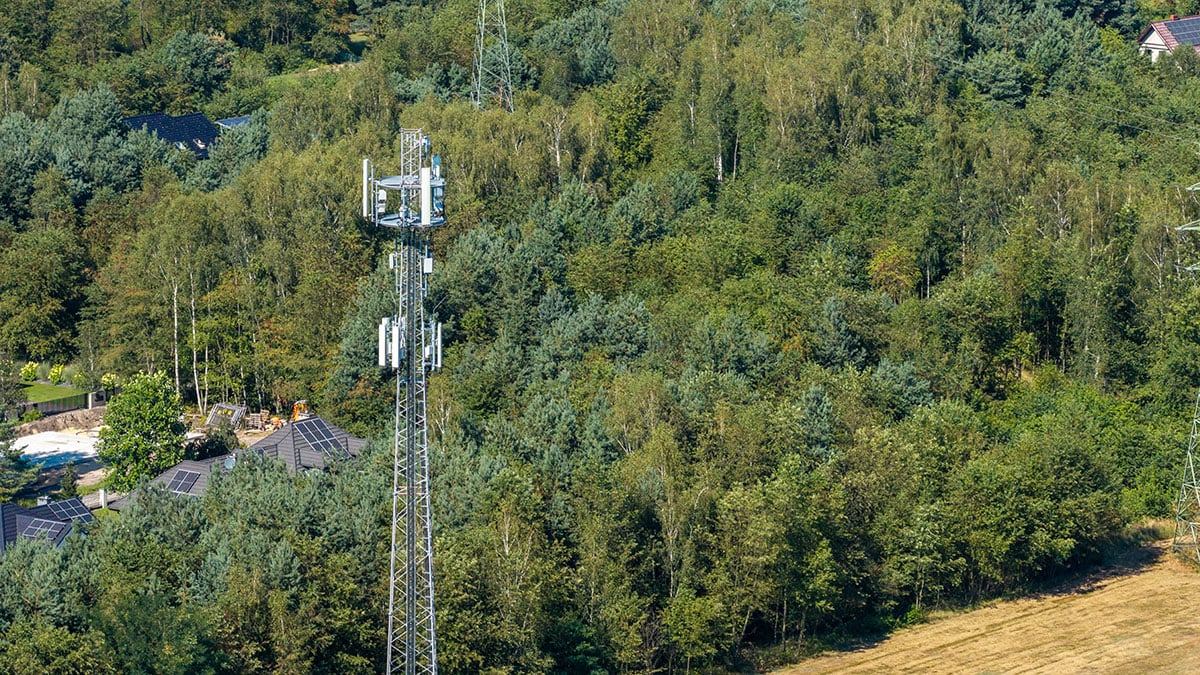
FocalPoint Positioning recently put its next generation Precise+ technology to the test under dense tree cover in Thetford Forest, Norfolk. Standard-precision GNSS – the technology behind everyday positioning in phones, watches, and cars – is accurate to around two metres in open sky. However, its accuracy degrades to 10 metres or more when satellite signals are obscured or blocked in cities and under tree cover.
High-precision GNSS – used in applications such as autonomous systems and robotics – uses carrier phase measurements to deliver centimetre-level positioning in open sky; however, it is also acutely vulnerable to reflections, multipath, and signal blockage.
In heavy foliage and deep urban canyons, it suffers from loss of lock and carrier wave cycle slips, sharply reducing both accuracy and availability. As a result, receivers in challenging environments are often unable to maintain a high-precision solution, instead outputting a level of performance no better than that of standard GNSS.
Reliable positioning in difficult environments is becoming increasingly important as autonomous systems move beyond controlled test sites into warehouses, forests, construction sites, and urban environments.
Many Industrial IoT applications, including robotics, asset tracking, and precision agriculture, depend on maintaining accurate positioning despite intermittent or degraded satellite visibility.
One approach to addressing this challenge is improving receiver-level signal processing before data reaches the positioning engine.
Focal Point Positioning has developed its Precise+ technology with this aim, seeking to maintain reliable carrier-phase tracking in environments where conventional high precision GNSS struggles.
This makes it particularly relevant for applications that depend on high-precision positioning, such as ADAS, autonomous vehicles, and robotics.
Supercorrelation, FocalPoint’s patented technology, is designed to suppress multipath interference. Precise+ extends this approach to carrier-phase positioning, generating accumulated delta range (ADR) observables intended to improve tracking performance during periods of signal fading and reduce cycle slips.
Designing the trial
To assess performance under challenging conditions, the team at Focal Point Positioning carried out a live trial in Thetford Forest in Norfolk using its software-defined radio (SDR) GNSS receiver (FPP-SDR).
The forest’s dense coniferous canopy severely attenuates and scatters GNSS signals, making it a demanding environment for both standard- and high-precision positioning systems.
Data was captured via multiple GNSS antennas and a LabSat 4 record-and-replay system, enabling post-processing with the FPP-SDR and comparison against third-party commercial receivers using live corrections. A NovAtel SPAN ProPak7 with IMU-ISA-100C provided the centimetre-level ground-truth trajectory.
The manufacturers and models of these receivers were not disclosed; the comparison reflects a FocalPoint-conducted benchmark and not an independent evaluation. These results were first presented at the European Navigation Conference, Vienna, 2026.
What the data revealed
Measurement domain
The evaluation measured pseudorange, Doppler and ADR performance across three receiver configurations using different coherent integration periods. The results showed improvements across all measured categories. The table below shows the 95th percentile errors across the three receiver configurations for each type of measurement: pseudorange (code phase), pseudorange-rate (Doppler) and ADR. In all cases, Precise+ showed a significant reduction in errors compared with Standard processing, with longer coherent integration further boosting Precise+ performance.
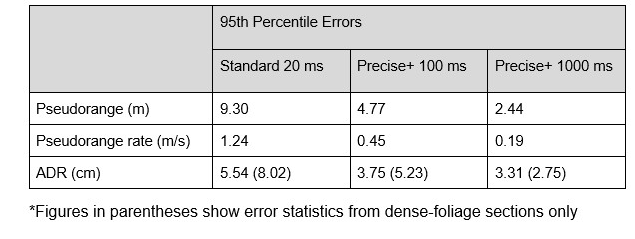
Also shown in parentheses are ADR error statistics generated from the densest foliage sections of the trial. As expected, the benefits of Precise+ are even more pronounced with a 66% reduction in the 95th-percentile ADR error relative to standard processing.
These gains are particularly important because ADR quality directly affects the stability and reliability of carrier-phase positioning solutions.
Positioning domain
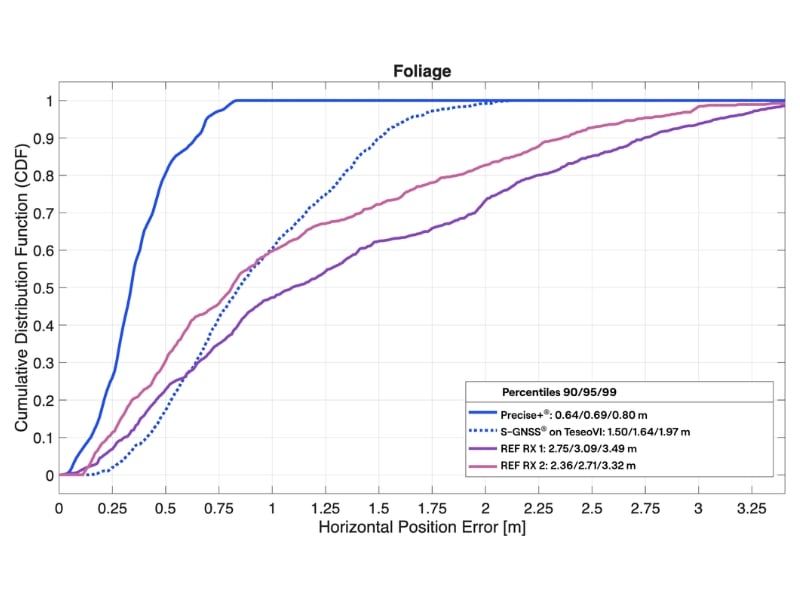
The impact of enhanced measurement accuracy on positioning performance was also demonstrated. In the figure below, high precision positioning results from the FPP-SDR in Precise+ mode are compared with outputs from commercial receivers.
Two state-of-the-art high-precision GNSS receivers with live correction data were used in the trial: REF RX 1 and REF RX 2, the latter being the only receiver trialled that featured inertial sensor aiding. Also included for comparison are standard-precision positioning outputs from a first-generation Supercorrelation-enabled receiver – an STMicroelectronics TeseoVI featuring FocalPoint’s S-GNSS Auto software.
Under dense foliage, Precise+ maintained 0.69m accuracy at the 95th percentile and remained sub-metre at the 99th percentile, achieving 0.80m. By comparison, REF RX1 and REF RX2 recorded significantly larger 95th percentile errors of 3.09m and 2.71m, respectively. Overall, Precise+ reduced 95th percentile positioning error by between 74% and 78% compared to these commercial high precision receivers.
The results indicate that extending receiver level multipath mitigation to carrier-phase positioning could improve the reliability of high-precision GNSS in environments where signal degradation has traditionally limited performance.
Also of note is the performance of the FocalPoint + STMicroelectronics TeseoVI S-GNSS receiver. Despite not featuring a high precision navigation engine, it also delivered stronger performance than the commercial high-precision receivers tested under foliage conditions, according to FocalPoint’s results.
Implications for future positioning systems
While sensor fusion, inertial navigation, and correction services will continue to play an important role in future positioning architectures, the trial highlights the importance of improving measurement quality at source. By enhancing receiver-level performance before additional technologies are introduced, developers can build a stronger foundation for autonomous vehicles, robotics, and other GNSS-dependent systems.
The Thetford Forest results suggest that receiver-level innovations could extend reliable high-precision positioning into environments where conventional receivers struggle. As autonomous mobile robots, drones, connected vehicles, and Industrial IoT deployments become more widespread, maintaining precise positioning outside ideal conditions will become increasingly important.
Further independent testing across different environments and applications will help determine how these improvements translate into commercial deployments.
FocalPoint is working with leading chipset manufacturers to bring Precise+ to market.
This article originally appeared in the October issue of IOT Insider