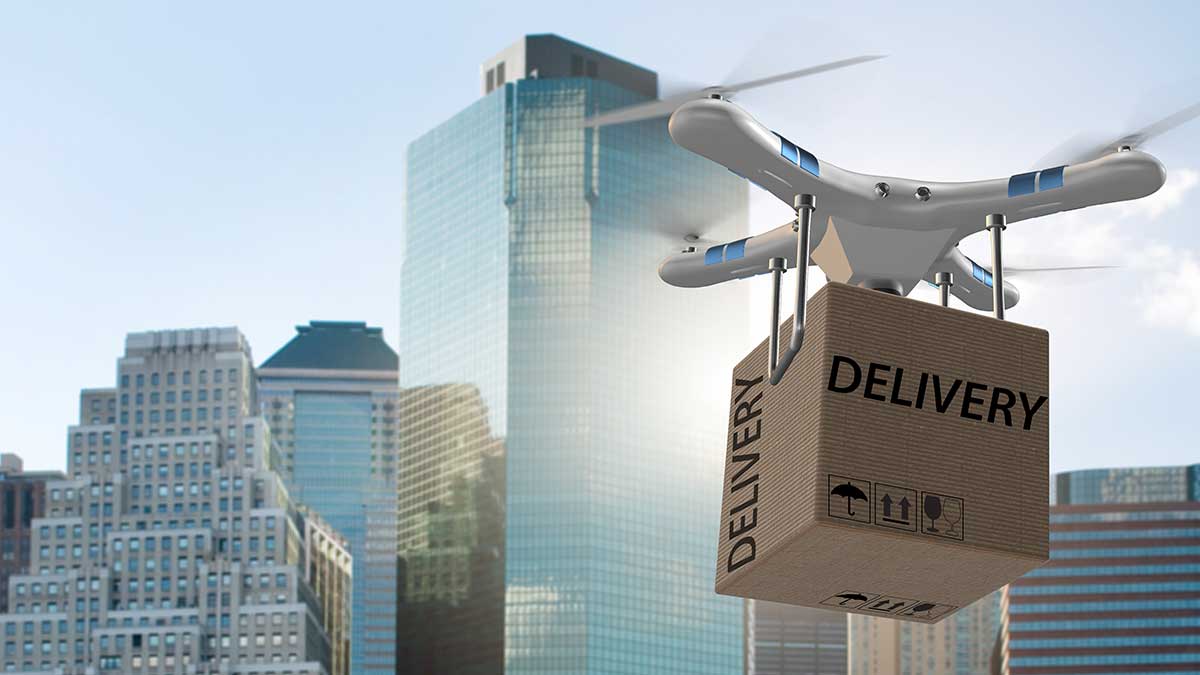
For years, autonomous drone delivery has been presented as the next major evolution in logistics. Instead of sending a van through congested roads to deliver a small parcel, an autonomous aircraft could fly directly from a fulfilment centre to your doorstep in minutes.
The technology is no longer science fiction, with drone delivery services operating commercially in parts of the world, while the UK is moving towards routine beyond-visual-line-of-sight (BVLOS) operations. Yet widespread adoption still remains in the future.
What is autonomous drone delivery?
Autonomous drone delivery uses unmanned aircraft to transport goods with limited or no direct human control. A typical system combines GPS, cameras, obstacle-detection sensors, communications networks and autonomous flight software. These technologies allow a drone to navigate its route, identify hazards and adjust its flight without requiring an operator to manually control every movement.
This system can bring you many benefits. Drones can avoid road congestion, reduce delivery times and potentially lower the cost and emissions associated with short-distance deliveries.
Why isn’t drone delivery already commonplace?
Although drone delivery technology has advanced rapidly, several challenges still prevent it from becoming a mainstream service.
Beyond Visual Line of Sight (BVLOS)
BVLOS capability is essential for large-scale delivery. If every drone must be within a pilot’s line of sight, operating thousands of drones becomes expensive and difficult. Truly autonomous drones must be able to navigate and make decisions without constant human control.
Connectivity and reliability
Reliable connectivity is essential for autonomous drones to communicate with operators, navigation systems and other aircraft. Network coverage can vary, creating a risk if a drone loses its connection. Drones must operate safely despite battery limitations, technical failures and changing weather conditions. Until drones can maintain reliable communication and safely handle unexpected failures, large-scale autonomous delivery will remain a concept for the future.
Regulation and airspace
UK regulations make autonomous drone delivery difficult, especially for BVLOS flights. Operators must obtain permission and prove that their drones can operate safely, which can be costly and time-consuming. Although the Civil Aviation Authority (CAA) is developing rules to support routine BVLOS flights, regulations for airspace sharing, safety and operator responsibility are still developing. This limits the ability to scale autonomous delivery nationwide.
Safety and autonomous technology
Autonomous delivery requires more than drones following fixed GPS routes. Advanced software can prevent the creation of drone highways, where repeated flights pass over the same houses. Instead, drones should automatically plan routes for picking up, delivering and recharging based on what is most efficient for the entire network. As such, drones need onboard systems capable of understanding their surroundings, making decisions in real time and safely responding to unexpected situations such as obstacles, bad weather or lost communications.
Battery, payload and infrastructure
Limited battery capacity restricts how far drones can fly and how much they can carry. Better batteries, more efficient propulsion and charging or battery-swapping infrastructure are needed to make delivery networks commercially viable.
Public acceptance
Noise, privacy and safety concerns could also limit where drones can operate, particularly in populated areas. For example, in drone photography, you’re required to check the airspace and be mindful of others’ privacy. Additionally, regular drone flights over homes may raise concerns about noise, cameras and the risk of accidents.
The UK is beginning to move beyond trials
You can already see examples of drone delivery operating in the UK. In 2023, Royal Mail launched an electric drone delivery service connecting communities in Orkney. The project demonstrated how drones can be valuable where conventional logistics are slow or geographically difficult.
There is also growing consumer demand for faster delivery. With 46% of customers saying they would pay extra for same-day delivery, the potential value lies in technologies that shorten the time between placing an order and receiving it.
In fact, one company, Wing, is beginning to test drone delivery “at scale” in Australia and Dublin, Ireland. The trials aim to deliver 1,000 packages a day to rival Amazon’s Prime Air system, which delivered only about 100 packages during its California and Texas trials.
Healthcare is another promising area where you can utilise drones’ advantages. Trials have explored the movement of medical samples, equipment and medicines, where shaving hours off a delivery can be more valuable than simply making an online shopping order arrive faster. For example, Project CAELUS in Scotland is using drones to transport medical supplies and diagnostic samples between mainland hospitals and remote areas.
When will drone delivery become mainstream?
The answer depends on what “mainstream” means. You should not expect drones to replace delivery vans across the UK in the next couple of years. The economics and infrastructure simply are not there yet.
A more realistic scenario is that drone delivery becomes more common in specific locations and use cases between 2027 and 2030. Remote communities, healthcare, urgent deliveries and suburban areas are likely to lead the way because drones can provide a clear advantage over conventional transport. The CAA’s roadmap is an important consideration because it targets routine BVLOS operations starting in 2027. That does not mean every UK town will suddenly have drones flying overhead. Instead, it creates the regulatory foundation operators need to scale.
As such, for genuinely mainstream consumer delivery, where you can choose a drone instead of a van when placing an online order, 2030 onwards is a more practical time frame. However, this is an estimate rather than a deadline. The pace of adoption will depend on regulation, public acceptance, operating costs, technology and the development of systems that can safely manage large numbers of drones in shared airspace.
The sky is the limit
Autonomous drone delivery has moved beyond the experimental stage, with commercial services already demonstrating that the technology works. The next challenge is scaling these services safely, reliably and affordably.
If regulation and investment continue to progress, you could see more drone delivery services and dedicated flight routes emerge over the next few years. By the next decade, drones could become a familiar part of the UK logistics network, particularly for smaller and urgent deliveries.
There’s plenty of other editorial on our sister site, Electronic Specifier! Or you can always join in the conversation by commenting below or visiting our LinkedIn page.