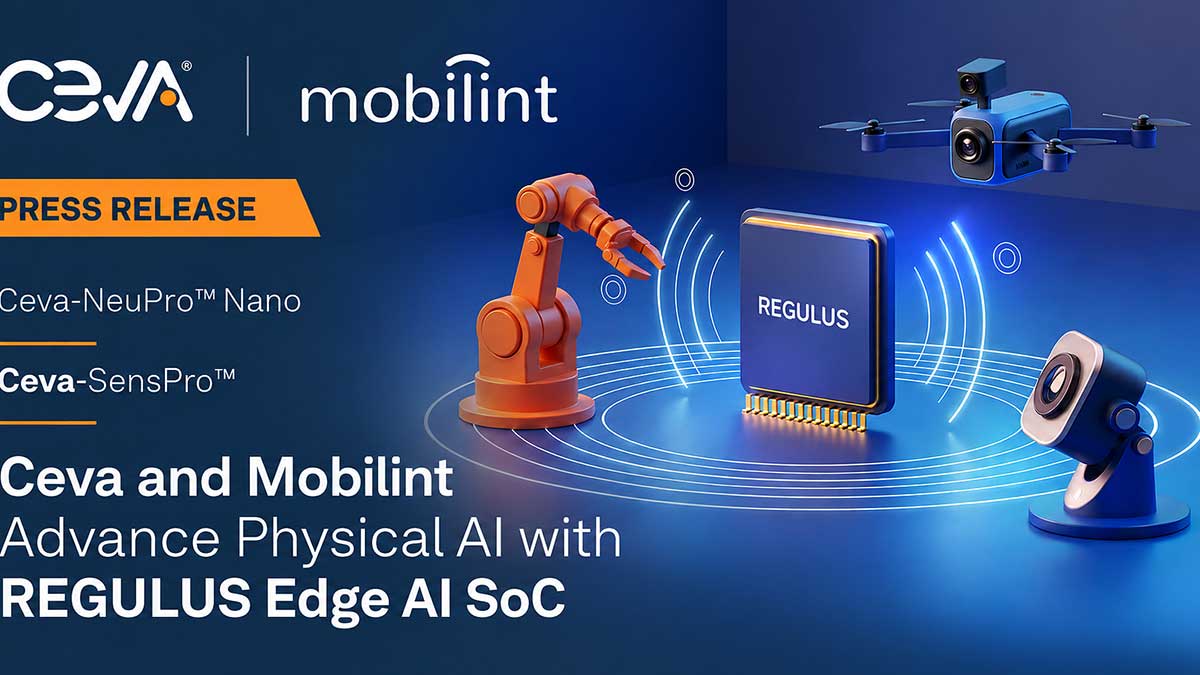
Ceva’s NeuPro-Nano neural processing unit (NPU) has entered its first production deployment, forming part of Mobilint’s REGULUS Edge AI system-on-chip (SoC), designed for real-time processing in power-constrained devices.
The REGULUS SoC combines Ceva’s NeuPro-Nano NPU and SensPro AI digital signal processor (DSP) with Mobilint’s proprietary AI processing architecture. The multi-engine design is intended to distribute sensing, signal processing and AI inference workloads across specialised processing units.
Mobilint claims the chip delivers 10 TOPS (trillions of operations per second) of AI performance at less than 3W, with support for up to 8GB of memory. Target applications include robotics, drones, machine vision, smart cameras and IoT devices, where processing data locally can reduce reliance on cloud connectivity and support real-time responses.
The two Ceva processors have complementary roles. SensPro provides programmable processing for sensing and signal-processing tasks, while NeuPro-Nano is designed to handle neural network workloads, including always-on inference. The combination is intended to support the range of workloads required by Physical AI systems that must interpret and respond to their surroundings.
The technology is already being used in commercial products. Mobilint’s MLD-R1 AI USB accelerator, which was previewed at COMPUTEX 2026, is now shipping. The device adds on-device AI capabilities to existing systems, supporting computer vision, video analytics and generative AI applications in areas including industrial automation, robotics, security and medical devices.
It also supports established AI development frameworks and ecosystems, including PyTorch, ONNX, Hugging Face, TensorFlow, TFLite and Keras.
For Ceva, the deployment represents the first production use of its NeuPro NPU family in commercial silicon. The company said the combination of NeuPro-Nano and SensPro would provide the flexible sensing and inference capabilities needed to run increasingly diverse AI workloads at the Edge.
There’s plenty of other editorial on our sister site, Electronic Specifier! Or you can always join in the conversation by commenting below or visiting our LinkedIn page.