Autonomous driving startup Wayve says its new robotaxi service which launched last week in the UK capital will be a key test of its machine learning system which attempts to teach cars how to drive rather than programming them to cope with every road they encounter.
The London-based AI company began offering supervised autonomous rides through Uber on Thursday, putting its approach to the test on one of the world’s most complicated urban road networks.
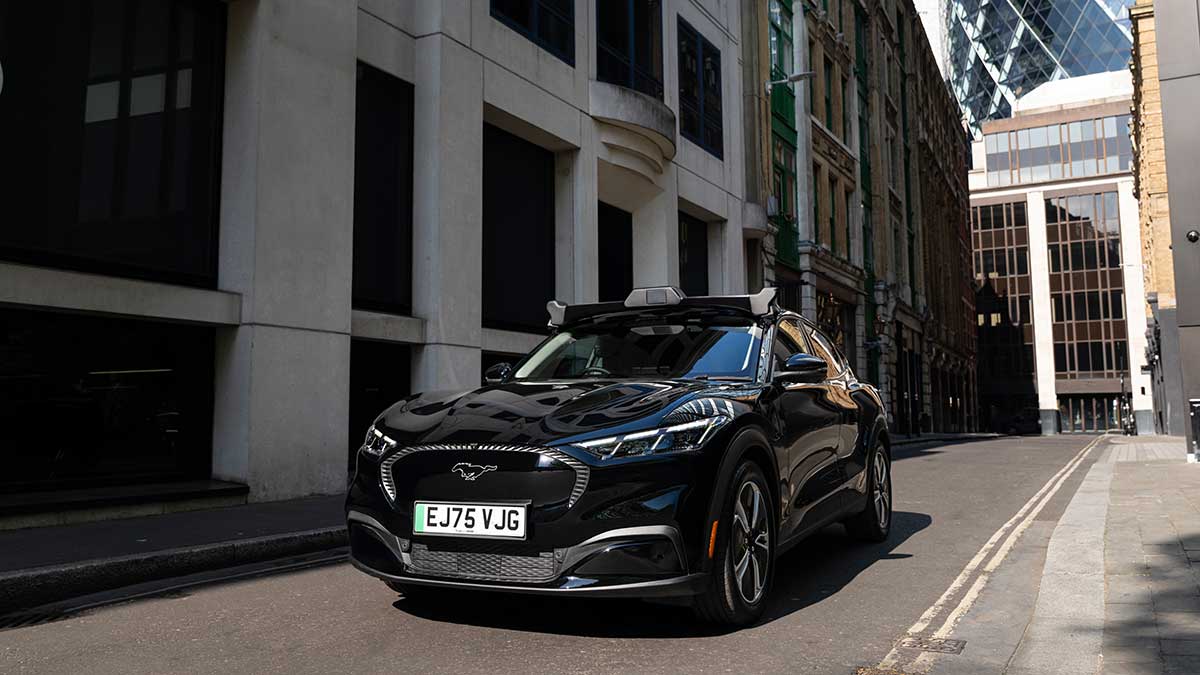
The service is initially small. Londoners requesting an UberX, Uber Electric or Uber Comfort can be matched with one of Wayve’s electric Ford Mustang Mach-Es at no additional cost, with a trained, Transport for London-licensed driver remaining in the vehicle to supervise the system.
However, the technology behind the cars points to a bigger shift in autonomous driving.
Wayve’s AV2.0 system uses an approach known as ‘end-to-end machine learning‘. Rather than relying heavily on high-definition maps and hand-coded rules to determine how a vehicle should respond, the system is designed to learn from driving experience, translating information from its sensors into decisions about how to navigate.
The company says that this makes it easier for machines to navigate things like roadworks, temporary speed restrictions, parked vehicles, cyclists and pedestrians. That is a different proposition from earlier generations of autonomous driving technology, which relied more heavily on detailed maps, software rules and predefined operating conditions, requiring engineers to anticipate and programme responses to a wide range of scenarios.
“Autonomous driving technology will complement the city’s rich transport network,” said Alex Kendall, Wayve’s co-founder and chief executive.
Certainly, London, with its constantly changing roads and unpredictable traffic, is likely to provide an exacting testbed for Wayve’s driving model.
The approach also reflects a broader shift in how the industry is thinking about autonomous driving.
NVIDIA’s Alpamayo platform, launched earlier this year, is another example of autonomous-driving technology moving beyond traditional rules-based systems. But while Alpamayo is focused on giving vehicles greater reasoning capabilities – allowing them to work through complex driving situations and infer likely outcomes – Wayve is putting greater emphasis on learning driving behaviour itself.
Wayve argues that just as a human driver can make a judgement about whether a pedestrian is likely to cross, whether a cyclist will move around a parked car or whether another vehicle is about to pull into traffic, its autonomous system can make equivalent assessments using data from its sensors and the behaviour it has learned from its training.
It says that this adaptability is an advantage when faced with unusual situations. Conventional rules can become brittle when engineers encounter scenarios that were not anticipated when the system was designed.
However, other autonomous driving companies point out that the more an autonomous vehicle learns rather than follows explicitly programmed instructions, the harder it can become to establish exactly why it made a particular decision.
Waymo, which is also preparing a London launch, has incorporated end-to-end models into its autonomous-driving system while retaining more conventional software and mapping. The company has argued that end-to-end models alone are not sufficient to guarantee safety at scale.
Wayve’s system is designed to work across different vehicle platforms and sensor configurations. The company has raised $2.8bn from investors and strategic partners including NVIDIA, Mercedes-Benz and Nissan, while Stellantis is working with Wayve and Uber on the potential deployment of Level 4 robotaxis. Nissan, meanwhile, is assessing Wayve’s technology ahead of plans to deploy it in Japan.
Wayve is already looking beyond its initial fleet of Ford Mustang Mach-Es. The company plans to introduce Nissan Leaf vehicles powered by its AI Driver and Nvidia’s DRIVE Hyperion platform, with the vehicles due to begin operating in Tokyo later this year.
The launch comes at a significant moment for Uber, which announced plans to cut about 3,300 corporate jobs, or roughly 10% of its global workforce, the day before the Wayve service began. The restructuring is intended to simplify the company’s operations and speed decision-making as Uber increases its focus on autonomous vehicles and other areas of growth.