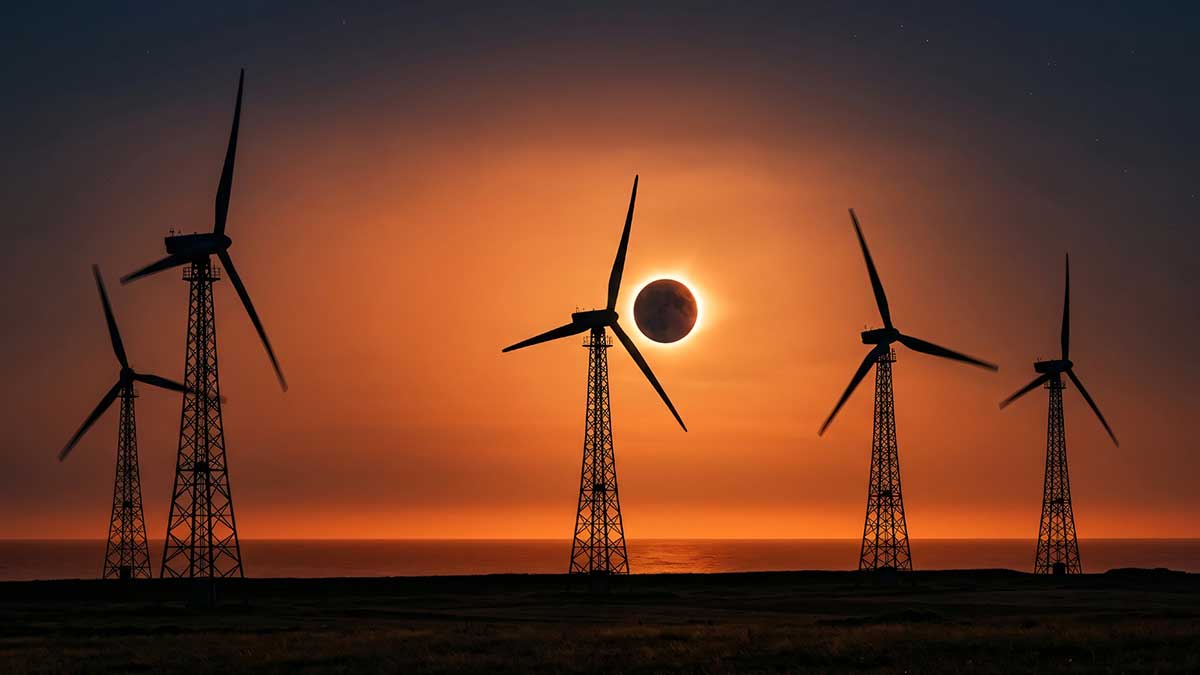
Britain’s solar eclipse will do more than give millions of people a reason to observe the skies this evening. For two hours tonight, it will also put the country’s smart home energy infrastructure to work, as connected devices help manage a temporary drop in solar generation at a time when electricity demand is rising.
Energy providers warn that as the Moon passes in front of the Sun, solar generation is expected to fall sharply just as millions of people return home and switch on appliances.
“During the eclipse we will lose 1GW of solar power generation as the moon crosses the sun,” says Kieron Stopforth, Head of Flexibility at Octopus Energy. “To partly compensate for that, we’re looking to connected devices such as smart meters, EV chargers and heat pumps to shift operation times.”
The energy supplier is asking customers to use less electricity between 6pm and 8pm, moving activities such as running the washing machine or dishwasher outside the eclipse window. Customers taking part in its Eclipse Power Down initiative will receive an hour of free electricity on Sunday.
The eclipse offers a timely demonstration of how connected devices are beginning to play a more active role in balancing Britain’s electricity network.
The principle is straightforward: not all electricity consumption needs to happen the moment a device is switched on. An electric vehicle can charge later, a heat pump can adjust its operating schedule and a home battery can store electricity when supply is plentiful and release it when demand is higher.
Individually, these changes are relatively small. But aggregated across hundreds of thousands of connected devices, they become a significant source of flexibility for the grid.
Octopus estimates that British homes could ultimately provide as much as 13GW of flexible capacity through smart appliances, EVs and home batteries.
Octopus is already attempting to aggregate some of this potential through Kraken, its AI-powered operating system for connected energy devices.
According to Stopforth, Kraken currently coordinates 500,000 devices representing around 2GW of power. It can enable devices enrolled in Octopus Energy’s Intelligent Octopus tariff, for example, to automatically draw power when electricity is expected to be cheaper and greener, allowing customers to pay lower rates.
By managing when those devices consume or store electricity, the platform is designed to flatten peaks in demand and shift consumption towards periods when electricity is more abundant, cheaper and greener.
“Devices don’t respond automatically, they need to be coordinated,” Stopforth says.
The company says its wider Octoplus rewards programme now has more than 2 million customers, while its flexibility initiatives have delivered more than 20.5GWh of free electricity and paid out over £11 million in rewards.
Stopforth believes household flexibility will become increasingly important over the next decade as more consumers install heat pumps, EV chargers, battery storage systems and rooftop solar.
With customers already able to export surplus solar power back to the grid, compatible EVs could eventually provide another source of flexible energy through vehicle-to-grid technology.
“Absolutely we are moving towards a model where millions of individual devices effectively become a distributed energy resource for the grid,” he says. “We see huge potential in smart home devices and see huge appetite among customers. Over the next five to 10 years we see more growth in this area.”