
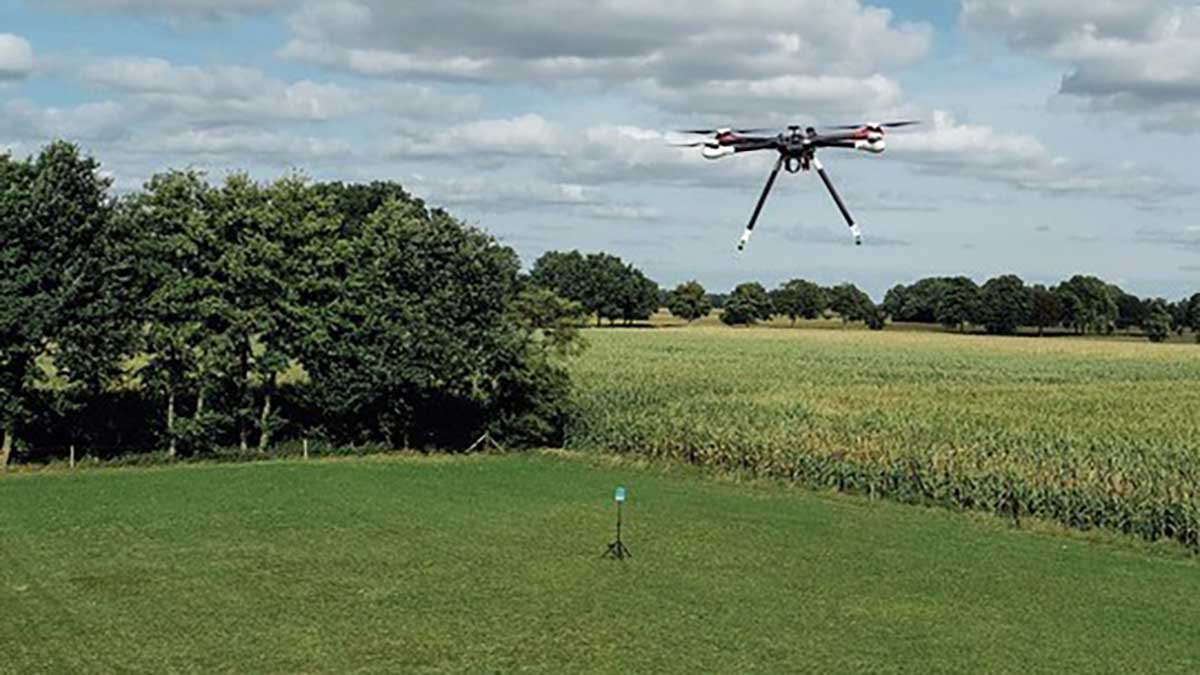
Researchers at Germany’s Fraunhofer Institute for Digital Media Technology (IDMT) have developed an acoustic sensing system that uses machine learning to detect and locate drones by their characteristic sound patterns.
The technology, which is set to be demonstrated at the Drone Days show in Germany later this month, uses machine learning to identify the characteristic sound patterns produced by unmanned aerial vehicles.
The work points to a broader role for connected acoustic sensors, as machine learning moves closer to the point at which data is captured. Rather than relying solely on cameras, radar or other active sensing technologies, IoT systems could increasingly use sound as another source of information about their surroundings.
For now, Fraunhofer is applying the approach to drone detection. The researchers say it could provide an additional sensing layer for airports, critical infrastructure, military facilities and large public events, particularly where a drone is beyond visual line of sight.
Rather than replacing existing detection technologies, the acoustic system is intended to complement radar, cameras and lidar. Its ability to operate without a direct line of sight could prove particularly useful in built-up or wooded environments, where an approaching drone may be hidden from optical sensors.
“Especially in built-up or forested areas, acoustics can provide decisive added value because it can detect drones even when they are not yet visible to other sensors,” said Christian Rollwage, group manager of Audio Signal Enhancement at Fraunhofer IDMT in Oldenburg.
Every drone produces a distinctive acoustic pattern from its motors, propellers and other components. Fraunhofer’s machine-learning algorithms are designed to identify these acoustic fingerprints even in complex, noisy environments.
The system can also combine signals from multiple microphones to determine the direction from which a drone is approaching. This allows it to detect and localise the aircraft rather than simply register its presence.
The system is passive: it listens to sound and vibrations in the environment rather than transmitting a signal. That reduces energy requirements and means the sensing equipment does not itself emit a signal that could reveal its location.
The acoustic sensors are intended to complement rather than replace established detection technologies such as radar, cameras and LiDAR. They could also be used as a ‘wake-up’ layer, activating other sensors when the acoustic system identifies a potential drone.
“With our acoustic technology, we offer a cost-effective, low-maintenance complement to existing drone detection systems,” Rollwage said.
Fraunhofer’s research suggests that acoustic sensing could have applications beyond drones. The institute says the same approach could eventually be adapted to recognise other acoustic events, including vehicles and gunshots.
The underlying research has been under development at Fraunhofer IDMT’s Oldenburg site since 2016, including through the AMBOS and ALADDIN research projects.
There’s plenty of other editorial on our sister site, Electronic Specifier! Or you can always join in the conversation by commenting below or visiting our LinkedIn page.