
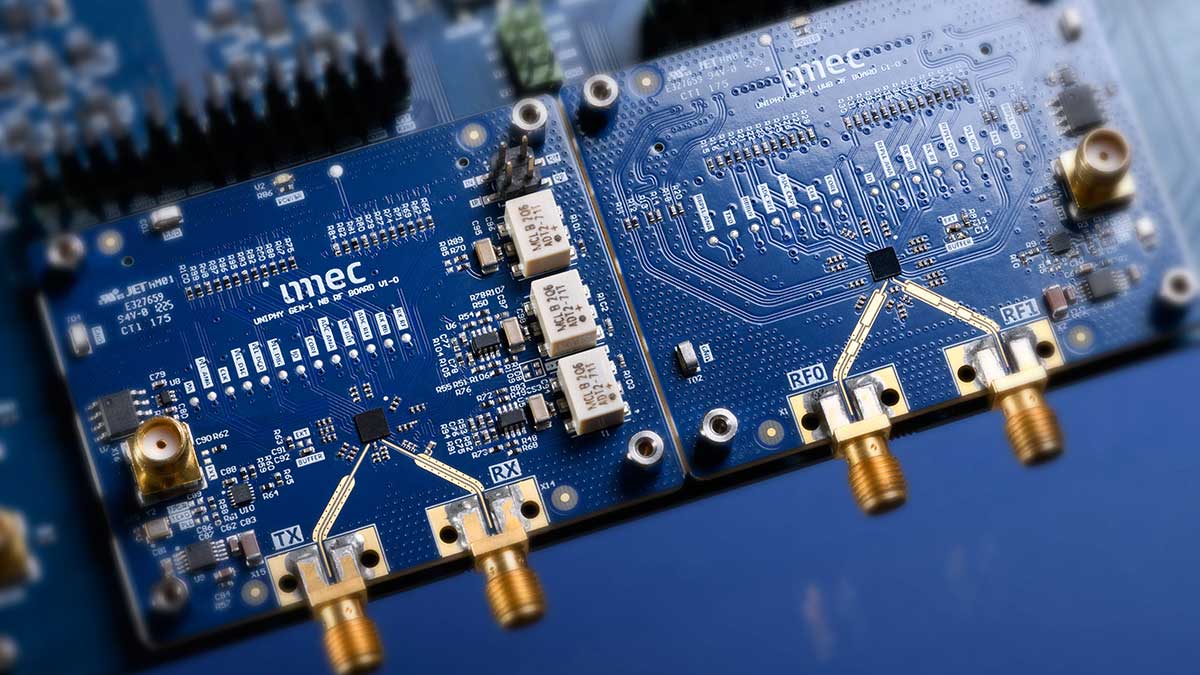
The Belgian research institute imec has unveiled what it says is the world’s first narrowband receiver chip compliant with the upcoming IEEE 802.15.4ab ultra-wideband (UWB) standard, a development that could significantly extend the range and reliability of next-generation positioning and localisation systems used in IoT devices.
The chip, presented this week at the IEEE MTT-S RF Integrated Circuits Symposium in San Francisco, validates a key feature of the emerging standard known as narrowband assistance (NBA), which combines conventional narrowband wireless signals with ultra-wideband technology to improve device discovery, synchronisation, and ranging performance.
According to imec, the receiver enables a fourfold increase in UWB ranging distance while maintaining low power consumption and resilience against interference from nearby Wi-Fi networks.
UWB has gained traction in recent years through its adoption in smartphones, wearables, connected vehicles, and industrial IoT applications. The technology offers highly accurate positioning and ranging capabilities, but its deployment at scale has been constrained by limited range and performance degradation in dense wireless environments.
The forthcoming IEEE 802.15.4ab standard aims to address these challenges by introducing NBA, which uses narrowband communications in the 5GHz to 6GHz spectrum to support UWB operations. The approach is designed to improve scalability and reliability while reducing the signal strength required for accurate ranging.
Implementing NBA presents significant engineering challenges, however. Receivers must be capable of detecting extremely weak signals while simultaneously operating in environments crowded with powerful Wi-Fi transmissions occupying neighbouring frequencies.
Imec’s solution combines a novel second-order transimpedance amplifier with precise filtering capabilities and an adaptive clip detector that continuously monitors interference levels. When strong wireless interference is detected, the receiver automatically activates additional filtering and gain control mechanisms to preserve signal integrity.
The design was fabricated using a 22nm CMOS process and consumes less than 6mW of power, according to the research organisation.
“Our low-power design achieves a 9dB improvement in dynamic range over state-of-the-art implementations while maintaining sensitivity to weak signals in the presence of strong Wi-Fi interferers,” said Anoop Bhat, Senior Researcher at imec.
The organisation said the receiver maintains a low noise figure of 3.2dB and can tolerate Wi-Fi blockers of approximately -32dBm, characteristics that are critical for reliable operation in crowded radio environments.
Beyond the standalone receiver, imec also disclosed what it described as the first complete transceiver architecture compliant with IEEE 802.15.4ab. By combining receiver, transmitter, and protocol-level innovations, the full platform delivers up to a 32-fold improvement in ranging performance compared with conventional implementations, the organisation said.
The advances could support a range of emerging IoT use cases where precise positioning and low-latency coordination are required. Examples include robot-to-robot communication in warehouses and factories, industrial asset tracking, and augmented reality devices that interact with their physical surroundings in real time.
Mitra Gilasgar, Portfolio Manager for Low-Power Wireless at imec, said the organisation is also investigating how the underlying NBA architecture could be applied to future generations of Bluetooth and other low-power wireless technologies.
The IEEE 802.15.4ab standard is expected to be published later in 2026, potentially providing a foundation for broader adoption of high-precision wireless positioning across consumer, industrial, and enterprise IoT markets.
There’s plenty of other editorial on our sister site, Electronic Specifier! Or you can always join in the conversation by commenting below or visiting our LinkedIn page.