
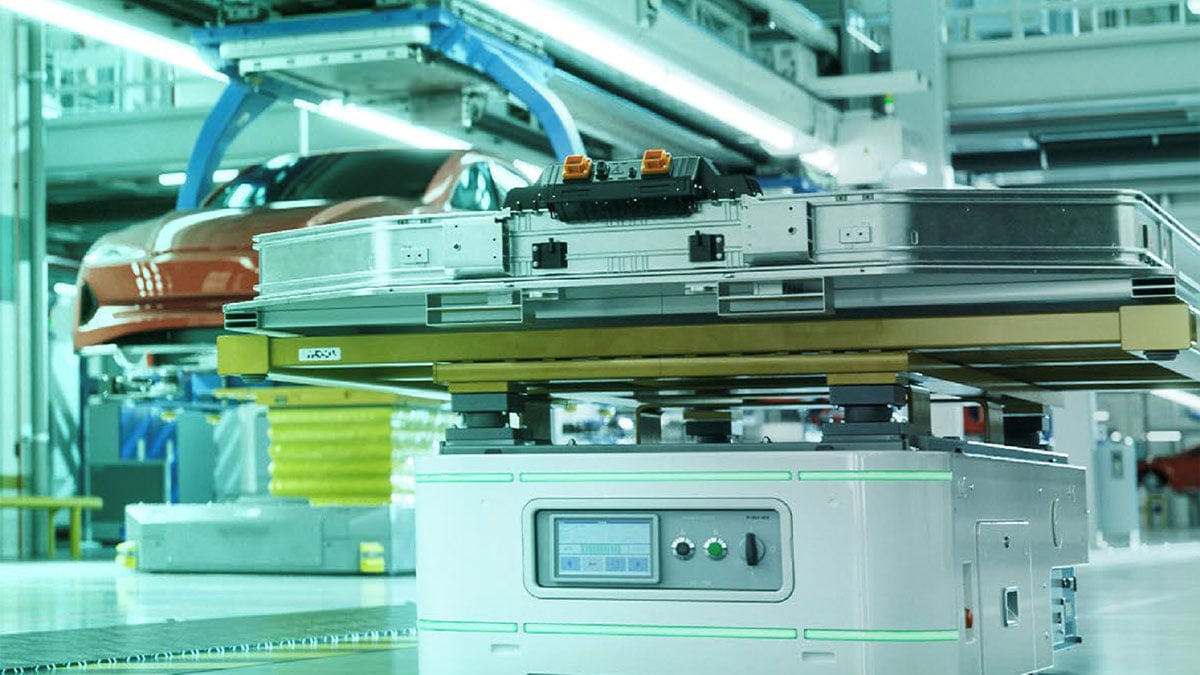
Automated guided vehicles (AGVs) and autonomous mobile robots (AMRs) are becoming central to smart factories and warehouses as manufacturers look to tackle labour shortages and improve productivity.
In factories and warehouses, transport robots move parts, pallets, and finished goods between production lines, storage areas, and packing stations. In e-commerce fulfilment centres, AMRs are also increasingly used for picking and sorting tasks.
AGVs typically follow predefined routes using guidance lines, magnetic tape, lasers, or markers, while AMRs navigate autonomously using sensors such as LiDAR and cameras. Many AMRs use simultaneous localisation and mapping (SLAM) technology to build maps, avoid obstacles, and optimise routes in real time using AI.
In addition to transporting parts and pallets, AMRs also provide extra functionality, such as part picking and sorting, which further reduces the need for human labour and eliminates operator errors.
Why wireless connectivity matters
AGVs and AMRs use various wireless technologies, such as Bluetooth technology, wireless LAN, and low power wide area (LPWA) networks, to acquire sensor and control information.
By leveraging wireless communication, highly accurate and reliable positioning can be achieved, which contributes to the prevention of process interruptions and accidents during transportation. Furthermore, highly reliable 5G and private 5G technologies are now being adopted for use in AMRs.
AGVs and AMRs rely on several wireless technologies, including Bluetooth, Wi-Fi, LPWA, and increasingly 5G and private 5G networks. Bluetooth is typically used for low-power sensor communications, while Wi-Fi supports high-bandwidth data such as video and positioning information. LPWA technologies enable long-range, low-power sensor connectivity, and 5G offers low-latency, highly reliable communications for real-time robot control and coordination.
Furthermore, ultra-reliable low-latency communications (URLLC) in 5G and private 5G enable highly reliable, low-latency, and high-throughput communications with systems such as the programmable logic controllers (PLCs) that oversee production-line equipment and warehouse management systems (WMSs) that manage incoming and outgoing cargo, materials, the transportation of products to and from a warehouse, and inventory management.
LPWA is used to collect small amounts of data, typically between sensors and metres, over long distances of several kilometres, with low power consumption and data rates of around 1 Mbps.
Cellular LPWA, such as LTE Cat M1 and NB-IoT, uses mobile phone base stations, while non-cellular LPWA, including LoRaWAN and Sigfox, primarily employs dedicated access points.
Interference and EMC challenges
Although commercial wireless communication modules are generally compliant with all relevant standards and regulations, their practical performance can vary significantly when installed in an automatic transport robot.
Factors such as metallic surroundings, dynamic changes in the wireless environment, and interference from surrounding equipment components may impact their operation.
These challenges can lead to unstable wireless communication during use. Therefore, it is crucial to verify that the wireless module operates properly when integrated into an automatic transport robot system.
Electronic components inside robots can also generate interference that disrupts wireless communications—a phenomenon known as “intra-EMC” or “autointoxication”. In severe cases, this can lead to data loss, latency, or communication failures.
Because wireless regulations and frequency allocations vary by region, manufacturers must test and certify robots for local compliance across multiple wireless standards and bands.
Electromagnetic noise generated by equipment in factories and warehouses, as well as the reflection and shielding of radio waves by metallic and other objects, can cause multipath interference and attenuation of radio wave strength, thereby degrading the quality of wireless communications. Additionally, radio interference originating from outside a factory or warehouse could degrade communications, potentially causing robots to malfunction.
To minimise this loss of communication quality requires a full understanding of the radio environment, both indoors and outdoors, which demands checking for the presence of interference. If unwanted radio signals are detected, their sources must be identified and eliminated.
Additionally, communication delays caused by factors other than radio signals must be considered. These include abnormalities in the communication routers, switches, and automatic transport robots installed in factories and warehouses.
Testing and validation
Anritsu provides RF and network test equipment for technologies including Bluetooth, Wi-Fi, LTE, NB-IoT, and 5G. Its tools support interference detection, antenna evaluation, throughput testing, protocol validation, and production-line testing for wireless devices used in transport robots.
Factories and warehouses can create challenging RF environments because of electromagnetic interference from other wireless systems. Monitoring tools such as real-time spectrum analysers help engineers identify transient interference, map affected areas, and locate signal sources before communications failures affect robot operations.
Future trends
As AI, 5G, and IoT technologies mature, transport robots are expected to play a growing role beyond manufacturing and logistics, including in agriculture, healthcare, and autonomous delivery applications.
Greater connectivity and autonomy will allow robots to coordinate more efficiently with sensors, machines, and management systems while reducing the need for manual intervention.

Written by Tomohide Yamazaki, Assistant Manager, Anritsu Corporation
This article originally appeared in the May 2026 magazine issue of IoT Insider