Today marks World Quantum Day, a day when you can expect physicists to start arguing about whether the cat is alive, dead, or somehow both, and whether anyone actually measured it properly in the first place.
That, in a nutshell, is how World Quantum Day tends to feel.
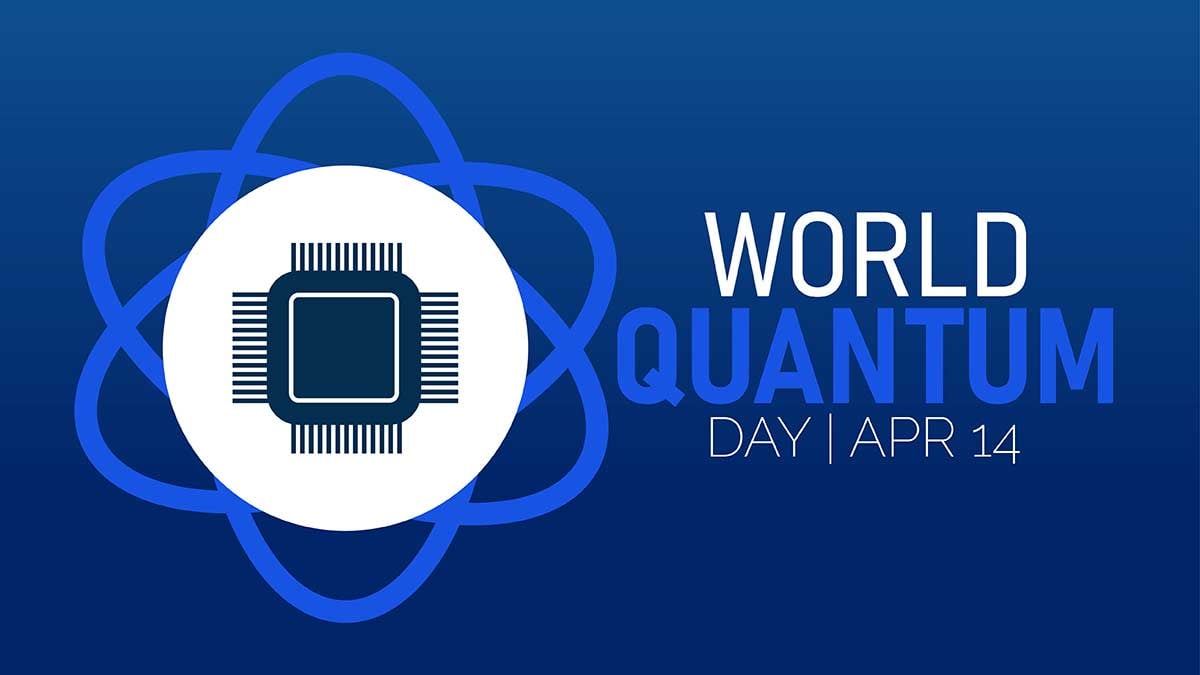
14th April has evolved into World Quantum Day, an informal global celebration of quantum science and the technologies it underpins.
What is World Quantum Day?
World Quantum Day was launched in 2021 by an international group of scientists, before being widely observed for the first time in 2022 by researchers, educators, engineers, and science communicators around the world.
It is not an official holiday, but it has become the quantum world’s closest equivalent to a fan day – think May the 4th for Star Wars, but instead of lightsabres and the Force, you get Schrödinger’s cat, superposition, entanglement, and a lot of very precise mathematics.
The date itself is not random. It is a nod to the approximate value of Planck’s constant (4.14 × 10⁻¹⁵ eV·s), one of the foundational numbers in Quantum Physics.
From there, the world of quantum science opens up into something far more practical than thought experiments. Universities, labs, and companies run talks, demos, and outreach events designed to make quantum science feel a little less abstract, and a lot more relevant to everyday technology.
The day is also gaining recognition beyond the scientific community.
In 2024, the US Senate formally recognised 14th April as World Quantum Day, highlighting the growing strategic importance of quantum technologies for economic competitiveness, national security, and innovation.
“Quantum is game-changing technology that can help solve problems faster than ever before, tackling issues from health care to agriculture. It’s important we continue to boost our STEM education programs to train students who will become the next quantum workforce changing the world,” said Senator Maria Cantwell.
The resolution also pointed to the role quantum science already plays in everyday technologies, from GPS to semiconductors, and emphasised the need to strengthen STEM education to prepare future talent for a quantum-driven economy.
Why does it matter?
But despite the geek humour, politicians around the world have been pouring billions of dollars of investment into quantum technology which could provide personalised medical treatments, potential cures for diseases, safeguards for national security and deliver highly paid jobs.
Experts also warn that World Quantum Day highlights a growing and immediate risk, particularly in cybersecurity.
“The post-quantum threat is no longer theoretical, it is already shaping today’s risk landscape,” says Chris Harris, EMEA Technical Director, Data & Application Security at Thales. “While quantum computing promises transformative breakthroughs, it will also fundamentally undermine the cryptographic foundations that protect our digital economy.”
“What’s changed is the timeline. The question is no longer if quantum will break current encryption, but when, and attackers are already exploiting that gap. ‘Harvest now, decrypt later’ has become the leading concern for organisations, with 61% citing it as their top quantum risk. Sensitive data stolen today could be exposed years from now, creating a long-tail security liability that many organisations are still underestimating. At the same time, most organisations are not in a position to respond effectively. Only 34% have full visibility of where their data resides, and less than half of sensitive cloud data is encrypted. You can’t protect what you can’t see, and in a quantum context, that visibility gap becomes a strategic risk, not just an operational one.”
There’s plenty of other editorial on our sister site, Electronic Specifier! Or you can always join in the conversation by commenting below or visiting our LinkedIn page.