
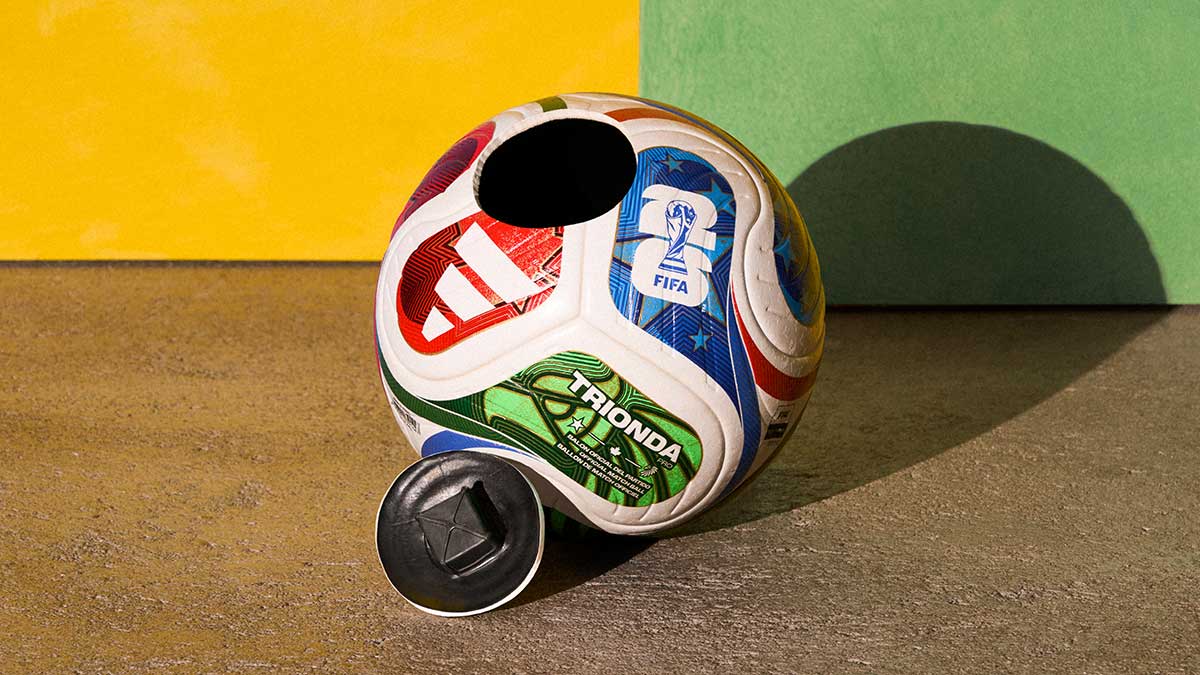
The most intelligent player at the next FIFA World Cup may not wear boots, complain to referees, or collapse theatrically in the penalty box. It will, however, spend 90 minutes being kicked very hard.
The humble match ball — once little more than stitched leather and trapped air — has quietly become one of the most sophisticated IoT devices in global sport. Hidden beneath the thermally bonded panels of adidas’ new World Cup ball sits a tiny sensor package capable of transmitting live movement data 500 times per second.
The technology first appeared publicly during the Qatar 2022 tournament with adidas’ “Al Rihla” ball, and FIFA has doubled down for the expanded 2026 competition across the US, Canada, and Mexico.
The newest ball, also made by adidas using technology from German sports tech firm KINEXON, continues the trend of embedding real-time telemetry directly into the game itself.
A football with firmware
Named ‘Trionda’ which means ‘three waves’ in Spanish, the ball contains an inertial measurement unit (IMU), suspended in the core and designed to withstand the sort of kicking a football receives in a World Cup match.
“As soon as the tournament hosts were announced, we knew we had to make something special – a ball that can be played everywhere, from the backyard to the world’s biggest stage,” said Solene Stoermann, Category Director at adidas, announcing the ball last summer. “TRIONDA is set to be a main character in the biggest show on earth, and we cannot wait for fans and players to enjoy the moment.”
The sensor measures acceleration, rotation, and movement in three dimensions, feeding data to stadium systems continuously throughout the match.
That matters because modern football officiating has become less about eyesight and more about timestamps.
The biggest challenge in offside decisions is not actually player position — camera systems already track that with eerie precision — but determining the exact millisecond the ball leaves a player’s foot. FIFA’s semi-automated offside system combines player tracking cameras with data from the connected ball to identify the precise “kick point”.
According to adidas, the sensor transmits data at 500Hz — meaning 500 data points every second. That is significantly faster than standard broadcast frame rates and creates an unusually granular digital picture of the ball’s behaviour.
Pitch perfect tech
The engineering challenge goes well beyond simply shoving an AirTag inside a football. KINEXON, which already produces its own ‘xBall,’ has developed a suspension system designed to stabilise the electronics inside the ball without affecting aerodynamics or weight distribution.
“Live ball tracking currently enhances real-time exercises and game analysis, live performance assessments, and creates new marketing opportunities,” says Daniel Linke, Product Strategy Lead at KINEXON Sports. “Additionally the solution provides referees with vital information about ball touch events that was previously inaccessible.”
adidas also says that the embedded electronics operate continuously for up to six hours, meaning that once charged, it should be good for a full game – even if the game goes to sudden death penalties. However, this does raise the possibility that somewhere beneath a stadium, next to elite athletes preparing for the biggest match of their careers, a technician may quietly be asking whether the ball is on 12% power.
Rebooting the beautiful game
And this is only the beginning. Once the ball becomes a live sensor platform, the possibilities multiply quickly: automated out-of-play detection, richer broadcast analytics, predictive trajectory modelling, real-time shot velocity, goalkeeper reaction analysis, and eventually entirely new fan experiences.
Elite football stadiums already contain dense networks of cameras, Edge computing infrastructure, AI-assisted officiating systems, biometric performance tracking, and low-latency data pipelines. The connected ball is simply the most visible — or perhaps most kickable — part of that transformation.
What’s more, it’s another sign of how IoT has escaped the factory floor and entered mass culture.
The same sensor principles used in industrial automation, logistics tracking, and autonomous systems are now embedded inside the most famous object in sport.
The World Cup ball has effectively become an Edge device with global television rights. And unlike most IoT hardware, this one occasionally ends up in the top corner from 30 yards.
There’s plenty of other editorial on our sister site, Electronic Specifier! Or you can always join in the conversation by commenting below or visiting our LinkedIn page.