
By Sharath Muddaiah, Head of Global Business Strategy and Customer Success for IoT Solutions at Giesecke+Devrient
The logistics sector is undergoing a rapid digitisation. Supply chain disruptions are affecting the safe and efficient movement of goods, while companies are under increasing pressure to deliver items quicker and in a more cost-effective and sustainable way. This is raising the importance of achieving real-time visibility into the location and status of items as they are transported.
Enter smart labels. They are modernising supply chain tracking by transforming any package into a trackable IoT device, and their popularity is soaring.
But the fast integration of these solutions is generating a tidal wave of data that must be harnessed effectively to drive operational efficiency, prevent stockouts and enable proactive decision-making, with a single label able to produce 1.5MB over its lifecycle. If every stakeholder is to benefit from the technology as smart labels are more widely integrated, sharing information efficiently across the logistics ecosystem is a must.
Transforming real-time tracking
Ultra-thin and only slightly larger than a credit card, a smart label can be applied to anything from large parcels to small envelopes. This makes them ideal for applications where a larger tracking device cannot be affixed, and suited for close tracking of valuable or sensitive documents.
These labels are powered by low-power cellular and GPS technology to provide a precise location to the organisation. They also monitor the surrounding temperature and can even detect instances of shock, helping businesses to protect sensitive goods. Also incorporated is a tamper-proof design for security. If someone opens the package, an alert is sent for remedial action, and the label itself is fully reusable for sustainability purposes.
At the heart of real-time visibility into the location and condition of goods in transit is the mass generation of data. Collectively, millions of labels can theoretically generate terabytes of data on a yearly basis. And for that data to be interpreted properly, Business Intelligence (BI) systems are central to making it accessible.
Business Intelligence and AI-driven insights
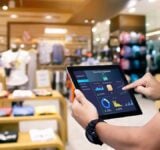
BI platforms identify patterns, trends and anomalies and presents them in a user-friendly visualisation for users to understand exactly the location and condition of goods in transit. With this information to hand, businesses can make better decisions to support decision-making and operational efficiency.
As an example, a phone manufacturer can apply smart labels to each item, enabling them to keep track of every phone as they are circulated to outlets across a country. With the BI technology delivering data on real-time inventory levels being sent to each store, any potential shortages can be identified ahead of time. This gives rise to supply chain management that reduces any unneeded delays, prevents stockouts and ensures improved customer experiences.
In the coming years, smart label data will be utilised by AI to drive automated actions, rather than relying on humans to make appropriate decisions. For example, AI could autonomously re-route lorries with information to faster or more fuel-efficient paths. It could also reallocate inventory in transit to better align with customer demand. As AI systems become increasingly accurate and proactive, they will be capable of fully streamlining logistics processes with minimal user intervention.
Collective data sharing for all stakeholders
Smart labelling offers significant benefits to adopting organisations, but these solutions are often implemented in isolation for internal tracking alone. Yet supply chain operations depend on multiple stakeholders – warehousing partners, logistics providers, manufacturers and retailers – and when they do not share access to the same data, the value smart labels can deliver across the wider ecosystem is greatly constrained.
The key is to establish a shared system in which the data generated by each label is accessible to authorised users across the broader supply chain. This enables better coordination and more informed decision-making. For example, retailers can refine their sales forecasts by drawing on real-time delivery information from couriers
Making data visible across the ecosystem introduces challenges that must be addressed, including interoperability, cross-border connectivity, network compatibility and the protection of transmitted data. However, these hurdles are steadily being overcome as smart label technologies become more sophisticated, enabling secure and reliable data sharing.
Turning shipments into actionable insights
Smart labels offer the opportunity to turn every shipment into a source of actionable insight. Together with robust BI platforms and emerging AI capabilities, organisations can move from reactive investigation to proactive management of their supply chains.
Real value, however, will only be realised when smart label data is shared effectively between all players across the wider ecosystem. Creating secure, interoperable frameworks for data exchange allows manufacturers, logistics providers, warehouses and retailers to work from the same view of reality, enabling minimised disruption, the protection of sensitive goods, optimised inventories and more sustainable operations. Smart labels may begin as a simple enhancement to tracking, but they can reshape how supply chains are coordinated, measured and enhanced.
Author biography

Sharath Muddaiah is Head of Global Business Strategy and Customer Success for IoT Solutions at Giesecke+Devrient. He holds a master’s degree in Telecommunication Networks. His 20+ years of experience ranges from contributing to the development and deployment of GPRS since the early days when the packet-switching protocol for wireless took more than a minute to get to your email to today’s rapid integration of IoT.
There’s plenty of other editorial on our sister site, Electronic Specifier! Or you can always join in the conversation by commenting below or visiting our LinkedIn page.