Don Osborne, Chief Executive Officer of EarthDaily, was on his way to a conference in Colorado when the company’s latest six satellites reached low Earth orbit aboard a SpaceX Falcon 9 rideshare mission earlier this month.
“I wasn’t terribly stressed about the launch itself,” he says. “But once they’re jettisoned, that’s when the fun begins. You have to track them, make sure you can communicate with them, point them in the right direction, and power them up one by one. That’s when the stress kicks in.”
As more companies deploy low Earth orbit (LEO) satellite constellations, EarthDaily is among those benefiting from increasingly frequent rideshare launch services, primarily from SpaceX and Blue Origin. But Osborne is clear that the more complex challenge begins after launch.
“It’s not a perfect analogy, but it’s a bit like coming home and switching on the lights one by one rather than all at once,” he says. “The sensors are very sensitive, so if the satellite rolls and points at the sun, you risk damaging them. It’s a bit like looking directly at an eclipse. You need to stabilise the spacecraft, point it correctly, and then bring systems online one by one, checking everything as you go.”
The company is now progressing through calibration and commissioning ahead of planned commercial operations later this summer.
Moreover, EarthDaily is part of a group of satellite data companies using LEO constellations offering to augment IoT systems with real-time Earth observation and geospatial intelligence.
Osborne says this new proliferation of LEO Earth observation networks means that the world’s farmers, weather forecasters and armed forces are increasingly looking to combine orbital and ground-based data into more complete analytical systems using IoT and satellite data.
“The old model was snapshots,” he says. “The new model is more frequent, more consistent measurement at planetary scale. That’s what enables IoT systems to move from local optimisation towards more global, context-aware intelligence.”
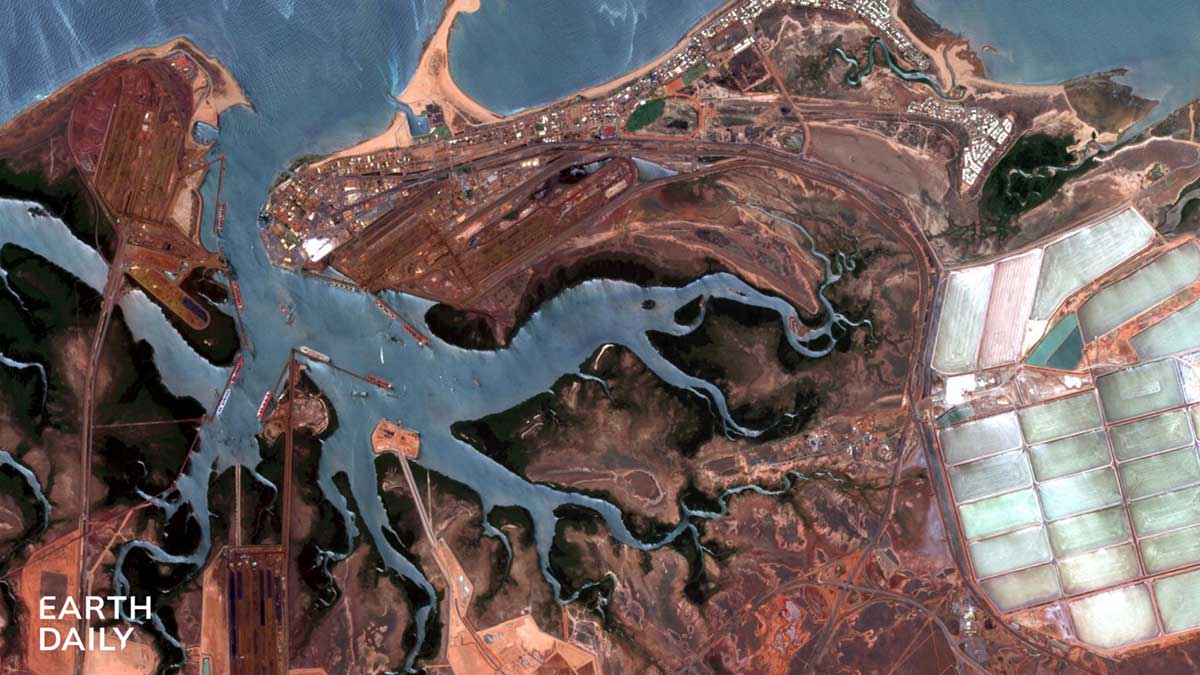
The EarthDaily Constellation, which includes the six newly launched satellites and a trial spacecraft deployed in 2025, is designed to provide daily, consistent global observations using 16 imaging systems across 22 spectral bands. Rather than focusing on high-resolution point imaging, the system is optimised for broad-area change detection, producing standardised datasets intended for AI and predictive modelling.
Osborne says this consistency is what makes the system particularly relevant to IoT networks in agriculture, logistics, insurance, and infrastructure monitoring, where it acts as a contextual layer rather than a primary sensing system.
“IoT gives you what is happening on the ground, down to individual machines, fields, and assets,” he says. “Satellite systems give you the wider context. When you bring those together, you get a more complete operational picture.”
He adds that this integration is beginning to reshape industrial IoT architectures, particularly in sectors such as agriculture, where satellite-derived change detection is increasingly used alongside ground-based sensor data to improve interpretation and validation.
“In agriculture, for example, you’re no longer just deploying sensors in fields and on machinery,” he says. “You’re building systems that ingest satellite-derived change detection as another input layer, which helps validate and interpret what your IoT devices are seeing.”
EarthDaily is one of several firms expanding LEO Earth observation capacity, alongside providers focused on daily revisit imaging, climate monitoring, defence intelligence and geospatial analytics. The company operates on a model that sells both raw geospatial data to clients as well as insights derived from the data.
Osborne argues that the combined effect of these constellations is to reduce latency and improve the reliability of global environmental data, a longstanding constraint for IoT applications that depend on timely external context.
“You can’t optimise an IoT system if your external environmental data is weeks out of date,” he says. “LEO constellations are reducing that delay to hours or days, and that changes how organisations approach forecasting and operational decision-making.”

The company is positioning its platform as a calibrated measurement system rather than a traditional imaging service, with each satellite contributing to a unified, AI-ready dataset intended for foundation model training and predictive analytics.
Osborne says this shift is particularly significant as IoT moves further towards predictive and, in some cases, automated decision-making, although he stresses that adoption remains uneven across sectors.
“The industry is moving from ‘what is happening’ to ‘what will happen next’,” he says. “That’s only possible if you have consistent, global-scale measurement that can be fused with IoT telemetry.”
He points to agriculture as an early example of this convergence, where satellite-derived indicators such as crop stress, moisture variation and disease propagation can be combined with ground-level IoT data from machinery and field sensors to improve yield prediction and resource optimisation.
EarthDaily expects its constellation to generate around 100 terabytes of data per day once fully operational, a scale Osborne says is only now becoming economically viable thanks to advances in cloud computing and machine learning infrastructure.
“Ten years ago, this would have been technically and economically unworkable,” he says. “Now it is becoming the foundation for entirely new industrial workflows.”
With an eighth satellite scheduled for launch later this summer, EarthDaily is continuing to expand its LEO footprint as part of a wider industry trend Osborne believes is still at an early stage of development.
“We’re at the beginning of a structural shift,” he says. “LEO constellations are turning Earth observation into a real-time contextual layer for IoT systems, and we are only just starting to see what that enables.”
There’s plenty of other editorial on our sister site, Electronic Specifier! Or you can always join in the conversation by commenting below or visiting our LinkedIn page.