As the global electric mobility sector prepares to mark World EV Day on 9 September, smart EV charging consultancy Versinetic has released new findings showing that cybersecurity and firmware reliability are becoming critical priorities across the UK EV charging sector. The research draws on responses from professionals working in charger design and manufacture, charge point operations, fleet and site charging, installation, maintenance, technical support and managed services.
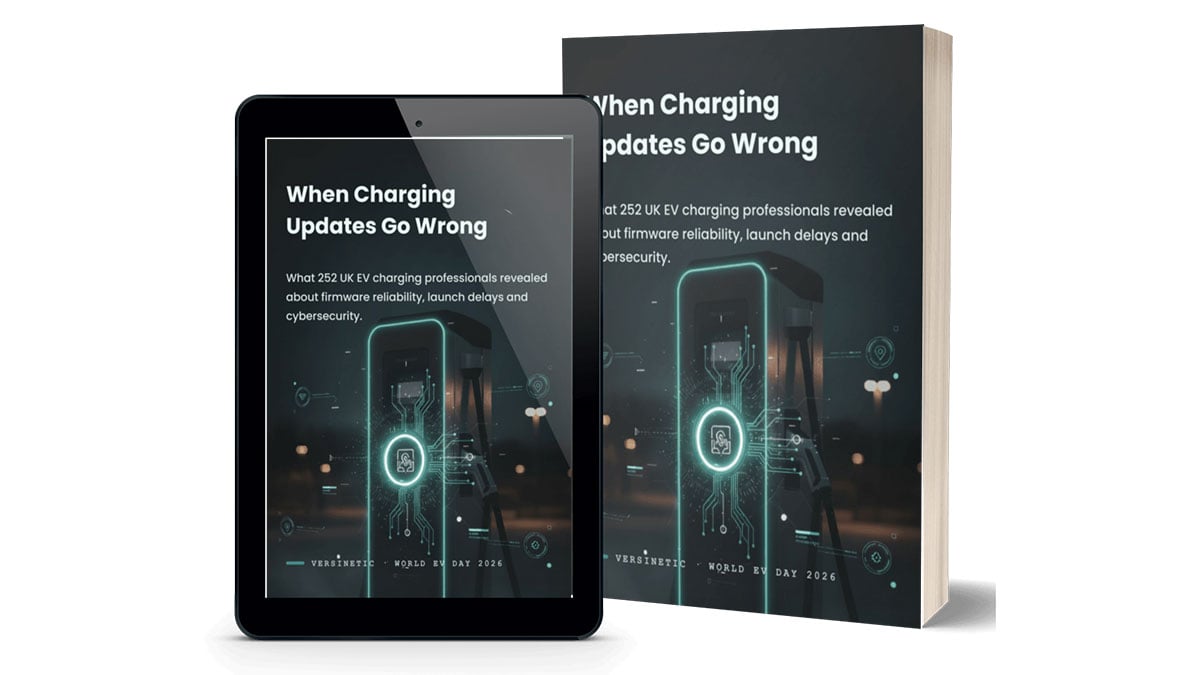
World EV Day provides a natural moment for the industry to focus on the software and firmware foundations that determine whether chargers work reliably and securely for drivers every day. Versinetic’s report, When Charging Updates Go Wrong: A 2026 UK EV Charging Firmware Insight Study, finds that firmware problems are routine rather than rare – and that the industry is increasingly focused on securing the update process.
Cybersecurity emerged as the clearest future priority. Stronger cybersecurity and signed firmware were named the top priority for the next three to five years by 59% of respondents, ahead of the other capabilities tested. Sixty-four per cent are at least ‘moderately’ concerned about cybersecurity vulnerabilities in charger firmware and software today, while 47% are ‘very’ or ‘extremely’ concerned specifically about weak or missing signing or verification of firmware updates.
The operational impact is already widespread. Only 4% said known firmware bugs had not affected any charging sessions in the previous 12 months – meaning 96% reported at least some impact. Nearly seven in ten respondents (69%) said at least 5% of their firmware updates had caused a noticeable issue in the past year, while more than half (57%) reported that firmware problems had delayed a certification or commercial launch over the past two years. Failed or incomplete updates, chargers requiring site visits after an update, vehicle compatibility issues and post-update performance problems were all widely reported.
The findings also expose a confidence gap, with firmware readiness remaining a final stress point. While 54% rate their own firmware readiness as ahead of peers, only 11% say they are well ahead. Set against the disruption figures, the results suggest there is still substantial room to make firmware release processes more consistent and resilient.
Julian Skidmore, EV Industry Analyst at Versinetic and author of the research findings, comments: “The next step for the industry is to make firmware management as disciplined as the rest of charger engineering. That means designing security into the update chain, testing against real-world conditions, staging releases carefully and making rollback a proven part of the process. As charging estates scale, repeatable firmware practices will be essential to protecting uptime, accelerating launches and maintaining driver trust.”
Firmware deployment also remains highly varied. Two-thirds of respondents (66%) use on-site updates to load firmware onto chargers, while 46% use over-the-air updates through a central system and four in ten rely on third-party service providers or maintenance contractors. The figures point to a hybrid operating environment in which hardware variants, connectivity, access methods, software versions and multiple delivery routes can all make consistent firmware management harder.
Dunstan Power, Managing Director of Versinetic, added: “An EV charger is no longer just power electronics in a box. It’s a connected product with a software lifecycle, and if that lifecycle is weak, uptime, security and customer trust all suffer. Most of the teams in this study want to do the right thing on firmware, but few have turned that into a repeatable process. The businesses that give firmware a named owner, and treat it as core engineering work, are better placed to scale.”
The findings note that many teams already use automated testing and continuous integration pipelines, hardware-in-the-loop testing, staged or canary rollouts, formal rollback plans and regression testing. Yet these practices are often unevenly applied, leaving residual risk when hardware variants, mixed connectivity, third-party dependencies and live customer demand combine.
A key practical offering in the report is a set of six priority checks for teams preparing their next EV charger firmware release:
- Build for lifecycle management so that every deployed hardware and firmware variant can be identified and its version known.
- Test the conditions that happen in the field, including hardware revisions, vehicles, poor connectivity, backend outages, interrupted updates and power-loss scenarios.
- Stage releases deliberately, starting with a representative pilot group and expanding only when telemetry supports it.
- Pre-test rollbacks so that recovery can return a failed device to its last known good state, remotely where possible.
- Secure the update chain through firmware signing, verification, device identity and controlled certificate management.
- Measure what matters, tracking failed sessions, update success rates, rollback frequency, recovery times, site visits and certification delays.
The report argues that these steps can reduce large-scale rollbacks, improve uptime, accelerate certification and strengthen confidence when scaling charger fleets.
There’s plenty of other editorial on our sister site, Electronic Specifier! Or you can always join in the conversation by commenting below or visiting our LinkedIn page.