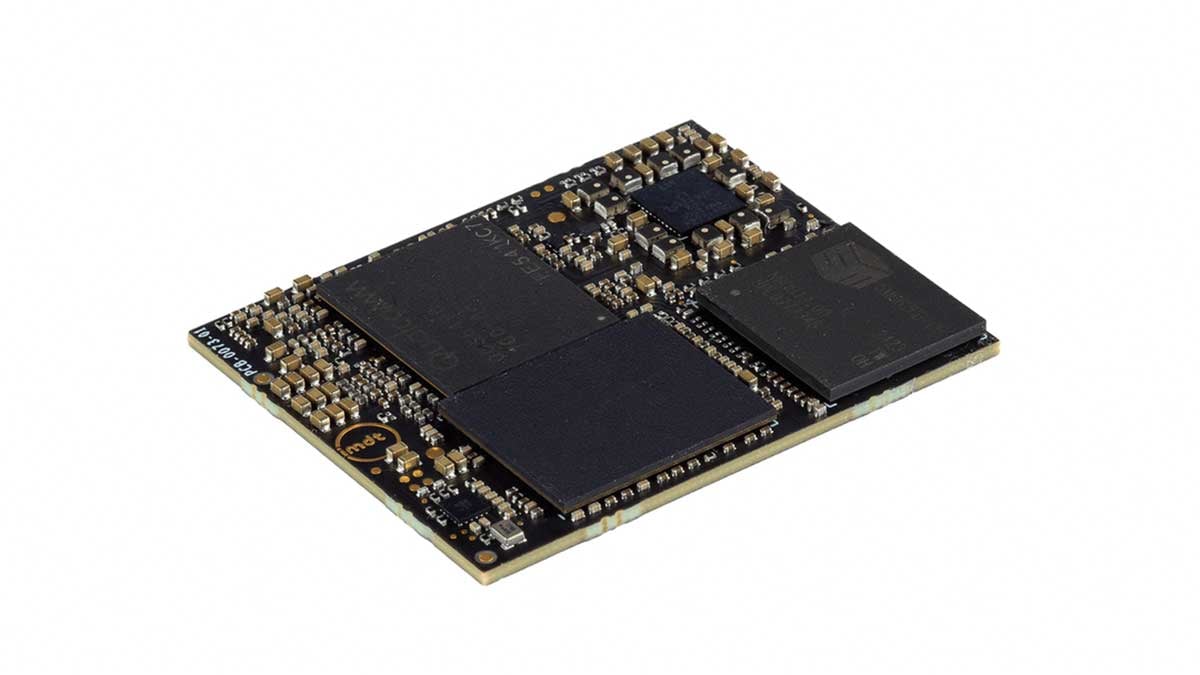
IMDT has expanded its system-on-module (SOM) portfolio with a new module based on Qualcomm’s Dragonwing Q-7790 processor, allowing developers to scale Edge AI computing performance without redesigning the underlying hardware.
The new module joins three existing models based on Qualcomm’s Dragonwing Q7 Series, with all four sharing a 37 x 30 mm footprint and a common carrier board design. The range spans AI performance from 3.5 to 48 dense tera operations per second (TOPS), depending on the processor.
The approach is intended to address a challenge for developers of connected devices: selecting a processor early in the design process can constrain future upgrades as AI workloads become more demanding. Pin-to-pin compatibility allows manufacturers to move between performance tiers while retaining the same carrier board architecture, potentially reducing redesign and requalification work.
The Dragonwing Q-7790 module delivers 24 dense TOPS of AI performance. It combines an eight-core Qualcomm Kryo CPU running at up to 2.8GHz with an Adreno 722 GPU and a Spectra 7-series triple image signal processor.
The module supports up to 48-megapixel image capture across four MIPI CSI camera inputs, WQHD+ playback at 144Hz and dual 4K displays at 60Hz. These capabilities target multi-camera vision applications in robotics, medical devices, industrial automation and commercial vision systems.
“Most of our customers are not choosing a module. They are choosing a hardware platform they may live with for years,” said Avi Shimon, Chief Executive of IMDT.
The common hardware design allows engineering teams to develop product variants with different computing requirements, potentially reusing more components across a product range.
Eric Mazzoleni, vice-president of industrial IoT and robotics sales for Europe at Qualcomm Germany, said the shared form factor gave developers flexibility to establish an architecture early and increase computing capabilities as requirements evolved.
The Dragonwing Q-7790 module supports Android and Linux, alongside security features including secure boot, encrypted storage, authenticated over-the-air updates and Qualcomm’s Trusted Execution Environment. Memory, storage, wireless connectivity and physical-layer interface options can be customised for individual products.
IMDT, which develops AI and vision systems and has operations in the UK and Israel, also plans a module based on Qualcomm’s Dragonwing Q-8750 processor. A separate portfolio using the Dragonwing IQ Series is also in development.
There’s plenty of other editorial on our sister site, Electronic Specifier! Or you can always join in the conversation by commenting below or visiting our LinkedIn page.