
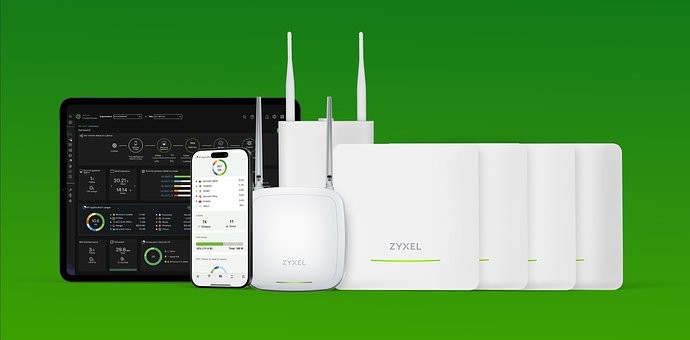
Zyxel Networks, a provider of cloud-managed networking solutions, has unveiled six new Wi-Fi 7 access points aimed at small businesses, seeking to make the latest wireless standard more accessible amid ongoing cost and complexity barriers.
Wi-Fi 7-capable devices have begun to proliferate among consumer and enterprise segments. Yet smaller organisations, often lacking dedicated IT resources, have been slower to adopt the technology. Zyxel’s new devices span indoor, outdoor and desktop deployments, offering cloud-managed Wi-Fi 7 connectivity at a price point designed to appeal to budget-conscious operators.
The company claims its latest models incorporate several features uncommon among Wi-Fi 7 access points. Notably, support for SSID VLAN tagging enables businesses to separate traffic for staff, guests and smart devices, enhancing security and simplifying network management.
The APs also introduce two proprietary innovations. Smart Mesh multi-link operation (MLO) combines mesh networking and dual-radio backhaul, which Zyxel says can increase throughput by up to 40%, while an RF-first design, with antenna isolation and optimised layouts, aims to mitigate interference in dense or congested environments.
All six units are powered by quad-core Qualcomm chipsets and support Zyxel’s NebulaFlex management platform, allowing flexible switching between cloud and on-premises control. Zero-touch provisioning and app-based onboarding are designed to simplify installation for organisations without IT teams.
“With this launch, Zyxel now offers 13 WiFi 7 access points, the most comprehensive portfolio in the industry,” said Kell Lin, Senior Associate Vice President, Networking Strategic Business Unit at Zyxel Networks. “These new models bring the benefits of WiFi 7 within reach of many more small businesses, combining performance, security and ease of deployment.”
Zyxel’s WiFi 7 APs also comply with EN 18031 security standards, aligning with the EU’s Radio Equipment Directive. The NWA30BE and NWA55BE will be available across EMEA from November 2025.
There’s plenty of other editorial on our sister site, Electronic Specifier! Or you can always join in the conversation by visiting our LinkedIn page.