
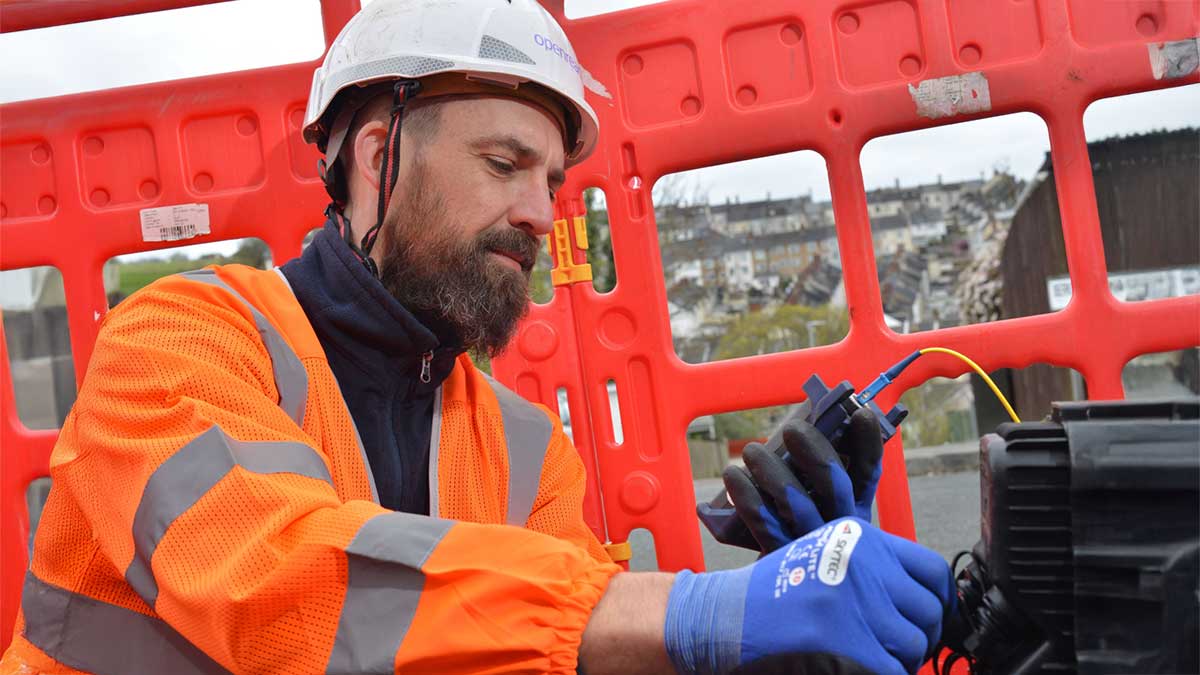
Industry groups have welcomed Openreach’s plans to bring next-generation full-fibre broadband to more than 1m UK premises over the next 12 months, as AI, Cloud services and connected devices drive up demand for data.
But the reaction also underlines that faster fibre connections are only one part of the infrastructure needed to support an increasingly connected economy, with the London Internet Exchange warning that investment in access networks must be matched by resilient interconnection across the wider internet.
Openreach said it plans to extend its use of XGS-PON, a passive optical networking technology capable of supporting symmetrical speeds of up to 10Gbps, across more of its full-fibre network.
The move will allow Openreach to increase the capacity of its existing fibre infrastructure rather than replacing the physical network. The company said the technology can support speeds of up to 8.5Gbps at current retail level, compared with today’s top download speed of 1.8Gbps on its full-fibre network.
“Our Full Fibre network already offers Gigabit capable broadband to more than 23.4 million premises, and more than 9.4 million customers have upgraded so far,” said Trevor Linney, Openreach’s Director of Network Technology. “As demand for data continues to grow, our investment in XGS-PON technology will enable us to offer even higher speeds over the same network, and the additional capacity needed to support the UK’s digital future.”
Linney said continued investment in network upgrades would create a platform for “the next generation of technology”, including AI-enabled services, smart homes, future mobile networks, Cloud-based business and public services.
Openreach plans to make the new higher-speed services available to more than 1m premises over the next 12 months. It is building on an XGS-PON pilot launched in March covering 40,000 residential premises in Guildford and surrounding areas.
Over the next five years, Openreach aims to extend XGS-PON to around one-third of its full-fibre network through further construction, network upgrades and equipment modernisation. It said it would consider expanding the programme further depending on demand and feedback from its communications provider customers.
The upgrade comes as Openreach’s full-fibre network reaches more than 23.4m premises, with more than 9.4m customers having upgraded. Most of the existing network uses GPON technology, which provides today’s gigabit-capable broadband services.
Openreach said the shift to XGS-PON was not simply about faster downloads. Its symmetrical architecture means customers can upload data at the same speeds as they can download it, a capability the company said could become increasingly important for applications that generate large volumes of upstream traffic.
These include AI applications, Cloud computing and telehealth, where high-resolution medical scans and other diagnostic information may need to be uploaded as well as received.
The technology could also support the infrastructure behind the growing number of connected devices and services in homes and businesses. Openreach said higher-capacity fibre would provide a foundation for smart homes and future mobile networks, as well as Cloud-based business and public services.
Yet the fixed-network upgrade also sits alongside growing pressure on the UK’s mobile infrastructure, which is increasingly important for IoT deployments that need connectivity beyond the home or office.
Ofcom said in June that mobile connectivity in the UK was “too often not good enough” and described reliable mobile connectivity as critical to economic growth and digital inclusion. It said improving mobile connectivity would require action from industry, government, local authorities, landlords and others.
For IoT, the two networks are complementary: fibre provides the high-capacity backbone and fixed connectivity for connected buildings and infrastructure, while 4G and 5G allow sensors, vehicles, industrial equipment and other devices to remain connected when they are mobile or located beyond fixed broadband. Ofcom’s latest infrastructure update put good 4G geographic coverage from all mobile operators at 84% of the UK landmass, while coverage from at least one operator stood at 96%.
Jennifer Holmes, chief executive of the London Internet Exchange, said the expansion would help prepare the UK for continued growth in data demand as households and businesses adopt more data-intensive services, from AI and Cloud applications to streaming and smart devices.
“Greater speed and capacity at the access layer will become essential,” she said. But she warned that faster connections to premises needed to be matched by “robust, scalable interconnection across the wider internet ecosystem” to keep traffic exchange efficient, reduce latency and prevent bottlenecks as data volumes rise.
Elizabeth Anderson, chief executive of the Digital Poverty Alliance, also welcomed the investment but said the benefits of faster networks would depend on affordability and access to suitable devices and digital skills.
“Progress cannot be measured by maximum speeds alone, but by how many people can genuinely access and benefit from them,” she said, warning that the gap between households with access to multi-gigabit services and those struggling with basic connectivity could widen without greater focus on digital inclusion.
For IoT, the significance of the upgrade lies less in headline broadband speeds than in the additional upstream and downstream capacity available to increasingly connected environments. As sensors, smart appliances and other devices generate more data, symmetrical connectivity can better accommodate the two-way traffic generated by connected applications.
Openreach said XGS-PON also provides a route towards future generations of passive optical networking. Industry standards are already being developed for 25G-PON and 50G-PON, meaning the investment can increase the capability of the existing fibre network while providing a pathway for further upgrades.
There’s plenty of other editorial on our sister site, Electronic Specifier! Or you can always join in the conversation by commenting below or visiting our LinkedIn page.