
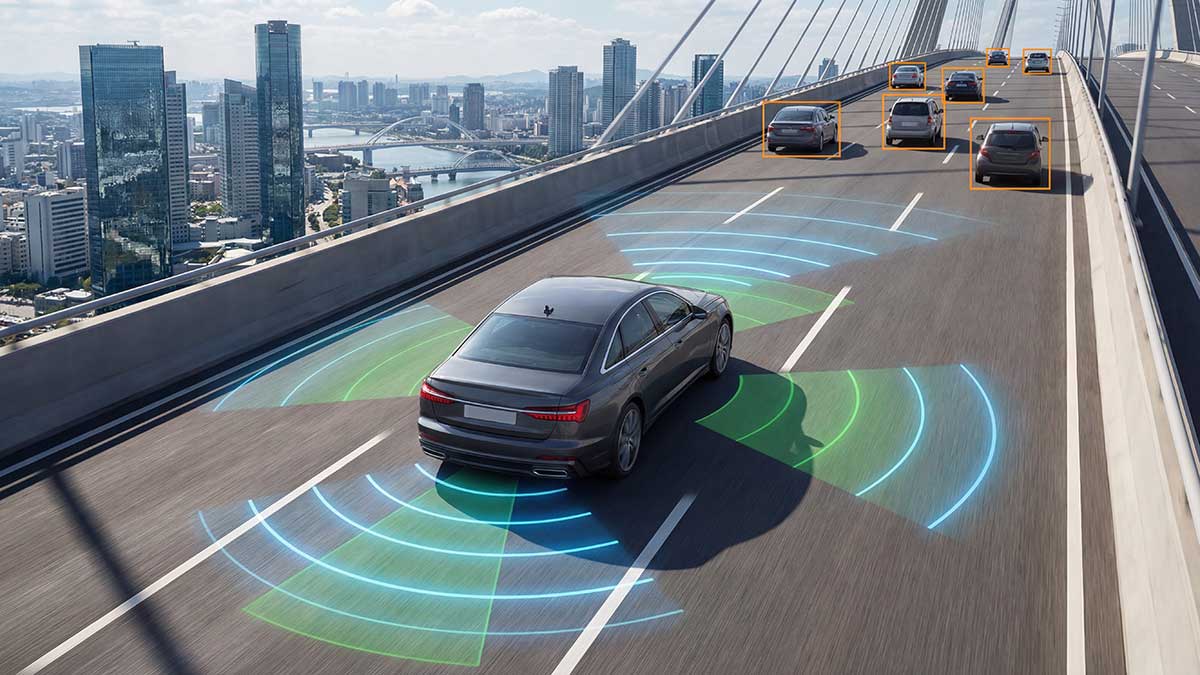
Around the world, road safety regulations are moving into a new era, and towards a new approach to keeping road users safe. Regulations are shifting beyond mandating sensors, and towards the active protection of vulnerable road users such as pedestrians and cyclists.
July this year saw a significant deadline in the European Union, mirrored by regulations in India and other territories, as well as UNECE regulations targeting safety for pedestrians and cyclists.
Evidenced by this, a new era of road safety is dawning, and the ability to retrofit modern sensors is growing in importance, with radar emerging as key technology to enable vehicles to detect and avoid vulnerable road users. Combined with other sensors such as cameras and Edge AI built into vehicles, cutting-edge sensors hold the promise not just of effective compliance, but a way to curb the 1.3 million worldwide deaths per year caused by car crashes.
For fleet operators and other organisations in the automotive space, the ability to retrofit vehicles to comply with ADAS regulations means embracing new technology. In particular, advanced radar sensing (including 4D radar) is growing in importance alongside sensor fusion (combining data from multiple sensors to reduce uncertainty). The ability to process data with AI at the edge (and within vehicles themselves) is also increasingly vital. The widespread adoption of such technologies has implications that go far beyond vehicles themselves and will impact smart infrastructure and how roads are used going forward.
Why 4D radar matters
Many of the sensors when assessed on their individual merits come with both benefits and limitations: cameras, for example, are strong in many ways, but struggle in adverse weather, while LiDAR comes with high costs and the performance can degrade in conditions such as heavy rain and fog.
Meanwhile, legacy radar systems lack vertical resolution, meaning their usefulness is limited compared to today’s 4D Imaging radar, which combines distance, velocity, and position with vertical resolution. On the road, this means that vehicles can ‘sense’ where a road object is, how quickly it is moving, and rapidly categorise objects (for example, as a pedestrian, a cyclist or a truck).
This means that vehicles fitted or retrofitted with such sensors can spot and categorize vulnerable road users easily, cutting the costs for operators who aim to comply with emerging regulations in the EU and beyond. With France, Germany, Italy and 14 other countries having signed agreements to allow testing of so-called ‘robotaxis’ with a common framework across participating countries, some vehicles already ship with more than 20 advanced 4D sensors.
Analysis by ResearchAndMarkets found that 169 million radar sensors were shipped in 2024 around the world – an average of 0.8 long-range radars per vehicle, and set to rise to one per vehicle by 2030.
Built for real roads
Radar systems can easily be integrated into existing vehicle systems, and work at ranges of more than 200 meters, with low power consumption. But it’s also vital that these sensors are integrated effectively. To truly deliver and comply with emerging global regulations going forward, a camera-plus-radar architecture will be crucial, offering a path to curb per-vehicle sensor costs.
It’s also vital that computing is performed at the Edge, where possible. Radar systems in autonomous vehicles or vehicles equipped with ADAS should be optimised to deliver 4D sensor data directly to the AI models in autonomous vehicles, while also remaining as power- and heat-efficient as possible.
Ensuring that sensors can be integrated seamlessly offers operators a cost-effective path to regulatory compliance. Working together, 4D radar sensing, sensor fusion and edge AI are helping to pave the way for a future where roads around the world are safer.
Looking forward
The ability of 4D imaging radar to generate point clouds rapidly will be vital to the evolution of the sector – both to comply with emerging regulations but also in the path towards truly autonomous vehicles. Point Clouds are sets of data points in 3D space which are used to ‘see’ the 3D shape of a physical object, with the ‘Cloud’ built from millions of individual measurement points.
While LiDAR can create Point Clouds, it is unable to measure velocity. Point Clouds will be foundational for the development of ‘true’ self-driving vehicles, such as SAE Level 3 autonomy where vehicles can drive by themselves with a human driver ready to take over when needed. It’s already clear that 4D radar will have an important role to play here.
Towards safer roads
Advanced 4D imaging radar will form an important part of a safer future on our roads. With the ability to create point clouds, velocity and vertical resolution, 4D radar offers a simple, cost-effective way to create a perception stack adequate for today’s regulations and tomorrow’s.
Combined with sensor fusion with cheap, effective cameras, and AI processing at the Edge, radar will be the ‘eyes’ of tomorrow’s vehicles – and the foundation of safer roads for all of us.