
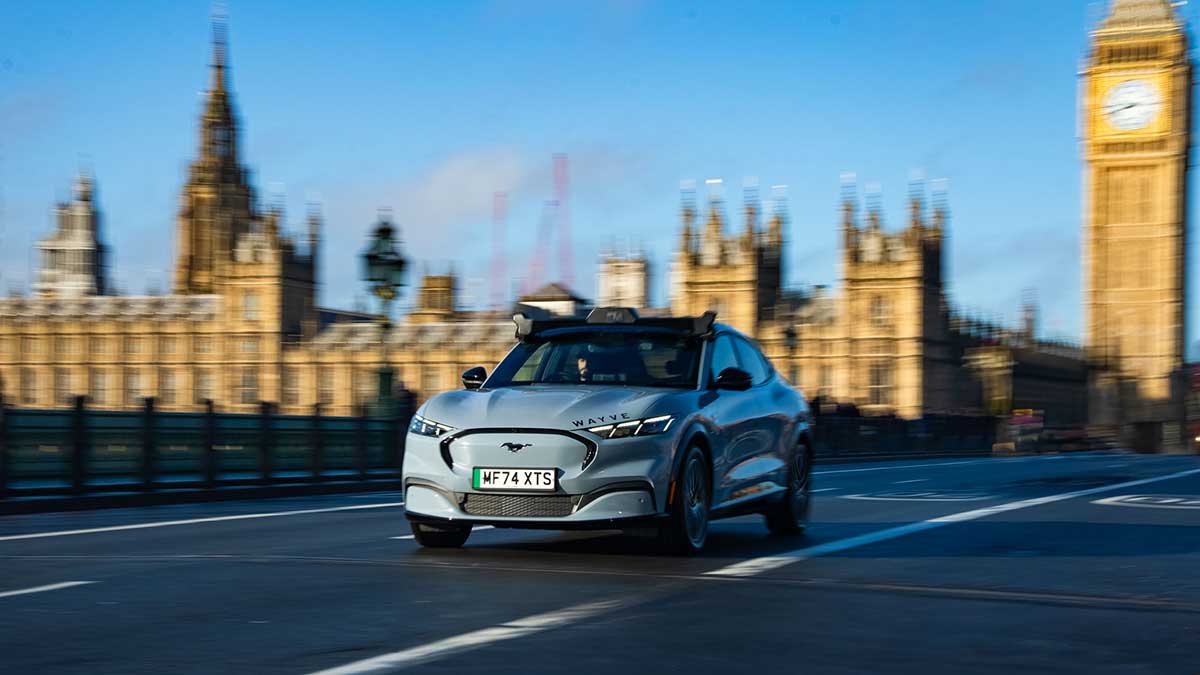
Uber and UK autonomous driving company Wayve have secured approval to begin carrying passengers in London after Transport for London (TfL) granted private hire vehicle licences to their fleet of autonomous electric vehicles.
The licences cover a number of all-electric Ford Mustang Mach-E vehicles equipped with Wayve’s AI-powered autonomous driving system, allowing the companies to begin passenger trials later this summer.
According to Uber, the approval completes the regulatory requirements for private hire operations in the capital, with the operator, driver and vehicle all licensed by TfL.
The approval completes the regulatory requirements for private hire operations in the capital, with the operator, driver and vehicle all licensed by TfL. Although the vehicles are designed to operate autonomously, each journey will include a trained, TfL-licensed private hire driver who can monitor the system and take control if required.
Uber said that more than 100,000 Londoners have joined its interest list over the past eight weeks for the chance to take part in the early deployment. A limited number of passengers will be invited to use the service later this summer, helping the companies refine the experience before a wider public launch.
The move marks one of the UK’s most significant real-world deployments of autonomous vehicle technology and represents a milestone in the commercialisation of connected, AI-powered mobility services.
Sarah Gates, Vice President of Global Affairs & Assurance at Wayve, said: “This licence is an important step towards giving Londoners the chance to experience autonomous driving technology.”
Uber also described the approval as a key milestone. Annie Duvnjak, Global Head of Autonomous Mobility Operations at Uber, said more than 100,000 Londoners had already registered their interest in experiencing Wayve’s autonomous driving technology.
However, the plans have prompted concerns from the GMB union, which represents private hire drivers.
Matthew Wright, GMB Regional Organiser, said: “We can’t go charging ahead with new technologies without considering the implications of autonomous vehicles on all parties.”
He questioned how drivers would be supported if automation reduced employment, who would be liable in the event of accidents, and how autonomous vehicles would serve disabled passengers.
“Driverless cars cannot replace the knowledge, experience, and human connection that a skilled driver offers,” Wright said, urging TfL to proceed “with extreme caution”.
Unlike many earlier autonomous vehicle programmes, which relied on detailed high-definition maps and tightly defined operating areas, Wayve’s AI-first approach is designed to learn from experience and interpret road conditions in real time. The company says its software has been trained on UK roads since 2018 and has demonstrated its adaptability across more than 500 cities worldwide.
For the IoT sector, the deployment highlights how autonomous vehicles are evolving into connected Edge computing platforms. Rather than relying on continuous Cloud connectivity to make driving decisions, Wayve’s AI Driver processes data locally from multiple onboard cameras and radar sensors, enabling real-time perception and control at the Edge. Connectivity remains essential for over-the-air software updates, fleet management, diagnostics and the collection of operational data used to continuously improve the AI models.
The London trial comes as the UK seeks to strengthen its position in artificial intelligence and connected mobility, with regulators, technology developers and transport operators working together to bring autonomous vehicle services into commercial use while maintaining public safety and regulatory oversight.
There’s plenty of other editorial on our sister site, Electronic Specifier! Or you can always join in the conversation by commenting below or visiting our LinkedIn page.