Nordic Semiconductor used the recent Hardware Pioneers Max show in London to set out how its nRF54 series is reshaping the balance between power consumption and on-device intelligence, as the company positions itself to serve a new generation of Edge AI applications on battery-constrained hardware.
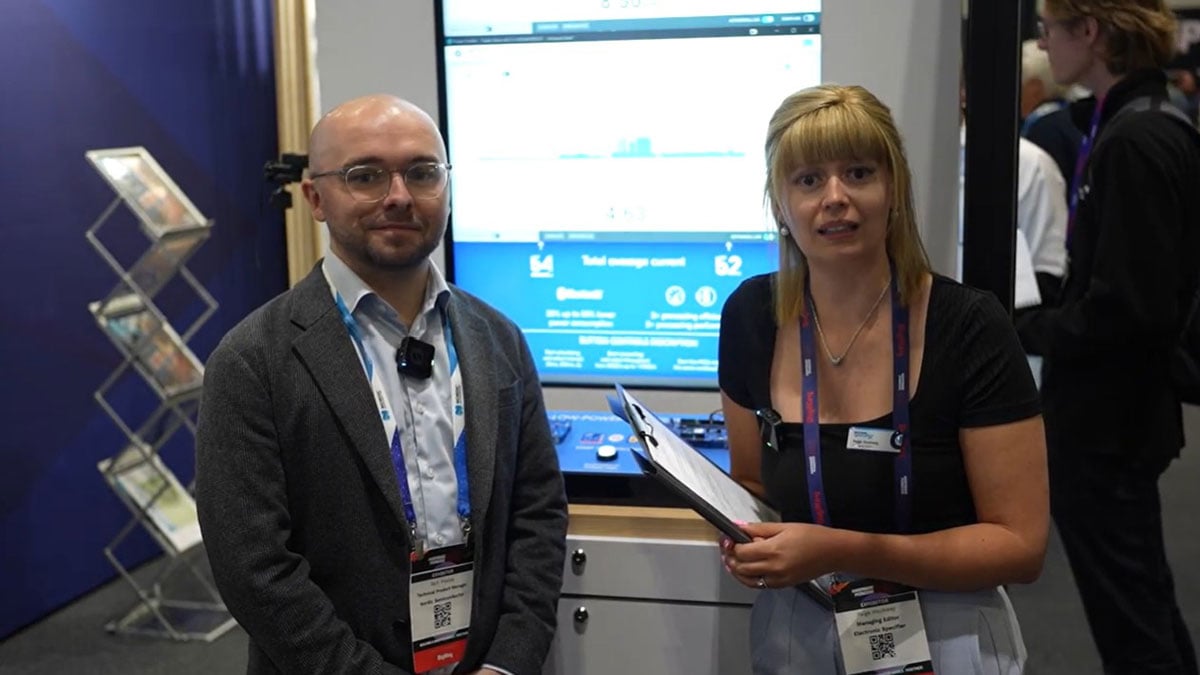
Speaking to IOT Insider on the show floor, Sam Presley, Technical Product Manager at Nordic Semiconductor, described a strong turnout from both new and existing customers. “We’ve seen a lot of both new customers interested in working with us, as well as people that we already know and have been using our technology,” he said.
Nordic has built its reputation on Bluetooth Low Energy, holding an estimated 40% share of the Bluetooth chip market and playing an active role in specification development. The nRF54 series extends that position, building on the widely deployed nRF52 platform. According to Presley, the priority was reducing power draw further, allowing manufacturers to add functionality without compromising battery life. “[With] the nRF54, we brought that to the next level, decreasing the power consumption, so that customers can build more complex, more feature-rich products whilst using smaller batteries and having longer battery lifetime,” he explained.
Edge AI on constrained hardware
A central theme of the conversation was the nRF54LM20B, which brings on-device AI capability to ultra-low-power products. Presley pointed to data privacy and latency as the two main drivers behind demand for local inference. “On-device Edge AI unlocks a whole number of opportunities,” he said, noting that keeping data on the device removes reliance on Cloud transmission and allows faster decision-making.
Nordic demonstrated this with a camera-based people-detection application running entirely on the nRF54LM20B. Presley suggested home security as a representative use case: a camera watching a room that can distinguish a person from a pet without sending footage to the Cloud. “You want to detect if a person is there or moving around, but not necessarily your cat or your dog,” he said, adding that avoiding Cloud processing also removes a significant cost burden for manufacturers.
AI-assisted development and the chip-to-Cloud model
Presley also addressed how AI coding tools are changing firmware development. Nordic is investing in Model Context Protocol (MCP) server services covering its SDK, documentation, and Cloud platform, intended to give tools such as GitHub Copilot and Claude better context on Nordic’s products. “Our goal here really is to enable customers to develop their applications and get them to production and support them out in the field in the shortest possible amount of time,” he said.
That ambition ties into Nordic’s broader chip-to-Cloud strategy. Beyond silicon and firmware tooling, Presley highlighted the nRF Cloud platform’s role in device firmware updates and remote debugging – capabilities increasingly required under regulation such as the EU Cyber Resilience Act. He noted that many manufacturers still lack visibility into how their products perform once deployed, and that Nordic’s platform is designed to close that gap by giving customers insight into field issues, including whether a firmware update has caused problems.
Where the market is heading
Asked about the trends set to shape the next generation of IoT devices, Presley pointed squarely to Edge AI, citing Nordic’s newer NPU-equipped silicon and its Newton platform, which allows machine learning inference to be added to existing products via over-the-air updates. He also flagged continued development across connectivity standards, including Bluetooth, Matter, and Thread, as smart home and industrial communications requirements evolve.