
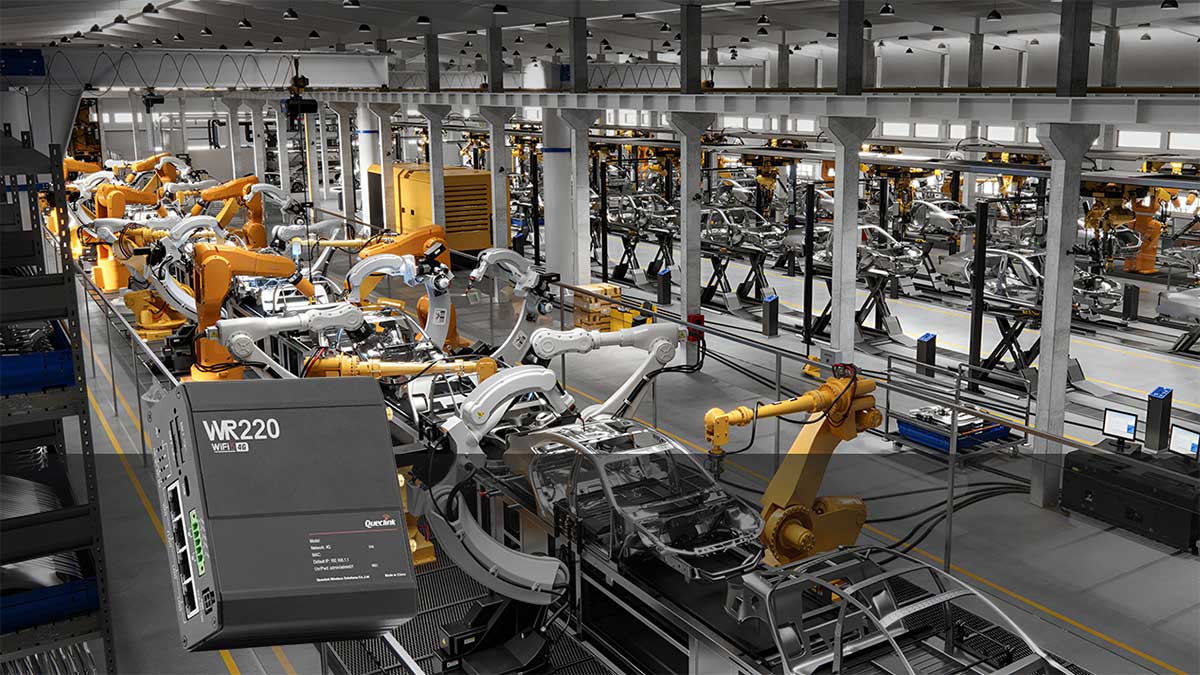
Queclink Wireless Solutions has launched a 4G LTE router platform designed to handle the challenging conditions and equipment requirements found in diverse industrial settings. Alongside advanced wireless connectivity, the WR220 Series delivers expanded flexibility through PoE-powered operation, broader accessory integration and enhanced interface options.
“WR220 is an industrial networking solution that enables businesses to effectively connect their infrastructure, equipment and systems,” explains Vernon Bonser, International Sales Director at Queclink Wireless Solutions. “The router has been developed for both internal and external applications, making it ideal for a wide range of smart environments including public transport, factory automation, surveillance, retail and utilities.”
Built for demanding deployments and harsh environments, the WR220 features an industrial-ready and compact design with a rugged aluminium enclosure, wide operating temperature range, and broad power input support. It also delivers stable wireless connectivity with 4G LTE Cat 4, dual SIM redundancy and intelligent failover mechanisms to maintain network availability across distributed sites, while remote management allows centralised monitoring, configuration and diagnostics.
The WR220 router combines networking, interfacing and wireless technologies in one compact platform to simplify deployment and reduce additional gateways or hardware requirements. This allows the industrial router to bridge legacy operational technology and modern cloud systems within a single architecture, providing straightforward roll-out without unnecessary technical complexity. Meanwhile, the router’s built-in BLE gateway allows direct connection with wireless sensors, beacons and Edge devices.
PoE PD support has been added to Queclink’s router offering for the first time, enabling the WR220 to receive both power and data delivery through a single Ethernet cable and making the WR220 ideal for space-constrained locations. It will streamline cabling requirements and deployment costs, especially in locations where dedicated power wiring is difficult.
“We have designed the WR220 for customers requiring a highly adaptable industrial router that delivers reliable industrial connectivity, flexible device integration and simplified deployment across distributed environments. As a result, we believe it will meet the diverse needs of system integrators, technology solutions providers, managed services providers, original equipment manufacturer (OEMs) and original design manufacturers (ODMs),” adds Bonser.
There’s plenty of other editorial on our sister site, Electronic Specifier! Or you can always join in the conversation by commenting below or visiting our LinkedIn page