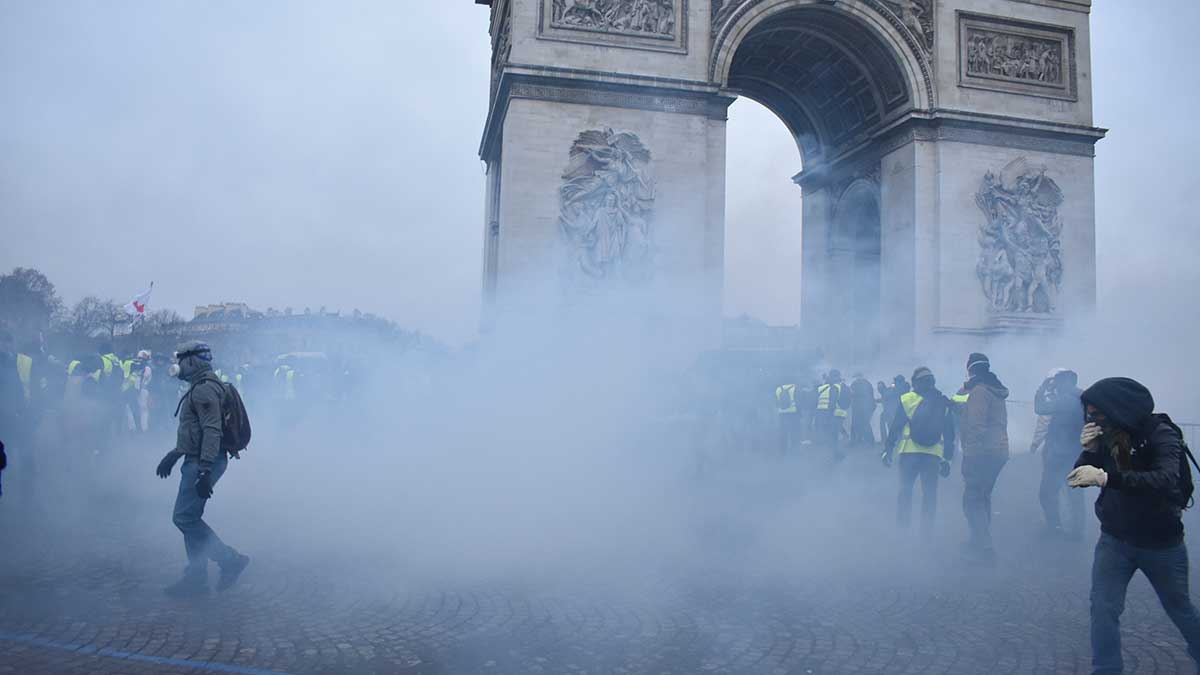
France’s wave of protests last weekend left a trail of looted shops, burning vehicles and damaged public buildings – and a substantial amount of digital evidence.
Following the unrest on 17 and 18 October, Prime Minister Sébastien Lecornu announced a “massive” law enforcement operation, with nearly 200 investigators in the Paris region tasked with analysing CCTV, shop security footage and social media videos to identify suspects.
“We have decided on several things,” Lecornu told reporters, describing the response as a “particularly significant and large-scale criminal justice response”. He said a second wave of legal action would be carried out in a “more deliberate, methodical manner”, pointing to videos circulating online that showed alleged looters who had not covered their faces.
The investigation highlights how connected cameras and digital platforms are becoming part of the infrastructure used to monitor public demonstrations. From CCTV networks and drones to facial recognition software and social media, technology can help authorities reconstruct events and identify suspects after demonstrations have ended.
But as the boundary between public safety and surveillance becomes harder to define, questions remain over who is being monitored, how the resulting data is used and what safeguards protect the right to protest.
IoT Insider examined some of the most prominent technologies and digital systems shaping how police monitor demonstrations and investigate unrest.
1. Connected CCTV and video analytics
CCTV is among the most established tools available to police investigating public disorder. Footage from public spaces, shops and transport networks can help officers reconstruct events and trace suspects’ movements.
Le Parisien reports that in Paris, investigators are using footage from the city’s public-space surveillance network alongside cameras operated by RATP and SNCF. By matching details such as clothing, bags and the time and location of an incident, they can attempt to follow suspects between camera locations.
Artificial intelligence and video analytics can extend these capabilities by helping operators search large volumes of footage for people or objects matching particular characteristics.
2. Drones
Drones give police an aerial view of public gatherings that can be difficult to obtain from street level. Equipped with cameras, they can monitor crowd movements, observe activity across a wider area and help officers coordinate their response as people move between streets and public squares.
French law permits aerial camera surveillance for specified public-safety purposes, including securing gatherings where serious public disorder is a risk. Such deployments must be proportionate to their purpose.
On 5 October 2026, the administrative court in Strasbourg upheld an authorisation for police drone surveillance around schools during demonstrations, while suspending a separate restriction on gatherings that it found too imprecise. A further court decision on 12 October upheld drone surveillance authorisations around schools in Isère. Both decisions concerned specific deployments, rather than establishing an unrestricted power to monitor any protest. Strasbourg Administrative Court and Grenoble Administrative Court.
3. Social media monitoring and online marketplaces
Demonstrators increasingly document events themselves, producing a large volume of photographs, livestreams and videos that can become evidence in subsequent investigations.
During the October unrest, French investigators examined social media footage alongside CCTV images. Publicly available videos can provide information about where an incident occurred, when it happened and what those involved were wearing. Investigators can then compare these details with other evidence.
Surveillance does not necessarily end when a demonstration disperses. Investigators can also look for evidence of suspected offences in the digital activity that follows.
In Paris, police are reportedly examining online resale platforms after allegedly stolen goods began appearing in listings. Advertisements can provide leads through photographs, descriptions and other information that investigators can compare with reports of theft.
4. Facial recognition software
Facial recognition software analyses facial features in images or video and compares them with reference images to identify potential matches. When used with surveillance-camera footage, it can help investigators identify people they are seeking without manually examining every frame.
The technology has been used in investigations following public disorder around the world. During the 2024 unrest in Sunderland, Northumbria Police used facial recognition software to review more than 10,000 hours of CCTV footage, according to UK reporting.
French police have also previously used facial recognition during riots. A government inspection report published in 2024 confirmed that officers had activated the feature in BriefCam video-analysis software during the summer 2023 unrest.
There’s plenty of other editorial on our sister site, Electronic Specifier! Or you can always join in the conversation by commenting below or visiting our LinkedIn page.