
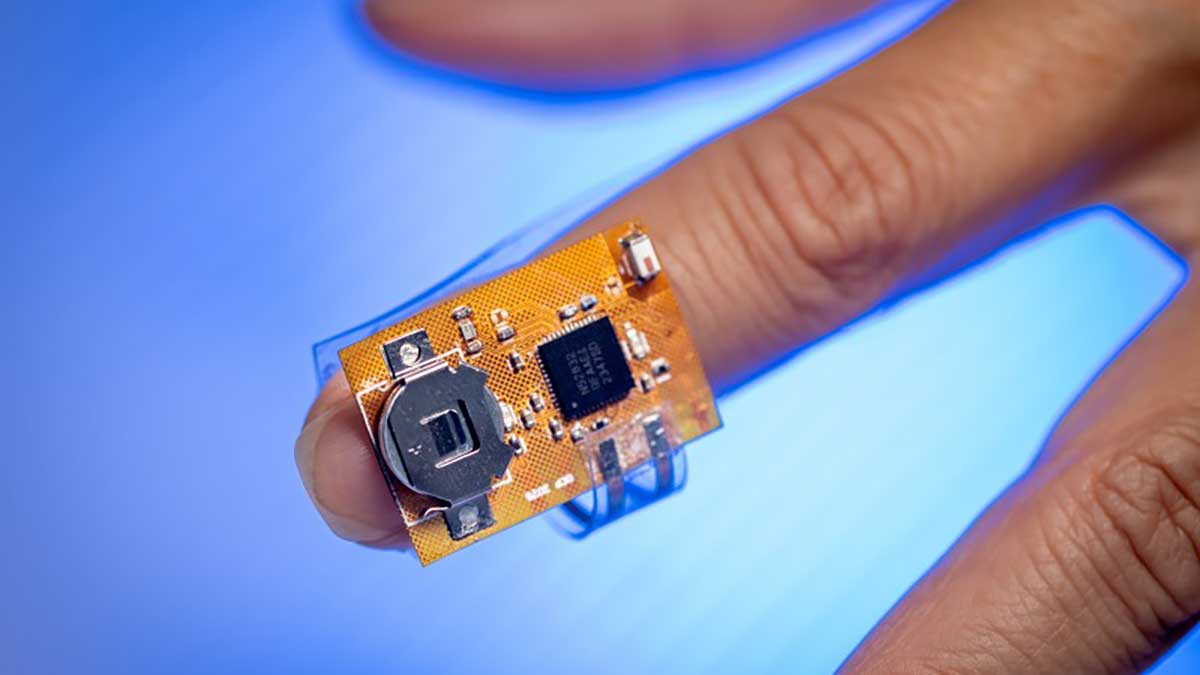
Researchers at the University of California San Diego have developed a battery-free wearable sensor that continuously monitors Parkinson’s disease medication levels through a patient’s sweat, highlighting the growing role of self-powered wearable technologies in connected healthcare.
The fingertip patch measures concentrations of levodopa — the primary drug used to manage Parkinson’s symptoms — by generating a small electrical signal from a chemical reaction between enzymes embedded in the sensor and the medication present in sweat. Because the reaction also powers the device, the patch requires no battery or external power source.
The research, published in Proceedings of the National Academy of Sciences, demonstrated that the wearable produced measurements comparable with conventional laboratory blood tests while providing continuous monitoring in real time.
Unlike traditional blood sampling, the flexible patch is worn on the fingertip, where sweat glands are particularly dense. A specialised absorbent hydrogel draws sweat from the skin before enzymes convert the presence of levodopa into a measurable electrical signal, allowing the device to function as both sensor and power source.
The work reflects a broader trend in IoT-enabled healthcare towards autonomous wearable devices that combine sensing, energy harvesting and wireless connectivity to enable continuous monitoring outside clinical settings.
Researchers tested the patch on healthy volunteers and people with Parkinson’s disease, finding that the wearable accurately tracked changing drug concentrations over time. The study also showed that patients with Parkinson’s cleared levodopa more quickly than healthy participants, helping explain why symptoms can fluctuate rapidly between doses.
The team says the technology could eventually be integrated into a closed-loop therapeutic system in which continuous drug monitoring is linked to an automated drug delivery pump, enabling medication to be adjusted in response to the patient’s needs.
The research was led by Tamoghna Saha, Joseph Wang and Irene Litvan at the University of California San Diego as part of a long-running collaboration on wearable sensors for Parkinson’s care.
There’s plenty of other editorial on our sister site, Electronic Specifier! Or you can always join in the conversation by commenting below or visiting our LinkedIn page.