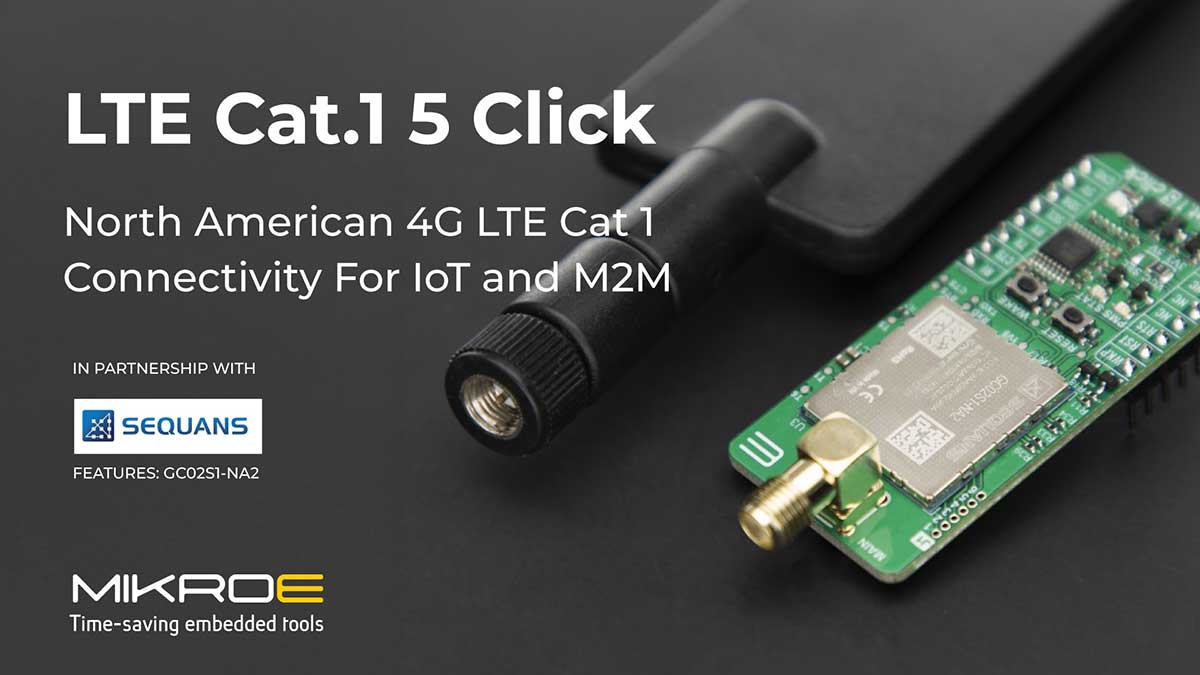
Embedded solutions specialist MIKROE has launched a new development board designed to help device makers add LTE Cat 1 bis connectivity to IoT applications across Europe as operators continue to retire legacy 2G and 3G networks.
The company’s LTE Cat.1 5 Click board is based on the GC02S1-EU2 cellular module from Sequans and supports 4G LTE Cat 1 bis connectivity for applications requiring reliable data transmission, low power consumption, and broad network availability.
The launch comes as demand grows for cellular technologies that can bridge the gap between low-bandwidth IoT standards such as NB-IoT and LTE-M, and more capable broadband cellular connections.
LTE Cat 1 bis has emerged as an increasingly attractive option for smart meters, industrial monitoring systems, payment terminals, security devices, and asset tracking applications, particularly in regions where older mobile networks are being phased out.
According to MIKROE, the board has been designed for European deployments and supports LTE bands B1, B3, B8, B20, and B28, enabling operation across frequencies commonly used by operators throughout the region. The module delivers download speeds of up to 10Mbps and upload speeds of up to 5Mbps.
Nebojsa Matic, Chief Executive Officer of MIKROE, said the technology was well suited to utility metering, industrial sensing, security systems, payment infrastructure, asset tracking, smart home devices, and wearable applications.
“Reliable and energy-efficient cellular connectivity remains a key requirement for a wide range of IoT deployments,” he said. “This board gives developers a straightforward route to integrating LTE Cat 1 bis communications into new products and proof-of-concept projects.”
At the heart of the board is Sequans’ GC02S1-EU2 module, which complies with 3GPP LTE Release 14 standards and incorporates the company’s Calliope 2 chip platform.
The board forms part of MIKROE’s broader ecosystem of Click add-on boards, which are designed to accelerate embedded development by providing standardised hardware and software building blocks. The company said developers can access supporting code libraries through its mikroSDK framework and implementation examples via its EmbeddedWiki platform.
There’s plenty of other editorial on our sister site, Electronic Specifier! Or you can always join in the conversation by visiting our LinkedIn page.