
By Ryan Carlson, Technology Evangelist at Soracom
IoT has a pilot problem no one wants to talk about. Not the technology kind. The kind where a perfectly good proof of concept sits in a slide deck for two years, gets re-pitched as a “Phase 2 initiative,” and quietly dies when the champion leaves the company.
We’ve gotten remarkably good at building 90-day demos that prove something works. We are terrible at proving something is worth doing.
The difference matters more than the industry admits.
The gap nobody planned
When an IoT pilot stalls, the autopsy usually blames the technology. Connectivity was unreliable. Integration was harder than expected. The hardware didn’t perform in the field. These are real problems. They’re also rarely the fatal ones.
The fatal ones are quieter. Buyers who approved the pilot can’t articulate the ROI to their leadership. Users who were never consulted don’t see how the solution fits their workflow. Operations teams discover they now own a fleet of SIMs and data pipelines nobody budgeted a person to manage. IT kills the project over security concerns that should have surfaced in week one, not month nine. Sales can’t explain the value. Distributors think the non-connected version worked fine.
Technology is almost never the bottleneck. The bottleneck is that nobody validated whether this connected deployment should exist before they started building it. The sensors work. The connectivity is proven. What’s missing is the organisational readiness to operate it.
Four questions that determine everything
Every IoT project, whether it’s an enterprise deploying sensors across 200 facilities or a startup shipping its first connected product, lives or dies on four dimensions of readiness.
Technology: Why does it work? The answer determines impact. Without a clear mechanism for delivering value, you’ve built something impressive that nobody needs.
Market: Why is there value? This is where most teams get it wrong. You have buyers calculating cost savings and ROI. End users evaluate whether the connected devices make their daily jobs easier. A maintenance technician using predictive maintenance alerts, a floor nurse tracking connected medical equipment, a field engineer diagnosing remote device failures. Buyers sign checks and approve deployments. Users determine whether the thing actually gets used.
Business: Why will they buy it? Price has to match the value of solving the problem. Plenty of pilots have worked perfectly, users loved them, and the project died because the cost couldn’t be justified against the status quo.
Organisation: Can we build and sustain it? Not just the initial build. The support infrastructure, the operational tooling, the cross-functional coordination required to keep a connected product alive in the field.
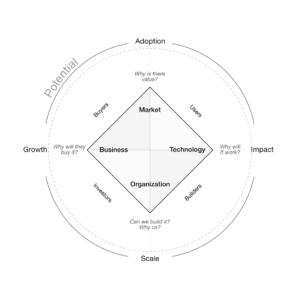
These dimensions are in direct tension. A lack of organisational scale undermines market adoption. A lack of technology impact undermines business growth. The readiness diamond isn’t a checklist. It’s a tension map.
The validation phase everyone skips
Here’s what happens constantly. Teams go from exploring an idea straight to building a plan, hiring engineers, and running an IoT pilot. They skip the step that determines whether any of this is worth the investment.
That step is validation. And it has two sides that need to run in parallel. The technology side is the proof of concept. Most teams get this one. Build a prototype, test the integration, prove the hardware works. Standard practice.
The business side is the proof of viability/value (PoV). Almost nobody does this well. A proof of viability is field research. It’s documenting the value chain of downstream implications. If you’re adding a remote monitoring sensor to predict motor failure, what does the maintenance tech’s current inspection cadence look like? How much time does eliminating a bi-monthly physical inspection actually save? Does a quarterly compliance report still require manual data entry because you skipped an integration? Can you quantify the labour savings, or are you guessing?
Proof of viability answers the questions buyers need: What are the alternatives? What’s the cost of doing nothing? Is this solving a problem that’s urgent enough and pervasive enough that customers will pay to fix it? For enterprises, it’s the ROI case for deploying and scaling connected systems. For product companies, it’s market validation that the IoT solution delivers measurable operational value. Without it, you’re running a pilot of connected devices and workflows on faith.
When both tracks run together, what you learn in the POC informs the business case, and what you learn in the market informs the engineering priorities. When they don’t, you get one of two outcomes: a solution looking for a problem, or vaporware that generates excitement and erodes trust in equal measure.
Where AI fits (and where it doesn’t)
AI is genuinely useful in the first three phases of the project lifecycle. IoT projects, from first sensor prototype to fleet-wide rollout, move through four stages: exploration, validation, acceleration, and commercialisation. That last phase is where teams go to market or roll out across the enterprise.
AI’s impact is strongest before you get there. Deep research tools can map market conditions and competitive landscapes in hours instead of weeks. AI-assisted prototyping has made the proof-of- concept stage almost trivially fast. The ability to put a working clickable mock up in front of a potential customer, collect feedback, and iterate the same day collapses the ideation loop between POC and market validation.
That speed is a gift and a hazard. An over-reliance on AI-generated code becomes a liability the moment a customer pilot has real stakes, especially in firmware and Edge computing where bugs aren’t fixed with a server-side patch. QA and code audits are serious steps where AI can assist but not substitute. And integrating AI into the product itself requires the same rigour as any other feature. The market is flooded with “Powered by AI” applications that are hard to differentiate. If the AI component isn’t solving a specific, validated problem, it’s just another feature that overpromises.
The more interesting application is using AI to strengthen the validation work most teams skip. Record user interviews and extract insights. Generate custom dashboards to elicit stakeholder feedback. Estimate the actual operational costs of running models in production. On a factory floor, different PLC models on the same production line often output sensor data in incompatible formats. AI can normalise that data across equipment models during validation, proving the integration is viable before a pilot stakes its credibility on it. AI as a research partner, a junior analyst, a rapid prototyping engine. Used this way, it helps small teams close gaps in knowledge, capabilities, and bandwidth.
The currency that actually matters
Every pilot is a trust exercise. The technology has to work. But the business case has to hold, the users have to believe in it, and the organization has to be ready to sustain connected operations at scale. Trust is the currency that fuels adoption, drives growth, and creates the opportunity to scale IoT deployments across the business. You don’t earn it with a demo of connected devices or dashboards. You earn it by doing the validation work before you build the plan.
Author biography:

Ryan Carlson is Technology Evangelist at Soracom, a company specialising in Cloud-native cellular connectivity for IoT applications. Ryan has helped pioneer connected products in energy, healthcare, transportation, and commercial services as a product owner, solutions architect, researcher, and principal IoT consultant. He has first-hand experience in product design, health data interoperability, user research, IoT corporate strategy, and overseeing product development and go-to-market strategies.