
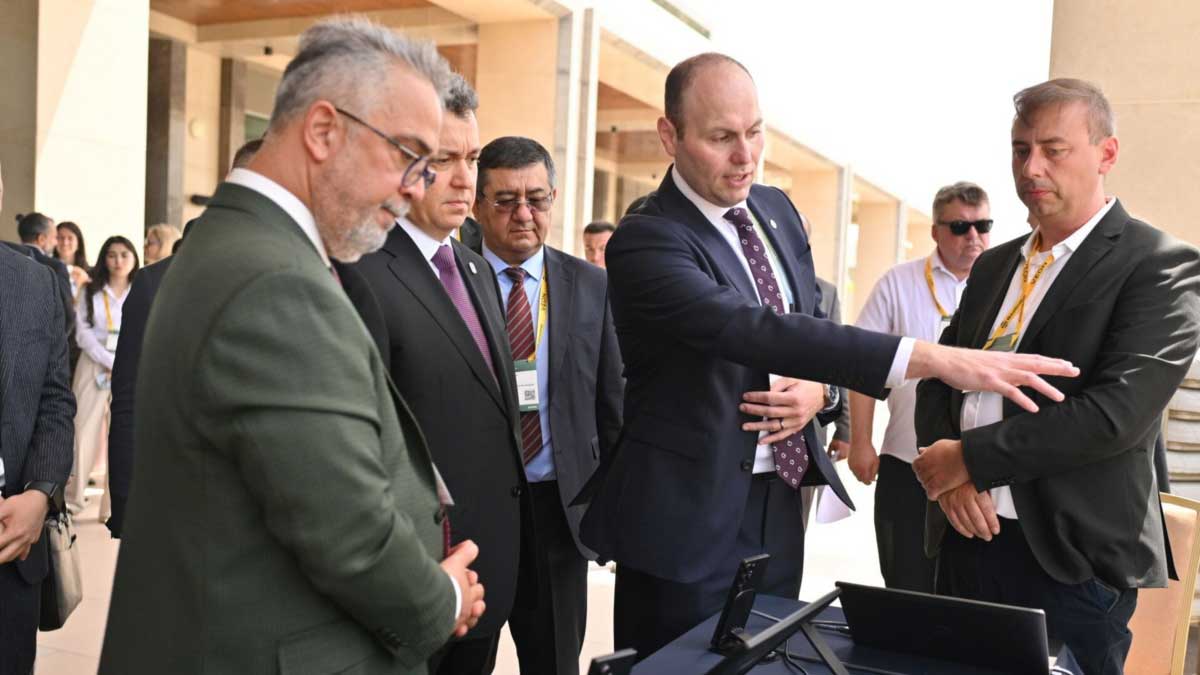
Satellite communications company Viasat has completed what it says is the first in-country direct-to-device (D2D) satellite connectivity demonstration in Uzbekistan, highlighting the growing role non-terrestrial networks could play in extending industrial IoT coverage across remote regions.
The demonstration, carried out during the GSMA M360 Eurasia event in Samarkand, was conducted in partnership with the Ministry of Digital Technologies of the Republic of Uzbekistan, satellite broadband provider UZ-SAT, and telecom operator Uztelecom.
Using commercially available Android smartphones, the trial showcased application-based messaging delivered over Viasat’s L-band satellite network using 3GPP non-terrestrial network (NTN) standards. One device connected via satellite through a companion device, while the other remained on a terrestrial cellular network.
The company said the trial demonstrates how satellites could help extend connectivity to industrial assets, vehicles, and IoT devices operating beyond the reach of conventional mobile infrastructure.
D2D connectivity is emerging as a key development within the wider NTN ecosystem, allowing standard mobile and IoT devices to connect directly to satellite services without requiring dedicated satellite terminals. Industry interest has accelerated as operators and equipment manufacturers move to support 3GPP NTN standards across mobile and industrial applications.
For industrial IoT deployments, the technology could help address longstanding connectivity gaps in sectors such as mining, logistics, agriculture, energy, and transport, where infrastructure limitations continue to restrict digital transformation initiatives.
Uzbekistan has announced plans to launch 228 industrial projects worth approximately €13bn by 2026 as part of a broader strategy to increase national GDP to between €220bn and €230bn by 2030. The country’s focus on industrial modernisation is expected to increase demand for resilient communications infrastructure capable of supporting remote monitoring, predictive maintenance, fleet management, and connected operations.
“Through standards-based satellite connectivity, we can bring connectivity to millions more devices in areas currently underserved by cellular networks, with benefits for safety, sustainability and efficiency,” said Sandeep Moorthy.
Viasat said its approach uses existing mobile satellite services spectrum and satellite infrastructure, enabling mobile operators to introduce NTN services without reallocating terrestrial spectrum or creating interference with cellular networks.
The company has been expanding its NTN activities through a series of D2D demonstrations across India, the Middle East, Brazil, and Mexico, while also pursuing satellite connectivity partnerships in the automotive sector.
Earlier this year, Viasat announced plans to work with UAE-based SpaceTech company Space42 to establish a jointly owned venture called Equatys, focused on developing global D2D services and evolving existing mobile satellite services towards 5G-compatible NTN architectures.
As satellite and terrestrial networks continue to converge, operators are increasingly positioning NTN-enabled IoT connectivity as a way to support industrial digitisation in regions where traditional infrastructure deployment remains commercially or geographically challenging.
There’s plenty of other editorial on our sister site, Electronic Specifier! Or you can always join in the conversation by commenting below or visiting our LinkedIn page.