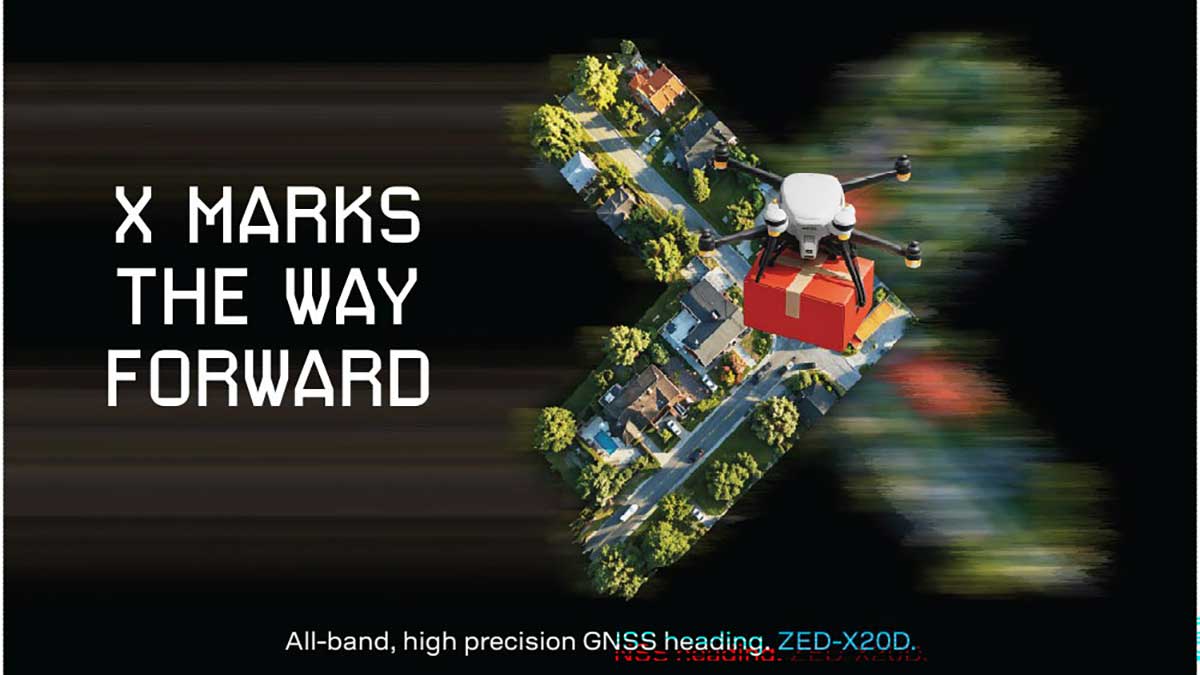
Swiss positioning technology group u-blox has launched a new high-precision navigation module in the United States, targeting fast-growing autonomy markets including drones, robotics, and precision agriculture.
The company said its ZED-X20D module is designed to deliver centimetre-level positioning alongside “motion-independent” GNSS heading, addressing a long-standing challenge in autonomous systems where small directional errors can accumulate into significant drift over distance.
“With the introduction of the ZED-X20D to the U.S. market, we are redefining what high precision GNSS means for autonomous systems,” said Andreas Thiel, Co-Chief Executive of u-blox. “It is no longer just about knowing where a machine is, but also exactly where it is pointing.”
He added: “By making heading directly observable, we are solving one of the most critical challenges in drones, robotics, and precision agriculture – eliminating drift and enabling reliable autonomy at scale.”
The ZED-X20D uses a dual-antenna architecture and supports all major GNSS constellations across multiple frequency bands, including L1, L2, L5 and L6, as well as L-band services.
According to u-blox, this “all band on both antennas” approach is intended to improve heading stability and resilience in challenging signal environments.
The module is aimed at applications such as unmanned aerial vehicles, including delivery and agricultural drones, autonomous agricultural machinery with auto-steering systems, marine navigation, and industrial robotics.
u-blox said the device supports a range of correction services, including RTK, PPP-RTK and PPP, and can be paired with its PointPerfect service, alongside Galileo’s High Accuracy Service, to deliver global or regional positioning support.
Security features have also been emphasised, with the company highlighting secure boot, signed firmware, hardware-based key storage, and support for Galileo OSNMA authentication.
It also claims the system incorporates interference monitoring and multi-band diversity to mitigate jamming and spoofing risks. The ZED-X20D is designed to be compatible with existing u-blox form factors, including earlier ZED-series modules, in an effort to simplify upgrades for existing customers.
Engineering samples are expected to be available from the second quarter of 2026, with an evaluation board already in circulation.
There’s plenty of other editorial on our sister site, Electronic Specifier! Or you can always join in the conversation by visiting our LinkedIn page.