Amid declining traditional car revenues, Tesla this week signalled a dramatic transformation: from an electric vehicle manufacturer to a networked ecosystem of autonomous vehicles, humanoid robots, energy assets, and AI-driven services.
The company’s Q4 2025 earnings call provided a front-row view of this shift, with Elon Musk, CFO Vaibhav Taneja, and other executives outlining a vision where Tesla operates as much as an IoT specialist as it does an automaker.
Tesla’s financial results reflect the tension of this transition. Annual revenue fell 3% in 2025, while quarterly profits plunged 61%. The Model S and Model X are being retired, marking an end to legacy, low-volume lines in favour of high-volume vehicles like the Model 3 and Y, as well as Tesla’s autonomous fleet initiatives.
“It’s time to basically bring the Model S and X programs to an end with an honourable discharge because we’re really moving into a future that is based on autonomy,” Musk told investors. “If you’re interested in buying a Model S and X, now would be the time to order it because we expect to wind down S and X production next quarter and basically stop production.”
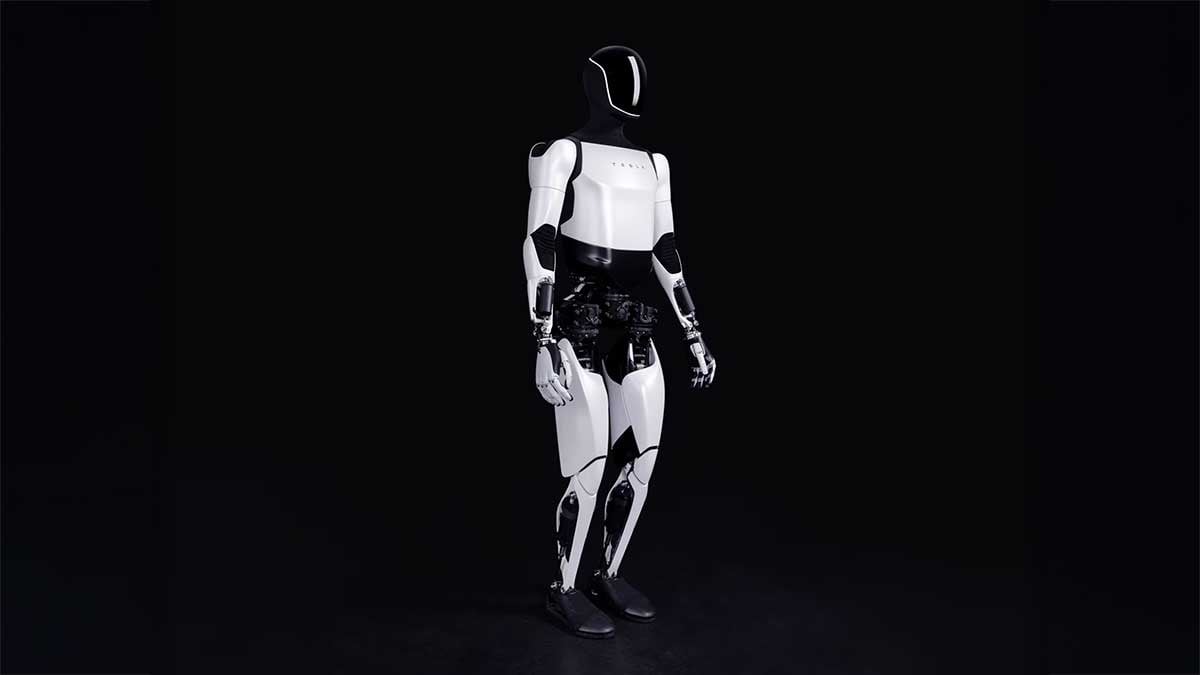
The transition goes far beyond cars. Tesla announced that its Fremont factory, which produced the S and X, will become a hub for Optimus humanoid robots.
Musk set a target of one million units per year: “Because it is a completely new supply chain, it’s just — there’s really nothing from the existing supply chain that exists in Optimus. Everything is designed from physics first principles,” he said.
“[It is a] general-purpose robot that can learn by observing human behaviour, so you can demonstrate a task or verbally describe a task or show it a task, even show it a video and it will be able to do that task.”
Early deployment of Optimus is already underway, though Musk cautioned that material production won’t scale until the end of the year.
Under Musk’s plans, each robot will become a connected, data-generating node, learning from humans and feeding information back to Tesla’s AI systems via its AI chatbot.
“If you’re managing a large team of Optimus robots to build a factory or build a refinery… you need… an orchestra conductor,” Musk said. “And so then Grok would be kind of the orchestra conductor for the Optimus robots to build that — hypothetically — and it might not be hypothetical in the future.”
This orchestration of robots and vehicles sits squarely within an IoT framework.
Tesla’s autonomous vehicles are another component. During the call, Musk pointed out that fully unsupervised rides are already underway in Austin.
“It is 100% unsupervised and FSD is 100% unsupervised — I mean, we obviously have cars operating with no one in them and no safety monitor and no follow car or anything like that in Austin right now,” he said.
Musk said he expected dozens of major cities to have autonomous vehicles by year-end, pending regulatory approval. He predicted that “probably less than 5% of miles driven will be where somebody is actually driving the car themselves in the future, maybe as low as 1%.”
Tesla’s approach treats each vehicle as an IoT node: constantly collecting data, improving software, and generating revenue through a shared fleet model.
“[It’s] an opportunity for a lot of customers to earn more by lending their car to the fleet than their lease cost to Tesla… it’s quite a good scenario,” Musk added.
During the call, Lars Moravy, Vice President of Vehicle Engineering, was equally bullish about the scale of the opportunity: “We would expect over time to make far more Cybercabs than all of our other vehicles combined… 90% of distance being travelled is 1 or 2 people… so it would mean that long-term Cybercab — we would make several times more Cybercabs per year than all of our other vehicles combined.”
Tesla’s IoT pivot also extends to energy. The company is connecting energy generation, storage, and consumption into a software-optimised network — essentially, an IoT energy ecosystem.
Tesla Energy revenue reached $12.8 billion in 2025, up 26.6% year-on-year, driven by the company’s high-density utility-scale lithium-ion battery energy storage system (BESS) Megapack and rechargeable home battery system Powerwall.
“The solar opportunity is underestimated,” Musk added. “We think the best way to add significant capability to the grid is… solar and batteries on Earth and solar in space. So that’s why we’re going to work towards getting 100 gigawatts a year of solar cell production integrating across the entire supply chain from raw materials all the way to finished solar panels.”
Crucial to this ecosystem is Tesla’s focus on AI and chip design. Musk said he personally oversees the AI5 and AI6 chip projects, dedicating Saturdays and a portion of Tuesdays to their development. “Completing the AI5 chip design… is arguably the number one most critical thing to get done,” he said. “If Optimus is completely useless without an AI chip… it’s not like the cars we can put steering wheels and pedals in… Optimus won’t even be able to… sit there without an AI chip.”
The company said it is even contemplating its own domestic chip fabrication facility, or “Terafab,” to mitigate geopolitical risk and secure memory and logic for future AI workloads.
“If we don’t do the Tesla Terafab, we’re going to be limited by supplier output of chips,” Musk said. “And maybe memory is an even bigger limiter than AI logic… currently there are no advanced memory fabs at scale in the United States. They are zero, literally zero.”
Autonomy and robotics are tightly linked to Tesla’s revenue strategy. Tesla is redefining the traditional car business as a software-centric, IoT-driven service.
As Taneja explained, the company is transitioning FSD to a subscription model, which may initially reduce margins, but ultimately transforms vehicles into recurring-revenue platforms. “Transportation, as we know, is changing… autonomy software will be the driver for growth from now,” he said.
And with competition from China increasing, the company says that these are things it needs to do just to stay ahead. “All this comes out of necessity. It’s not that we want to do it. It’s just we have no choice,” Taneja told investors.
There’s plenty of other editorial on our sister site, Electronic Specifier! Or you can always join in the conversation by visiting our LinkedIn page.