NXP Semiconductors is seeking to reduce the time and complexity involved in developing autonomous robots with a new hardware and software platform that brings together artificial intelligence, motor control, connectivity and security.
The Dutch semiconductor group unveiled its unified robotics platform at electronica 2026, positioning it as a way for developers to move from evaluating individual components to building complete robotic systems without having to integrate and validate each subsystem independently.
While much of the attention surrounding autonomous robotics has focused on increasingly powerful AI processors, NXP says the practical challenge is coordinating those processors with sensors, communications, power management and real-time control
systems.
According to NXP, this integration work can take months, slowing development and making it harder for robotics companies to bring new designs to market. Its platform aims to reduce that process through pre-integrated software, validated hardware
subsystems and a common development environment.
The underlying problem, according to Vincent Largadelle, Global Robotics & Drone Marketing Manager at NXP Semiconductors, is that many robotics developers are primarily software engineers who do not necessarily want to spend time navigating complex hardware architectures.
“People we have in front of us, they are software people. So you need to speak their language first,” he told IoT Insider.
Rather than introduce a proprietary software environment, NXP has built its robotics software development kit (SDK) around established open-source frameworks, including PX4, ROS 2 and Zephyr. The intention is to give developers familiar tools while reducing the work involved in integrating them with the underlying hardware.
The SDK brings together drivers, middleware integrations, reference applications and reusable software components. Crucially, NXP says it will maintain and update the environment as the wider open-source ecosystem evolves, rather than simply releasing a collection of validated software once.
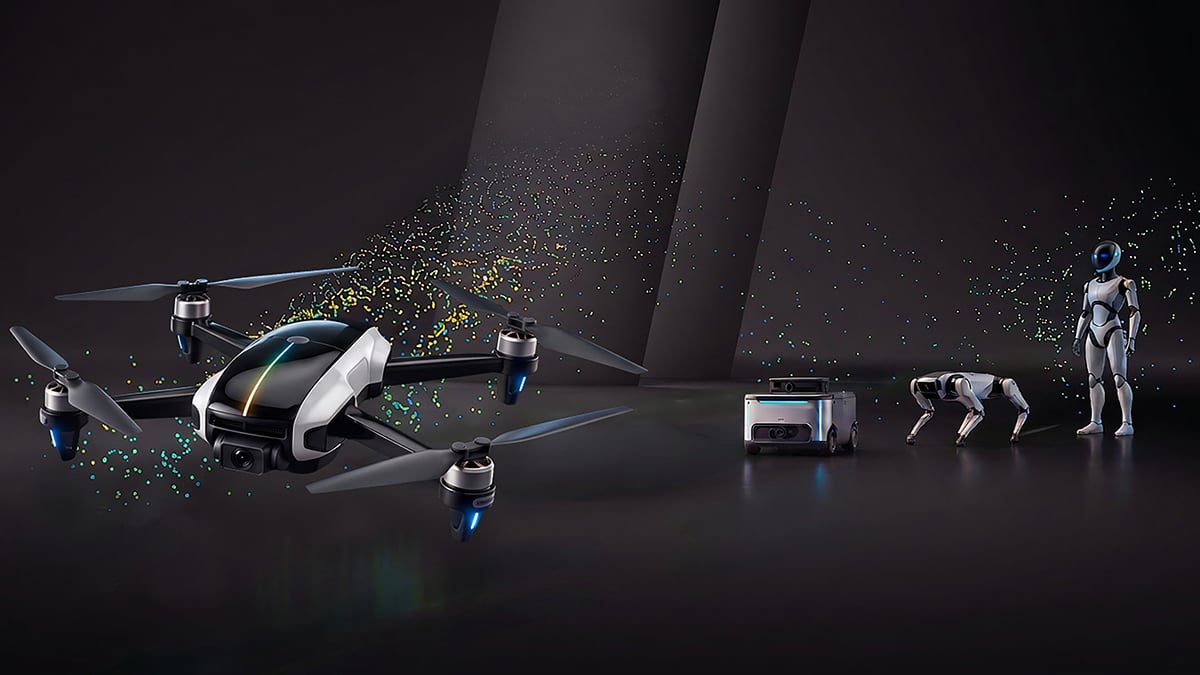
Drones are the first application targeted by the platform, although NXP says the wider architecture is intended to support autonomous mobile robots (AMRs), service robots and humanoid systems. Its initial drone reference designs combine several NXP processors to handle different functions, including autonomous computing, flight management, sensor networking
and motor control.
The company says developers can get individual drone functions running in less than 30 minutes using the reference designs and supporting SDK. However, Largadelle said the 30-minute figure refers to enabling individual functions, such as
motor control, using pre-existing software binaries and hardware. Developers still need to integrate these into their own aircraft, with the overall development time depending on the complexity of the application and whether a mechanical platform is already available.
“If you get your mechanical stuff already available, in a couple of days or weeks, depending on what they want to integrate and the level of complexity,” he said.
Security is another area NXP is seeking to address as autonomous machines become increasingly connected and operate beyond controlled environments.
Largadelle said the company’s approach combines functional safety and cybersecurity, including security capabilities integrated into its processors and dedicated secure elements for functions such as authentication and device protection.
He argued that the two disciplines cannot be treated independently. “There is no safety without security, and no security without safety,” he said.
However, protecting individual components is only part of the challenge. Autonomous systems must also maintain predictable behaviour when communications are interrupted or external inputs become unavailable.
NXP’s neural axis architecture is intended to reduce dependence on external connectivity by distributing processing and control across the machine itself. Largadelle said that, in a drone, onboard cameras, previously uploaded maps and AI processing could help maintain localisation if communication with the ground is lost.
What happens next, however, depends on how the customer has programmed the aircraft and the purpose of its mission. A drone might be configured to return to its starting point, identify a suitable landing location or continue a particular task.
“It really depends on the type and size of the drone and its payload,” Largadelle said. “So, it really depends on the algorithms inputted by the customer, the purpose of the mission and of course the legislation where it is flying. We have all the building block, and the customers can really work on the use case.”