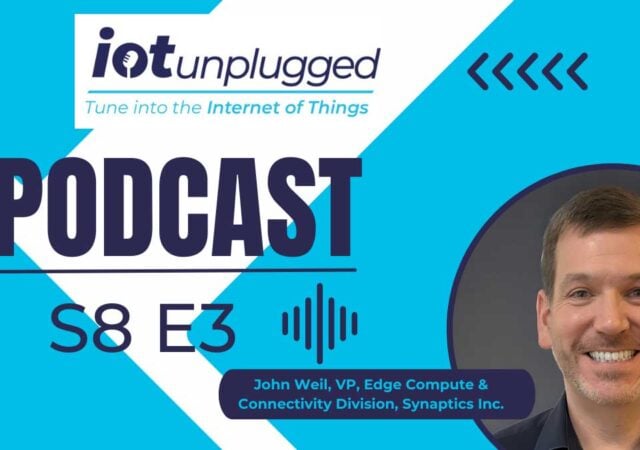
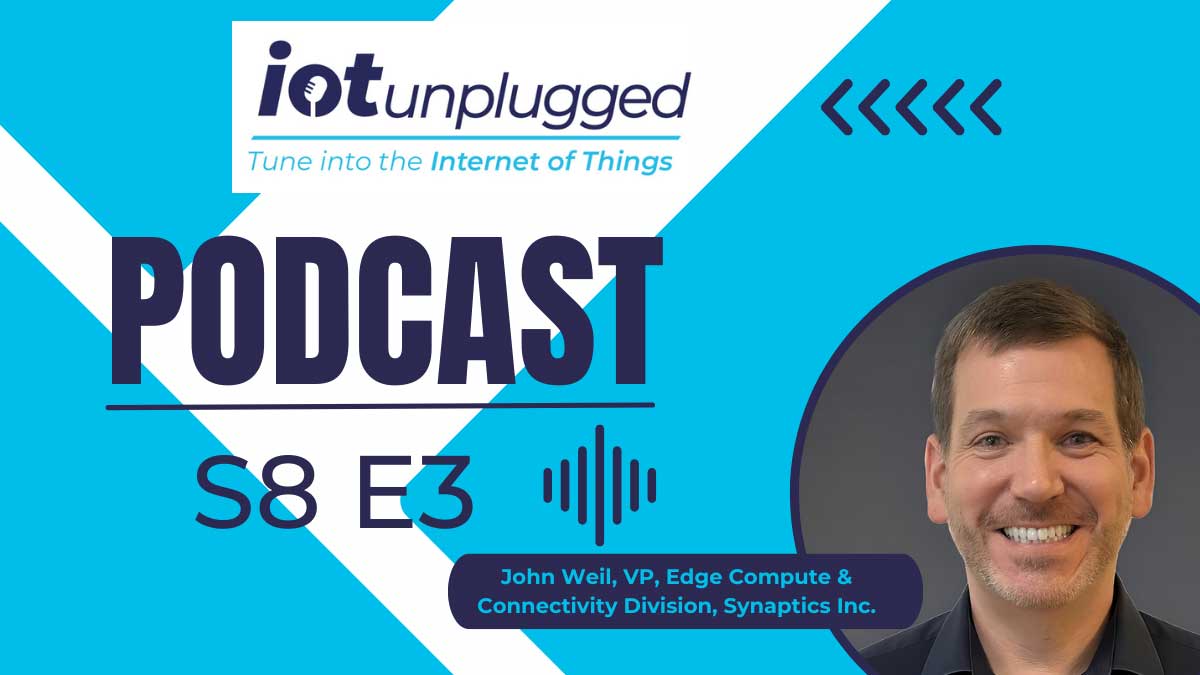
In this episode of IoT Unplugged, John Weil, Vice President of the Edge Compute and Connectivity Division at Synaptics, argues that physical AI represents the next major evolution of the Internet of Things, enabling connected devices to perceive their surroundings, make decisions locally, and interact with the physical world without relying on constant Cloud connectivity.
Weil says recent advances in AI models and Edge computing have brought the technology to a tipping point, making it practical to embed sophisticated AI capabilities into everyday products and industrial equipment.
According to Weil, physical AI builds on the progress made by generative AI by combining Edge AI with sensor data, allowing devices not only to process information but also to understand and respond to real-world environments.
“It’s one thing to bring a chatbot to the Edge,” Weil said. “The next step is enabling that chatbot to interact with the physical world and make localised decisions.”
That shift, he argues, fundamentally changes the role of IoT.
For years, connected devices have primarily collected data, sent it to the Cloud, and waited for instructions in return. Physical AI moves intelligence directly onto the device, allowing it to analyse information and make decisions in real time.
“My favourite line is that it makes IoT finally work,” Weil said. “Before, IoT was a data collection concept. Now we’re making the device intelligent.”
Running AI models locally also brings practical advantages. Weil says Edge-based processing improves response times, reduces Cloud computing costs, and enhances privacy by limiting the amount of personal or operational data transmitted to remote servers.
“If we can do it at the Edge, there’s less need to share your environment with a data service provider,” he said. “You improve latency, improve privacy, and reduce Cloud costs.”
While the Cloud will continue to play an important role for accessing external information or handling large-scale AI workloads, Weil believes many common applications can already run entirely on embedded processors.
Consumer products are among the first examples. He describes appliances that users can converse with naturally, from coffee machines that remember individual preferences to dishwashers capable of explaining why they failed to complete a cycle and guiding owners through simple maintenance tasks.
Rather than displaying an obscure error code, an AI-enabled appliance could explain that its filter needs cleaning and provide step-by-step instructions.
Industrial applications, however, may prove even more significant.
Weil believes robotics will be one of the earliest sectors transformed by physical AI, allowing autonomous mobile robots to make local decisions inside factories and warehouses without relying on continuous communication with central control systems.
He also points to healthcare, where intelligent medical devices could guide patients through diagnostic procedures at home while analysing data locally before passing relevant information to clinicians.
Despite concerns around cybersecurity, Weil argues that moving intelligence onto devices can actually reduce risk by limiting continuous internet connectivity. He says the industry’s focus is increasingly shifting towards protecting the AI models themselves from manipulation.
“The new threat envelope is how you secure the models,” he said. “If someone can manipulate the model, they may be able to push it outside its guardrails.”
Looking ahead, Weil predicts physical AI will significantly change industrial automation over the next five years.
Drawing on his own experience developing factory robots earlier in his career, he expects future machines to move beyond simply following programmed instructions to continuously adapting manufacturing processes in real time.
Rather than merely detecting production drift, he believes robots will automatically compensate for changes, using cameras, touch sensors and AI to improve precision and dexterity while working safely alongside human operators.
“I think collaborative robots are inside five years,” Weil said. “The next five years are going to be fun.”
To hear more about what they had to say, listen on Spotify, Apple Podcasts, and at the link below.