Digital transformation is affecting sectors as diverse as manufacturing, retail, smart cities, smart homes, transportation, logistics, utilities, healthcare, and public safety.
The integration of technologies such as AI, Cloud computing, and IoT is changing the way companies and organisations operate and deliver value.
The aim of digital transformation is to increase efficiency and competitiveness by making systems more flexible and quicker to adapt to new requirements.
However, rapidly changing markets can be a double-edged sword: new business opportunities arise quickly, but if you are not ready to service those needs with a new product or service, then that window of opportunity will close equally quickly, or be seized by another provider. Time to market has never been more crucial.
At the same time, the embedded AI market is expanding rapidly as AI becomes integrated into Edge devices and IoT applications.
The IoT is one of the key drivers of this trend, as devices need high-performance capabilities to handle and interpret data at the Edge in real time.
Edge AI enables real-time local decision-making without the latency associated with Cloud processing. This is especially important for IoT systems, where devices often need to analyse data and respond instantly.
New AI-powered applications
There are many different use cases.
In IIoT (Industry 4.0) manufacturing, AI can help deliver predictive maintenance programmes by analysing data from vibration, sound, and temperature sensors to detect changes and abnormalities, which can be a warning that a machine is entering a failure condition.
AI also improves robotics through route planning, collision avoidance, and robotic arm path optimisation, maximising the benefits of robotics and Autonomous Mobile Robots (AMRs). On production lines, vision systems equipped with AI can detect manufacturing errors at high speeds.
Advanced Driver Assistance Systems (ADAS) systems often rely on AI to process LiDAR, radar, and camera signals for lane-keeping, emergency braking, and object recognition, and in-cabin cameras can monitor drivers’ facial expressions to detect drowsiness. Edge AI cameras in smart cities can be used to ease traffic flow by adjusting traffic signals in real time.
In the smart home, there are many emerging applications for AI, including motion detection surveillance systems that distinguish between animals, vehicles, or humans, thus reducing false alerts.
Smart applications and environmental systems increasingly use AI to understand user behaviour and optimise energy consumption.
The medical industry is another application where AI is being locally employed. Wearable patient monitoring systems track vital signs (ECG, heart rate, heart rate variability) for conditions such as arrhythmias or falls, sending alerts to healthcare personnel. Handheld, AI-powered ultrasound scanners and imaging devices are used to help clinicians analyse images and detect patterns without needing experienced, trained operators.
On the farm, AI-equipped drones and IoT sensors monitor soil conditions, moisture levels, crop health, and pest activity, automating irrigation and fertiliser use to increase yields.
In logistics systems, intelligent asset trackers monitor high-value or fragile items, triggering alerts if temperature, vibration, or other environmental conditions cross defined thresholds.
These examples highlight both the diversity of AI-powered IoT applications and a key challenge: many new products are being conceived by industry specialists rather than embedded systems experts. Combine this inexperience in electronics design with extreme time-to-market pressure and the challenges become obvious.
Enter the smart AI module
Even for experienced designers, combining all the functionality required to implement a successful AI-powered design is a complex process, which potentially requires many iterations as changes in product specification are demanded.
One way to shortcut the process is to employ modules that wrap up all the hardware development and regulatory certification issues, and which use readily available, industry-standard software.
SIMCom has more than 20 years of experience in IoT modules and wireless communication technologies. Now the company has turned its attention to providing smart AI modules that give engineers a head start in designing imaging applications.
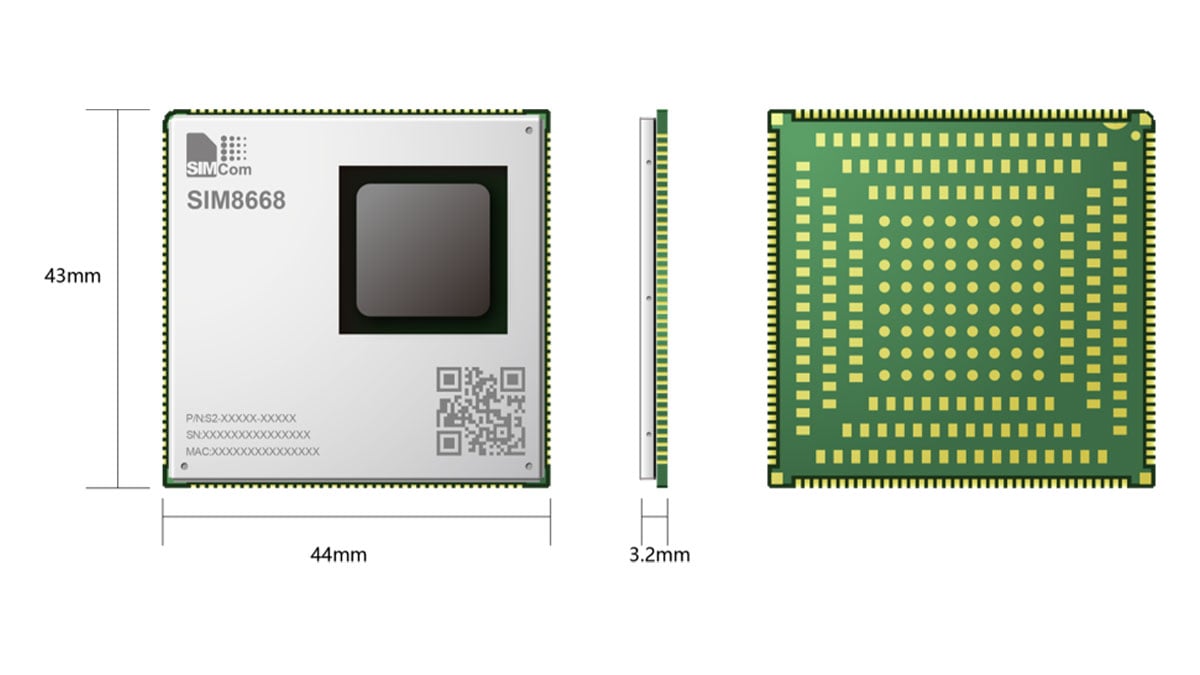
Recently, SIMCom has introduced two new modules that incorporate an AI core, MCU, and Wi-Fi/Bluetooth connectivity in one compact 43 × 44 × 3.2 mm module.
The SIM8666 and SIM8668 modules integrate AI processing, connectivity, and multimedia support into a compact platform designed to accelerate Edge AI development.
By integrating processing, connectivity, multimedia, and AI acceleration into a single platform, the modules allow developers to reduce complexity, shorten development cycles, and bring new Edge AI products to market more quickly.

Written by: Mads Fischer is European Sales Director at SIMCom
This article originally appeared in the May 2026 magazine issue of IoT Insider.