
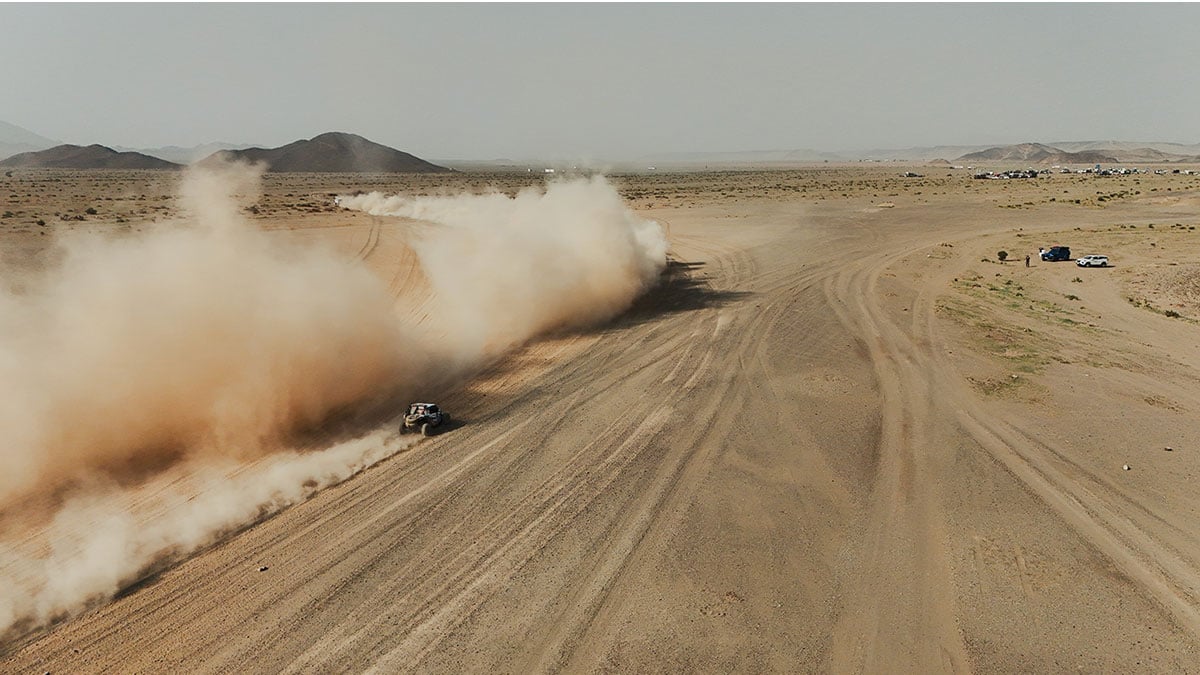
In the Saudi Arabian desert, Wialon transformed a Dakar-inspired off-road challenge into a live stress test for fleet IoT infrastructure. Darya Chumak, Head of Partner Success at Wialon, who took part in the challenge, explains how combining GSM, satellite telemetry, geofencing, and API-driven automation, the deployment demonstrated how modern fleet platforms can maintain resilient, real-time operations across extreme terrain, unreliable connectivity, and complex multi-tenant environments.
In January 2026, Wialon deployed its fleet management platform in one of its most demanding real-world environments to date: a multi-day off-road challenge across the Saudi Arabian desert inspired by the Dakar Rally.
The Dakar Rally, is an annual off-road endurance event, widely regarded as the world’s toughest motorsport competition as it crosses remote and hostile terrain much tougher than conventional rallying. Driver fatigue, and the rough terrain frequently result in accidents and serious injuries.
The event began in 1978 as a rally from Paris, France, to Dakar, Senegal, but since 2020, has been held in Saudi Arabia.
 The Wialon Challenge Dakar, in which crews navigated their own off-road vehicles across 1,900 km of vast Arabian desert, was inspired by Wialon’s involvement in the rally itself, as our platform tracked the support vehicle of the Gurtam Toyota Gazoo Racing Baltics Team, led by Dakar Ultimate class driver Benediktas Vanagas.
It was not designed as a demonstration or simulation. Instead, it functioned as a live operational stress test of a full-stack fleet IoT architecture combining GSM and satellite telemetry, multi-tenant account structures, event-driven geofencing logic, and API-based automation.
The environment introduced all the constraints typical of remote fleet operations, including intermittent connectivity, high-vibration conditions, and the absence of fixed infrastructure.
My team comprised 12 Wialon partners from Lebanon, South Africa, Australia, Tanzania, Ireland, Serbia, Georgia, Ukraine, Saudi Arabia, Morocco, Chile, and Mexico. Two of us were female. Interestingly, this is a higher percentage of women participants than the actual rally itself, where just over 5% of the competitors were women.
Hybrid connectivity across GSM and satellite networks
Operating in remote desert areas without fixed infrastructure, teams also worked with fluctuating mobile and satellite connectivity, mirroring real environments where stable data transmission is critical.
At the core of the deployment was a hybrid telemetry architecture designed to maintain continuous visibility across variable network conditions.
The primary layer relied on Teltonika FMC800 and FTC880 devices, providing GSM-based GPS tracking under normal network conditions.
In parallel, Garmin inReach Mini 2 devices were used to maintain satellite connectivity in areas where cellular coverage was unavailable. Onomondo SIM cards provided international cellular coverage to support roaming and cross border consistency.
WiaTag, Wialon’s mobile tracking application, was also deployed to extend tracking capability beyond dedicated hardware. In practice, this created a three-layer redundancy model where GSM, satellite, and software-defined mobile tracking could seamlessly complement each other depending on environmental conditions.
Field provisioning and system configuration
Device provisioning was intentionally structured to reflect real-world deployment complexity. All tracking devices were pre-registered in Wialon prior to field installation, but with a deliberate mismatch between device IDs and organisational accounts. This required on-site correction during setup, simulating common fleet onboarding scenarios where assets are frequently reassigned, misconfigured, or migrated between accounts.

Configuration included object creation for each vehicle, mapping of devices to fleet entities, and validation of data streams under live conditions. Transmission intervals were tuned according to expected mission intensity, with additional filtering applied to reduce GPS drift and signal noise caused by desert terrain.
Despite distributed installation conditions and limited infrastructure, all devices were successfully brought online within approximately 45 minutes.
Multi-tenant account architecture
The system was structured around a hierarchical, multi-tenant account model designed to mirror real fleet operations at scale. A top-level “Mission Control” account provided full visibility across all vehicles and teams, while individual team accounts operated in isolated environments with restricted access to their own assets. An additional organiser account was used for oversight and competition management.
This architecture enabled controlled segmentation of operational data while maintaining centralised monitoring capability. It also reflected typical SaaS fleet deployments where different stakeholders require varying levels of access to the same underlying telemetry infrastructure.
Geofencing as an event-driven control layer
Geofencing played a central role in converting raw location data into structured operational events. Rather than serving as simple mapping overlays, geofences functioned as programmable triggers for scoring, navigation, and compliance logic.
In timed missions, for example, teams were required to enter predefined geofenced zones within specific time windows. Wialon evaluated each entry event in real time, automatically calculating deviation from target timestamps to determine scoring outcomes.
In navigation-based tasks, geofences effectively replaced traditional addressing systems entirely. Checkpoints existed only as digital boundaries, enabling automated verification of route completion without manual oversight.
Geofence grouping was also used to manage access control dynamically, allowing entire sets of operational zones to be enabled or restricted instantaneously across multiple teams.
Real-time tracking and simulated SVR operations
One of the more advanced scenarios implemented during the challenge was a simulated stolen vehicle recovery (SVR) exercise. In this setup, one vehicle was given a time advantage, while another was tasked with tracking and intercepting it using live telemetry data.
The system supported real-time position updates, role-based visibility controls, and geofence-defined operational zones that structured the exercise. Relative movement between vehicles could also be monitored using Wialon’s interposition logic, a feature typically used in production environments such as multi-trailer logistics operations where maintaining precise spacing between assets is critical.
API-driven integration and external event processing
A key extension of the system was the integration of Wialon’s API with external messaging and telemetry platforms. Event data generated within Wialon, including geofence entries and speed violations, was extracted in real time and mapped to external communication channels such as Telegram and Garmin inReach devices.
This required custom logic to bridge telemetry events with external device ecosystems. In practice, Python-based scripts were used to dynamically generate integration workflows, allowing rapid deployment of new notification rules without manual development cycles. This approach demonstrated Wialon’s flexibility as an API-first platform capable of supporting ad-hoc integrations in field conditions.
Telemetry optimisation and data integrity
Operating in desert terrain introduced predictable challenges around GPS stability and signal continuity. To address this, the system was configured to dynamically adjust transmission frequency based on mission requirements, balancing real-time visibility against battery consumption and network load.
Additional filtering mechanisms were applied to remove low-confidence position data and reduce GPS drift, ensuring that tracking outputs remained reliable enough for scoring and operational decision-making. In high-precision scenarios, devices were configured to transmit data at one-second intervals to improve spatial resolution.
Automated reporting and scoring infrastructure
Wialon’s reporting engine was used as the backbone of the challenge’s scoring system. Predefined report templates were executed through scheduled jobs, automatically generating daily performance summaries across multiple metrics including distance travelled, speed compliance, and route efficiency.
These reports were distributed automatically to organisers, eliminating manual processing and ensuring consistency in scoring across all missions. The system effectively functioned as an automated evaluation layer built directly on top of live fleet telemetry.
System load and operational scale
Across the duration of the challenge, the platform processed tens of thousands of GSM telemetry messages alongside continuous satellite updates from remote segments of the route. These streams were supplemented by event-based notifications triggered through geofences and API-defined logic.
The result was a continuous, multi-source data environment combining high-frequency positional updates with structured event data, all processed in real time across a mixed connectivity infrastructure.
Remote configuration and adaptive device control
During specific missions, devices were dynamically reconfigured in the field using Wialon’s Configurator tool. This allowed parameters such as transmission frequency to be adjusted remotely in response to mission requirements.
In one example, update intervals were reduced to one-second frequency during a GPS-based mapping exercise to improve route accuracy. This demonstrated the platform’s ability to adapt device behaviour in real time without requiring physical access to hardware.
Conclusion: fleet IoT as an event-driven infrastructure layer
The Dakar Challenge acted as a live deployment of a multi-layer IoT fleet management system operating under extreme environmental constraints. The architecture combined hybrid connectivity, event-driven geofencing, API-based automation, and multi-tenant system design into a single operational framework.
While framed as a partner challenge, the technical implementation closely reflected real-world fleet deployments in logistics, security, and remote asset management. The results demonstrated that modern fleet IoT platforms are evolving beyond passive tracking systems into programmable infrastructure layers capable of supporting complex operational logic in real time, even in environments with limited connectivity and extreme physical conditions.
Written by: Darya Chumak, Head of Partner Success Team Americas at Wialon. Chumak has been a part of
the Wialon team for over 6 years and supported the company’s partners across Europe, Africa, the Middle East and the Americas. She is based in Dubai, UAE.
This article originally appeared in the May 2026 magazine issue of IoT Insider.