
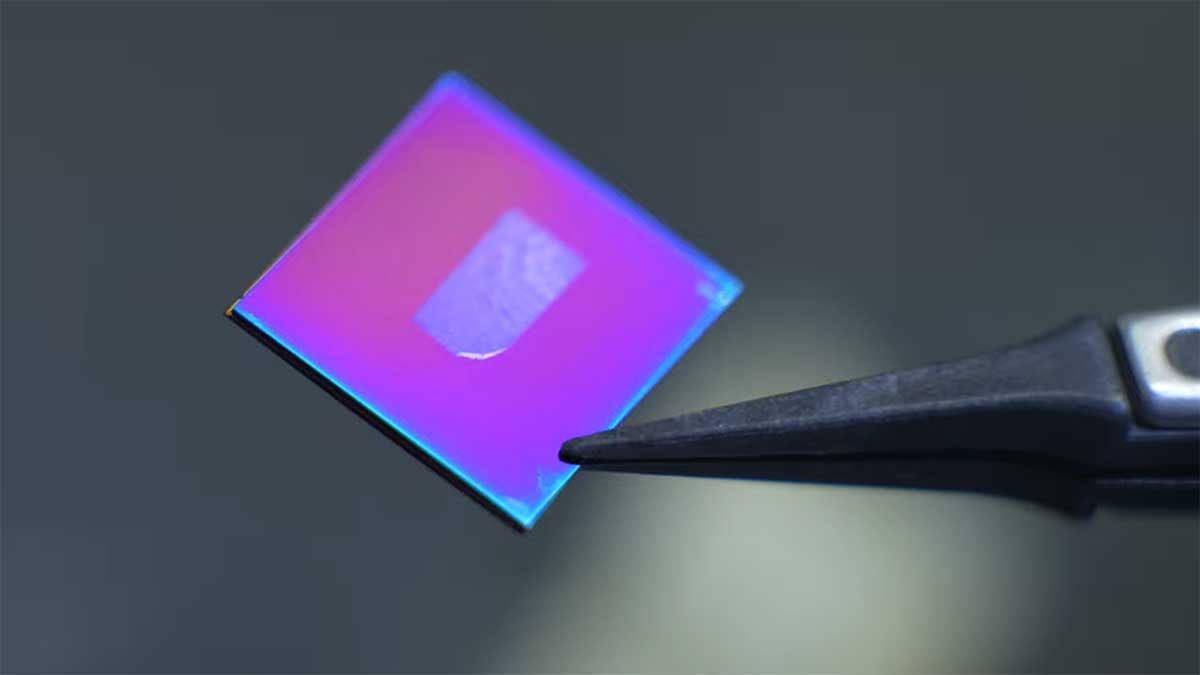
Researchers in the US have demonstrated a centimetre-scale carbon nanotube film with what they describe as a record-breaking ability to convert light frequencies, a breakthrough that could strengthen the optical foundations underpinning next-generation communications and computing systems used in the IoT ecosystem.
The work, led by Rice University and published in ACS Nano, shows that carefully aligned, single-enantiomer chiral carbon nanotubes can produce “giant” second harmonic generation (SHG), a nonlinear optical process in which incoming light is converted into light at twice the frequency.
In practical terms, this allows infrared light signals to be converted into visible light far more efficiently than in conventional materials, a capability that is central to photonic chips, optical interconnects, and high-speed data processing hardware increasingly used in edge and cloud infrastructure.
Chiral carbon nanotubes are hollow cylinders of carbon atoms with a built-in twist, which can exist in left-handed or right-handed forms. While theorists have predicted for decades that this structural chirality should produce unusually strong nonlinear optical effects, experimental verification has been limited by the difficulty of isolating and aligning nanotubes of a single handedness at scale.
“Typically, when we have a macroscopic ensemble of carbon nanotubes, half of them are right-handed and the other half are left-handed,” said Junichiro Kono, a senior researcher on the study. “So, their chiral properties cancel each other out.”
That cancellation has historically prevented researchers from measuring the intrinsic optical behaviour of chiral nanotubes, particularly their ability to generate second harmonic signals.
The Rice-led team overcame this by producing centimetre-scale films composed of a single enantiomer of (6,5) carbon nanotubes, aligned and densely packed into wafer-like structures using controlled vacuum filtration techniques.
“We successfully made a wafer of film packed closely with chiral CNTs that showed uniform optical properties,” said Kono.
The resulting material exhibited strong SHG when illuminated with laser pulses tuned near the nanotubes’ excitonic resonance, a quantum state in which electrons and holes bind together under light excitation. According to the researchers, this resonance dramatically enhances the nonlinear optical response.
The team reports an effective nonlinear susceptibility of 4.9 × 10² pm/V for the fabricated film, and an inferred intrinsic value of 1.6 × 10³ pm/V for an ideal perfectly ordered crystal. That places the material among the strongest known nonlinear optical systems operating in the near-infrared range.
The findings, the authors argue, confirm long-standing theoretical predictions that one-dimensional quantum confinement in nanotubes should amplify light–matter interactions to an exceptional degree, particularly when combined with structural chirality.
Beyond the fundamental physics, the researchers emphasise potential technological implications. Nonlinear optical materials are widely used to convert and route light signals in photonic devices, including those used in fibre-optic communications and emerging silicon photonics platforms.
“CNT is a promising flexible semiconductor for electronics and photonics,” said Hanyu Zhu, a Rice materials scientist who led the study alongside Kono. “The film may be easily integrated with silicon photonics for optical information processing and communication.”
He added that the work represents the first time the effect has been both accurately predicted and experimentally verified at this scale: “For the first time, we were able to make a more accurate prediction and experimentally demonstrated it.”
The ability to integrate such films into chip-scale architectures is particularly significant for IoT-related infrastructure. As connected devices proliferate, demand for low-latency, high-bandwidth data movement between sensors, Edge processors, and Cloud systems continues to grow. Photonic interconnects are widely viewed as a potential solution, replacing or complementing traditional electronic signalling in data-heavy environments.
However, current nonlinear optical materials used in photonics often require high power inputs, are difficult to miniaturise, or lack compatibility with standard semiconductor manufacturing processes. The researchers suggest that carbon nanotube films could help address several of these constraints simultaneously due to their flexibility, scalability, and compatibility with wafer-scale fabrication.
There’s plenty of other editorial on our sister site, Electronic Specifier! Or you can always join in the conversation by commenting below or visiting our LinkedIn page.