
NeoCortec, the Danish developer of ultra-low-power wireless mesh networking technology, has unveiled a major software update aimed at making large-scale IoT deployments faster, simpler, and more energy-efficient.
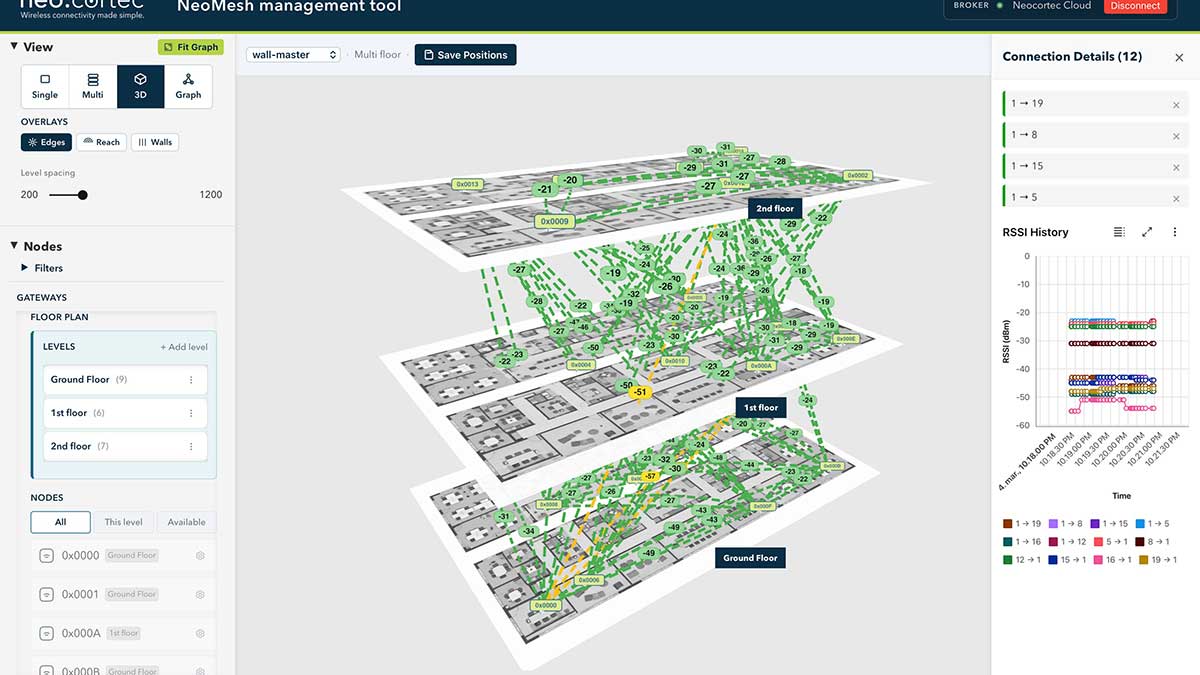
At embedded world 2026 in Nuremberg, Germany, the company showcased the next-generation NeoGW software alongside a new web-based Network Management application, providing enterprises with tools to monitor and control NeoMesh networks from a single platform.
NeoMesh, NeoCortec’s flagship protocol stack, is designed to overcome the scalability and power limitations of conventional IoT networks.
Unlike Zigbee, Thread, BLE Mesh, or Zwave, which rely on central coordinators and mains-powered routers, NeoMesh adopts a fully distributed “fat-flat” architecture. Each node independently manages its local environment, enabling networks of thousands of devices to operate efficiently, even when battery-powered.
Speaking to IoT Insider, Thomes Steen Halkier, CEO at NeoCortec, explained the distinction: “Most other mesh networks… build on the same core principle of having a central coordinator who organises the network. The task of organising a network of 1,000 devices is just too cumbersome for a central device, which is why those technologies built for smart homes don’t scale into bigger buildings. With NeoMesh, every device is equal. Devices communicate locally, and the routing is handled in a next-best-hop principle — nobody needs to know the entire network.”

The distributed model allows devices to sleep for long periods and operate for up to 10 years on small batteries. Dynamic network topologies automatically adapt to changing conditions, providing resilience and redundancy across multi-storey buildings or industrial installations.
NeoCortec initially deployed NeoMesh in its own hardware modules before licensing the stack to OEM customers. Honeywell was among the first adopters, integrating the protocol into commercial fire detection platforms.
Halkier told IoT Insider: “Since then, we’ve worked with other OEMs and module manufacturers to integrate our software into their devices.” NeoMesh has recently been extended to run over LoRa modulation, providing a mesh alternative to LoRa’s traditional star topology and improving range and noise resilience for enterprise deployments.
“LoRa gives you improvement in range and noise capability, but it comes at a slight increase in current consumption,” Halkier explained. “If you want very low current consumption and don’t need extended range, you can use regular FSK modulation. But if you’re building smart buildings or other networks that need robust communication, LoRa is perfect.”
The updated NeoGW software strengthens integration between NeoMesh networks and enterprise systems, supporting native MQTT connectivity for seamless communication with major cloud platforms. The new web-based Network Management application provides administrators with a centralised interface to monitor, configure, and control networks across multiple sites.
“NeoGW has always been a key component in bridging NeoMesh networks with enterprise systems,” Halkier told IoT Insider. “With native MQTT integration and improved message alignment for cloud environments, we are making it significantly easier for our customers to connect their NeoMesh deployments to the platforms they rely on.”
The update addresses a common challenge for manufacturers and facility managers: integrating wireless networks into existing systems without extensive technical expertise. Halkier said: “We found that many potential customers see the benefits of our technology, but they don’t necessarily have the skill set to integrate it. Think of a streetlight manufacturer: he may know how to bend a metal tube and fit a luminaire, but he doesn’t know IoT architecture. Our platform, and partnerships like the one with Enrich in Germany, give them a high-level proof of concept that can be directly implemented in their products.”
NeoMesh is particularly effective for retrofitting older buildings. Halkier described a recent Copenhagen installation where 100 temperature sensors were deployed across multiple floors in under three hours to optimise heating. “Two technicians went room to room, mounted the sensors, and left. Everything was operational. And with a battery lifetime of 10 years, you don’t have to touch it again for a decade,” he said.
Looking ahead, NeoCortec is exploring further expansion over LoRa and 2.4 GHz frequencies, where traditional Wi-Fi and IoT networks often struggle with noise. “We see a huge opportunity to provide communication inside smart buildings where conventional 2.4 GHz networks are crowded. LoRa allows you to communicate effectively even in the noise floor,” he said.
There’s plenty of other editorial on our sister site, Electronic Specifier! Or you can always join in the conversation by visiting our LinkedIn page.