
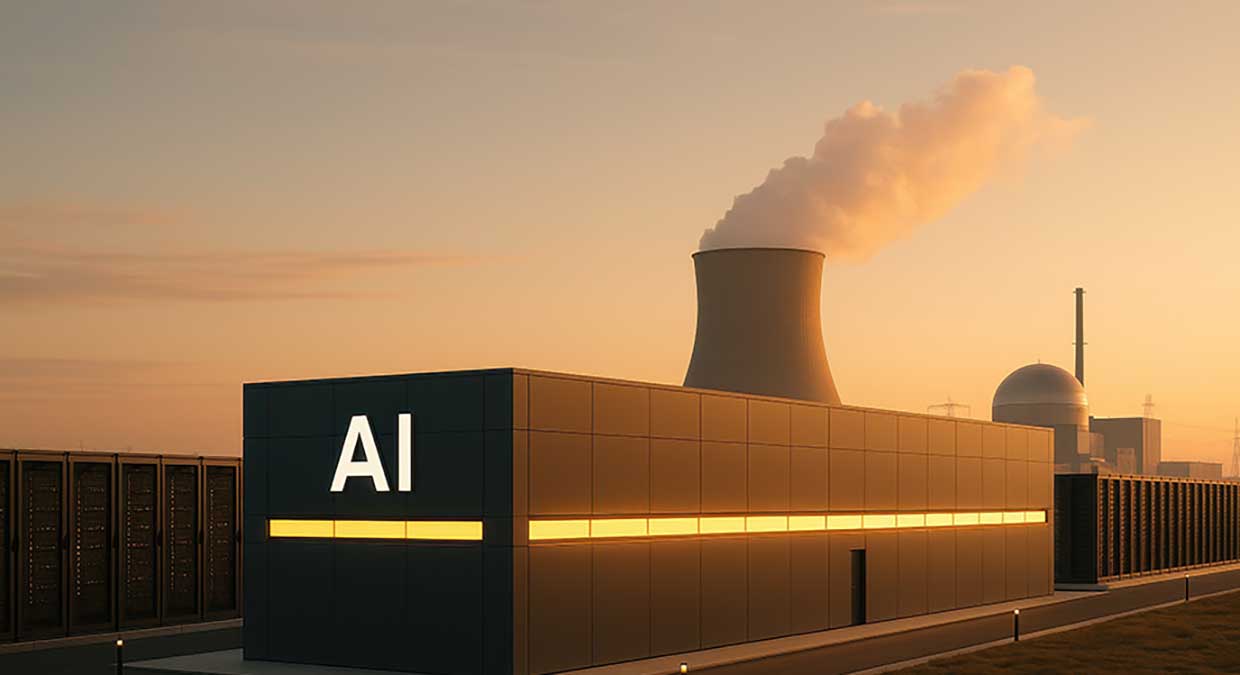
As the world races to build the infrastructure powering artificial intelligence, Karl Havard, Chief Commercial Officer at Nvidia-backed Cloud provider Nscale, has warned that the pace of AI development is now far outstripping the ability of renewable energy systems to keep up.
Speaking at the Schneider Electric Innovation Summit in Copenhagen, Havard said that Nscale, which has recently won major contracts to provide artificial intelligence infrastructure to Microsoft and OpenAI, and which currently operates a data centre in Norway, was finding it hard to expand quickly enough to meet demand due to sustainable power constraints.

“AI infrastructure is being developed at incredible speed, with new iterations coming out every year,” Havard said. “Each requires different power demands, yet the energy industry is struggling to match that pace.”
Nscale, which was spun out of an Australian Bitcoin miner and relaunched as an AI Cloud provider in 2024, has rapidly become one of the UK’s most prominent – and best capitalised – AI infrastructure start-ups.
The company has raised $1.5bn in fresh funding and plans a potential IPO as soon as next year. In September, Nvidia chief executive, Jensen Huang said his company would invest £50 million in Nscale to speed up deployment of up to 300,000 of its GPUs.
But Havard said the speed of AI’s expansion brings an uncomfortable energy dilemma.
“Renewable energy is abundant, but it cannot reach the national grid as quickly as AI infrastructure is being deployed,” he explained. “Decisions are being made at a high level to say, ‘I can’t wait for that – I need my next model trained now.’ That puts companies like us, and the big Cloud providers, in a difficult position.”
In response, Havard said firms are exploring creative ways to offset their energy impact. “If we can find renewable energy, great. If not, we have to look at alternative solutions — can we pipe renewable energy directly into data centres, or use batteries to store power and reduce the burden on the grid?”
He believes that AI, if managed responsibly, could help accelerate the adoption of green energy rather than undermine it. “I’d love AI to be a catalyst to help citizens benefit from renewable energy,” he said. “It shouldn’t just be data centres — local and wider communities should share in those benefits.”
Yet as infrastructure expands, so too does the question of control. Havard warned that global Cloud disruptions — from outages in AWS’s US East region to cable cuts in the Middle East — have pushed governments and companies to think differently about where AI systems are hosted.
“The need to deploy AI is now viewed through the lens of sovereignty,” he said. “Could an AI infrastructure be deployed in the UK where everything — energy, network, water, land, software — is sovereign? That’s the direction many countries are heading.”
Such a shift, Havard suggested, could fragment global energy policy. “Rather than seeing more international coordination, nations may become more insular, looking to secure their own energy sources to power sovereign AI systems,” he said.
There’s plenty of other editorial on our sister site, Electronic Specifier! Or you can always join in the conversation by commenting below or visiting our LinkedIn page.