
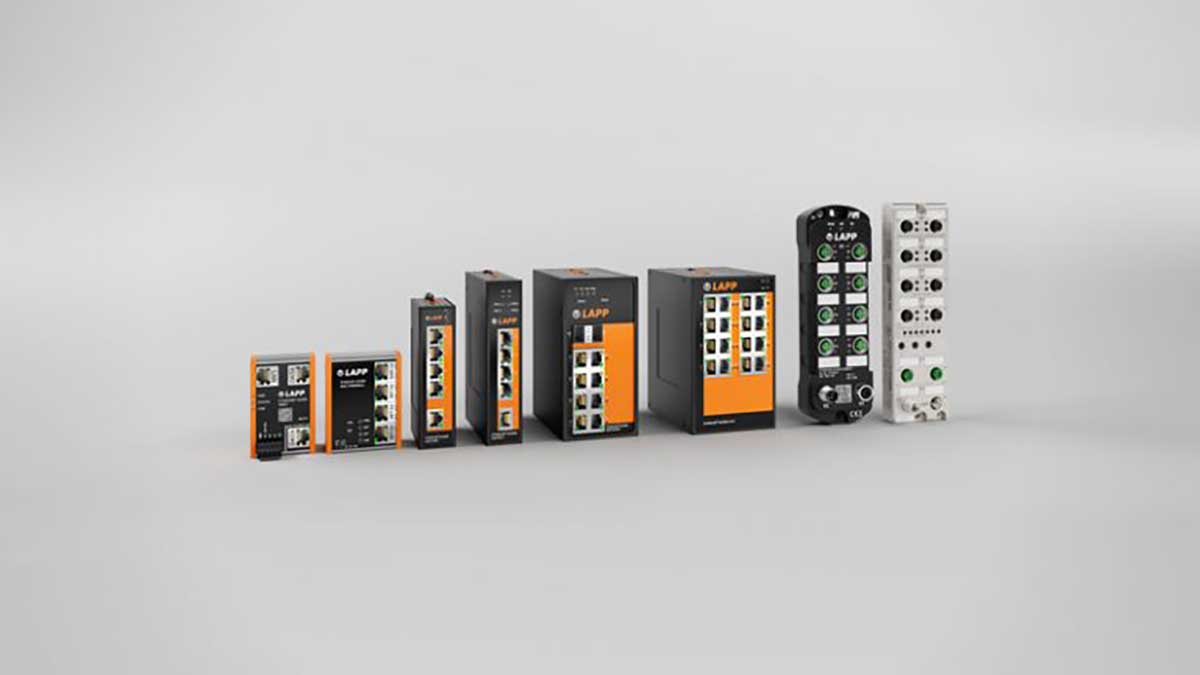
LAPP has entered the remote I/O market for the first time with the launch of its UNITRONIC ACCESS range, a move the German cable and connectivity group says will support the growing shift towards decentralised automation on the factory floor.
The new devices, which include IO-Link masters and hubs, form part of a broader strategy to expand LAPP’s Industrial Communication portfolio. The company, a global supplier of cable and connection technology, claims the products will simplify sensor–actuator integration at the field level and reduce both installation time and system complexity.
“IO-Link is increasingly replacing classic digital and analogue signal transmission,” said Rob van der Sluis, LAPP’s Head of Product & Business Development Cluster West. “It transmits structured data, enables diagnostics and remote control, and works with inexpensive unshielded standard cables. It is, in many respects, an ideal solution for the lowest level of the automation pyramid.”
Van der Sluis said the decision to introduce active components marks a significant step for LAPP. The UNITRONIC ACCESS line, he noted, allows the firm to supply customers with a complete infrastructure for industrial networks—from sensors through to controllers, and onward to cloud environments.
LAPP said the devices are distinguished by their protocol flexibility. The multi-protocol versions support five Industrial Ethernet standards—PROFINET, Ethernet/IP, EtherCAT, Modbus TCP and CC-Link IE—as well as four IoT protocols, including OPC UA and MQTT. The units are housed in metal casings and operate across a temperature range of ?40°C to 70°C, features intended to ensure reliability in demanding industrial environments.
Decentralised systems are becoming increasingly attractive for machine builders and plant operators, according to LAPP. Installing modules directly on machinery—made possible by IP67 and IP69K protection ratings—can reduce cabinet wiring, free up space and cut the risk of errors. Van der Sluis added that the modules offer “plug-and-play commissioning” and automatic sensor parameterisation, which, he said, reduces both installation and maintenance costs.
The company plans further expansion of the range, including diagnostic and visualisation tools. These developments, LAPP said, can be previewed at its Exploration Centre in Stuttgart.
There’s plenty of other editorial on our sister site, Electronic Specifier! Or you can always join in the conversation by visiting our LinkedIn page.