
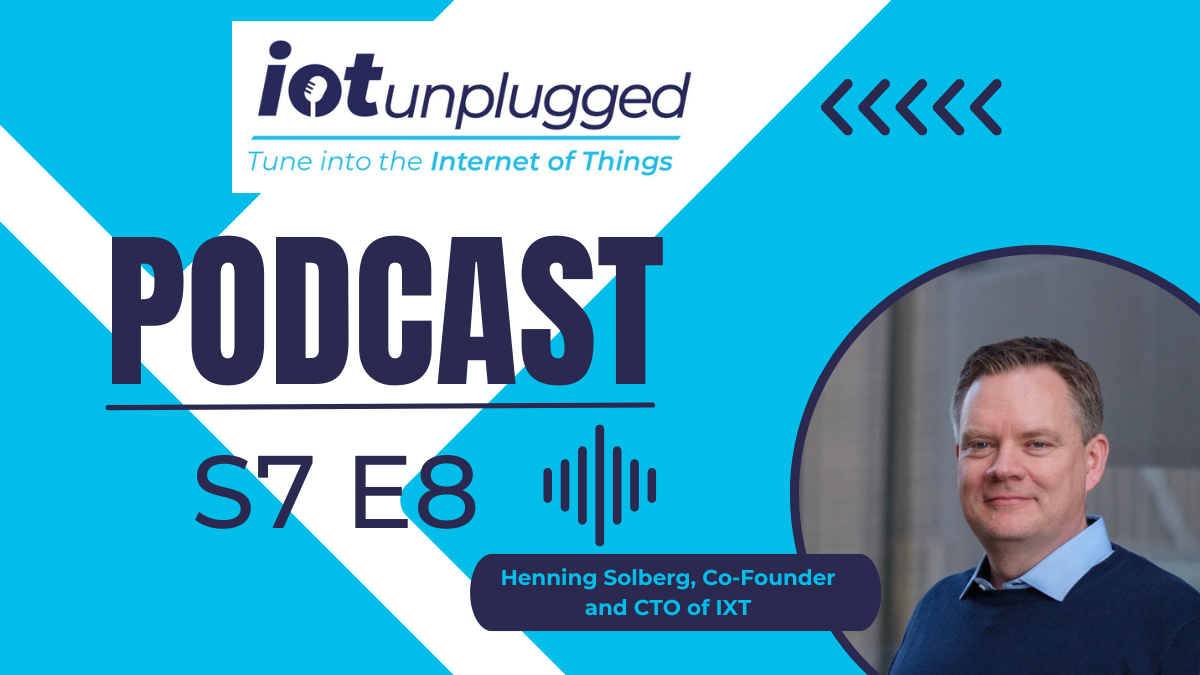
In this episode of IoT Unplugged, host Caitlin Gittins speaks with Henning Solberg, Co-Founder and CTO of ixT, about the critical role of network security in the Internet of Things (IoT) landscape.
The conversation explores the evolution of connectivity, the challenges of building secure global networks, and how the adoption of frameworks such as Zero Trust can reshape the future of IoT security.
Henning begins by introducing ixT, a Norwegian-based connectivity company founded in 2024. Although the business is relatively young, its founders bring decades of experience in the cellular and IoT sectors.
Henning himself has spent over 25 years in telecommunications, with around two decades focused on IoT and machine-to-machine (M2M) communications. The company was established with a clear mission: to provide efficient, secure, and truly global connectivity for all types of devices, regardless of geography or application.
He explains that ixT was created to address inefficiencies and legacy issues in the telecommunications sector. While many operators claim to provide IoT connectivity, only a small fraction actually produce their own services, with the majority reselling existing solutions. This has led to a lack of innovation, with most providers competing purely on price. ixT’s Greenfield approach—building a network from the ground up using the latest technologies—allows it to design for efficiency, scalability, and robust security from day one.
The discussion then moves to the concept of “generic connectivity” versus “IoT-specific connectivity.” Henning argues that the distinction is becoming increasingly blurred. Historically, industries separated consumer connectivity (e.g., smartphones and tablets) from IoT connectivity, but in practice, all devices now rely on seamless, ubiquitous connections. The key difference lies in whether a human is present on the other end of the device. Unattended IoT devices require greater control and monitoring to ensure reliability and safety, yet the underlying connectivity principles are much the same.
Henning highlights the growing complexity of providing global connectivity amid political and regulatory challenges. Different countries impose varying rules around data routing and roaming, creating barriers for companies that simply want their devices to function wherever they are deployed. ixT’s approach is to simplify these complexities for customers, allowing them to focus on their products while ixT manages the connectivity layer.
A major focus of the episode is on network security, particularly the adoption of Zero Trust architecture. Traditionally, cellular networks relied on isolation and private access points to provide security. However, Zero Trust represents a paradigm shift—it assumes no device or connection is inherently trustworthy. Instead, every data flow is continuously verified and monitored. In practice, this involves isolating endpoints, inspecting sessions between devices and central systems, and blocking malicious activity at the network level.
Henning notes that Zero Trust is increasingly expected by customers as a standard feature, not an optional add-on. By making it an opt-out service, ixT ensures that all customers benefit from advanced protection without additional complexity. Looking ahead, Henning predicts that Zero Trust will become integral across all communication types, with AI playing a growing role in detecting anomalies and enhancing real-time protection.
To hear more about what Solberg had to say about secure networks, listen on Spotify, Apple Podcasts, and at the link below.
For more on the latest industry news, check out our news page or our sister site, Electronic Specifier! Plus, you can comment below or visit our LinkedIn page.