
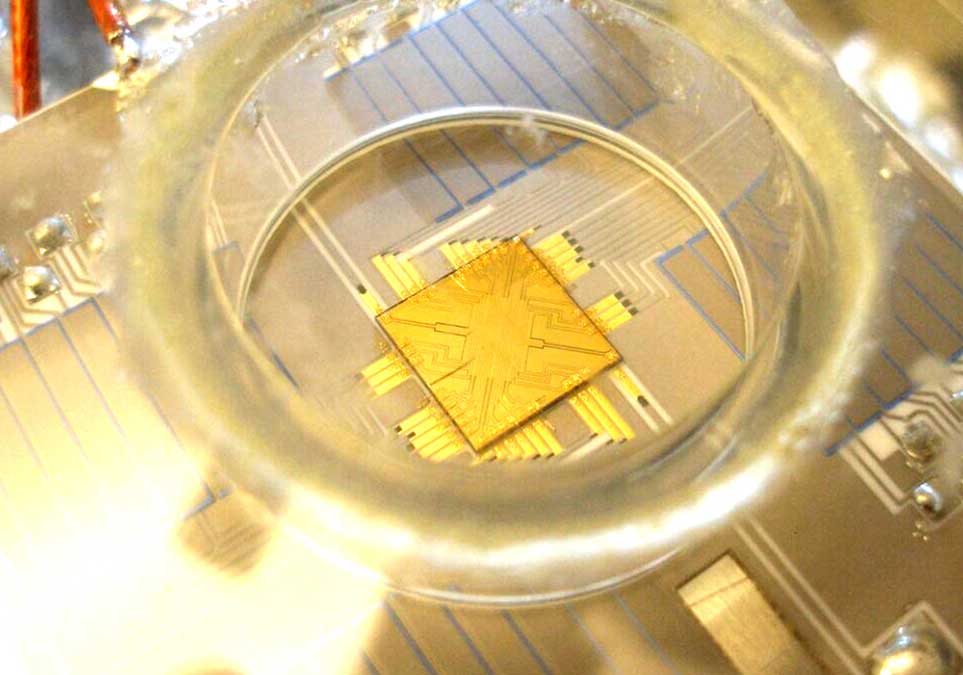
A German startup has unveiled a new approach to quantum computing that replaces traditional laser-based control with microwave radiation, significantly reducing energy use and system complexity.
EleQtron, a spin-off from the University of Siegen, has integrated Direct Digital Synthesis (DDS) technology from Spectrum Instrumentation into its quantum systems, allowing for precise control of trapped ion qubits through microwaves rather than lasers.
The company’s patented MAGIC (Magnetic Gradient Induced Coupling) quantum processors use this approach to perform quantum operations with far less cooling and power consumption than conventional laser-based systems.
The use of microwaves, generated by Spectrum’s Arbitrary Waveform Generators (AWGs), marks a significant simplification in hardware architecture. Each of Spectrum’s M4i.66xx-series AWG cards can produce up to 20 independent sine wave carriers per channel using DDS technology. This enables fine-tuned manipulation of qubits, including control over amplitude, phase, and frequency, with timing resolution down to 6.4 nanoseconds.
Quantum processors such as eleQtron’s MAGIC use ytterbium ions (171Yb+) confined in a Paul trap, a standard technique in ion-based quantum computing. Where other systems rely on high-precision lasers to target individual ions, eleQtron’s design achieves the same effect through microwave modulation, operating at around 12.64 GHz. The approach leverages the Zeeman effect—where magnetic fields split atomic energy levels—to distinguish between qubits by modulating the frequency in steps of 3–5 MHz.
By eliminating the need for complex laser setups, the microwave-based system consumes roughly one-fifth of the power of competing designs and is easier to scale and integrate into chip-based ion traps.
EleQtron turned to Spectrum Instrumentation after reaching the performance limits of its previous waveform generation hardware. The flexibility and performance of Spectrum’s DDS-enabled AWGs have since become integral to the company’s system design, allowing rapid signal modulation required for quantum operations.
According to eleQtron, Spectrum’s technical support and documentation quality were key factors in the successful implementation of the DDS solution.
The development underscores a broader shift in quantum computing towards simplifying control architectures and improving energy efficiency. As researchers seek to make quantum processors more reliable and scalable, microwave-based control could offer a promising path beyond the laser-dependent systems that dominate the field today.
There’s plenty of other editorial on our sister site, Electronic Specifier! Or you can always join in the conversation by commenting below or visiting our LinkedIn page.