
The transition into a 6G-powered world is well underway. Smart cities are developing at a blinding pace, autonomous vehicles like robotaxis are already on the road in select areas, and with 5G having been deployed worldwide for years now, it’s time to look ahead to the physical-cyber interconnectedness and level of advancement that will come with the next generation of network tech. But before it becomes a true reality, there are hurdles to address.
High-frequency radio waves, like those in the millimetre wave band, are currently in limited use for 5G applications. The millimetre band provides obvious benefits, namely high-speed and high-capacity transmissions, which are near-essential for many major forward-looking use cases within the 6G world of the future. However, its drawbacks – including the need for line-of-sight and signals’ subsequent susceptibility to being blocked, as well as the cost of infrastructure required to make them usable – have proven a significant obstacle to development and adoption. These drawbacks compound in high-speed conditions, making transit-related use cases like cars, trains, and vehicle-to-everything (V2X) communication even more difficult to develop effective high-frequency solutions for.
Specifically, high-speed environments create two main problems for transmissions within the millimetre band. Firstly, they require more antennas across a journey, each one of which needs even more candidate beams. Secondly, switching between these antennas at high speeds causes both propagation delays and rapid changes in the Doppler frequency, and can be easily disrupted by shielding and obstructions (like buildings or passing vehicles). The result is a need for a truly enormous amount of antenna infrastructure that still delivers heavily degraded communication signals.
To tackle these obstacles, NTT, Inc., NTT DOCOMO, INC. and NEC Corporation have developed a distributed MIMO (multiple input and multiple output) system that suppresses degradation at the 40 GHz band (which falls within the millimetre wave band) within a system with high numbers of antennas over multiple locations. This solution efficiently selects the most suitable antenna as the destination, enabling fast switching and spatial multiplexing transmission. It then uses frequency and timing compensation measures to keep reception frequency and timing on the mobile-terminal side relatively consistent, regardless of the surrounding conditions. Our successful test of this novel technology thus achieved stability for high-capacity transmissions in high-speed environments, enabling high-volume communication and data collection without significant degradation.
What is MIMO, and why is it important?
MIMO stands for “Multiple-Input and Multiple-Output.” As the name suggests, MIMO utilizes multiple antennas at both the transmitter (source) and receiver (destination) to increase the transmission speed and enhance reliability. It’s an alternative to point-to-point radio transmission systems, like multiple-input and single output (MISO), or single-input and multiple output (SIMO); these are highly susceptible to several types of signal fading, which can occur when signal fragments are distorted or lost entirely over their journey due to noise or interference. In high-speed use cases, for example, a mobile terminal may pass by large obstacles like buildings, or have obstacles like other vehicles pass by it, thereby blocking the signal.
Using spatial multiplexing, MIMO involves generating multiple different versions of the same transmission across numerous independent antennas, to then be sent outward through the air for the receiver to collect. After gathering, demodulating and decoding a broad range of signals, the receiver combines them to create an approximation remarkably close to the original signal with few errors.
MIMO has been around for decades, and its commercial use has broadened considerably since its introduction. It is now used heavily in Wi-Fi transmission and mobile phone networks, including 5G/LTE, but one of the most significant applications are often in critical use cases that cannot accept degradation of communication quality. For example, first responders, law enforcement, and military/government agencies often deal with high-pressure scenarios that can be catastrophically disrupted if transmissions are interrupted or degraded.

How exactly does conventional tech fall short?
High-frequency distributed MIMO transmission requires consistently detecting and assigning the optimal combination of beams and antennas, based on and in response to changes in the radio communication environment for each mobile terminal. However, applying conventional beam-search technology to distributed MIMO systems is very inefficient.
The communication quality of each possible combination must be observed by transmitting a beam identification signal for each one. For each distributed antenna being observed in this way, the beams must be switched to avoid interference between one another. As a result, the more antennas there are, the more measurement time is required to test them all before selecting the optimal antennas. Large antenna networks lead to long search times, which in turn cause communication degradation.
Another problem area exists within the communication between mobile terminals and base stations. Mobile terminals align the frequency and timing of signals coming from a base station, allowing them to communicate. The problem with this system as it currently operates arises when the terminal is moving at high speeds, such as those housed on cars or trains. The propagation delay from the mobile terminal, alongside changes in the Doppler frequency as it moves, will be different for every single distributed antenna every single time it switches. As a result, communications transmissions are degraded even further.
How does the new technology work?
Japan currently uses the 28 GHz band for millimetre-wave 5G. The experiment testing this technology was conducted in the 40 GHz band, which will be among those used in the future, such as 5GA and 6G mobile phone networks.
NTT’s new beam search technology uses the same beam identification signal simultaneously and at the same frequency across multiple distributed antennas, keeping the measurement time constant even with more antennas. Since they are the same beam identification signal, there is no interference, and a mobile terminal can look at the combined reception quality of the beams from each antenna to pick the most appropriate one. As such, the optimum combination can be found in the same amount of time it would normally take with testing just one antenna, even with more and more antennas involved.
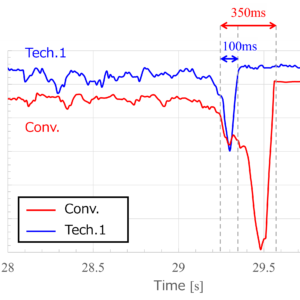
In the test, the selection time was reduced regardless of the number of antennas. The test involved 4 antennas, but it is assumed that the technology can perform similarly with far more. With faster selection and without subsequent degradation, NTT’s test was able to maintain throughput over 100 Mbps while cutting the drop time to 1/4 of conventional technologies, even with obstructions like passing vehicles. In contrast, the conventional method experienced a major drop in throughput after being blocked (shielded) by a large vehicle passing by, which persisted until the antenna and beam were switched.
To address degradation due to propagation delay and Doppler frequency changes, the new technology allows distributed antennas to cooperate to pre-compensate for the reception frequency and timing of the mobile terminal. Using uplink reference signals to measure changes in Doppler frequency and propagation delay for each distributed antenna, the system then signals other distributed antennas to pre-compensate for transmission frequency and timing, thereby enabling suppression of those changes when the antennas switch.
As a result, there are no abrupt shifts in frequency or timing whenever antennas are switched, keeping them consistent on the mobile terminal side and eliminating any effects perceptible to the user. When tested in a high-speed environment, conventional technology experienced drastic drops in throughput when the antennas switched, plummeting to just 10 Mbps. In contrast, the new technology maintained throughput at 100 Mbps using millimetre waves, even at the same high speed.
Now that these problems have been solved, what does it mean for the future?
This new system has successfully moved MIMO a step into the next generation by solving key problems associated with transmitting at the frequency bands required for 6G. The streamlining of MIMO tech for high-speed environments, including cars and trains, will enable high-speed and high-capacity content transmission for passengers in these vehicles without loss, degradation, or other reductions in speed and quality.
V2X involves vehicles communicating with large numbers of other systems within their environment. This can include other vehicles, pedestrians, and infrastructure and systems within smart cities. As such, functional and reliable V2X systems are not only beneficial to existing transportation methods; they will be crucial to the success and viability of autonomous driving by directly linking self-driving cars to the environments they navigate through and the obstacles they encounter.
For autonomous driving, massive amounts of sensing data must also be collected and transmitted without corruption or loss, which this technology provides a proven method for. This new evolution of MIMO technology addresses several of the most significant challenges facing truly reliable V2X communication.
Overall, the demonstrated capability of consistent and dependable communication at the millimetre wave band is a vital step towards widespread adoption of this band throughout society – bringing 6G even closer to our modern reality.



By: Takuto Arai, Access Network Service Systems Laboratories – NTT; Toshiki Takeuchi, Advanced Network Research Laboratories – NEC Corporation; Satoshi Suyama, 6G Tech Department – NTT DOCOMO
This article originally appeared in the February issue of IoT Insider