
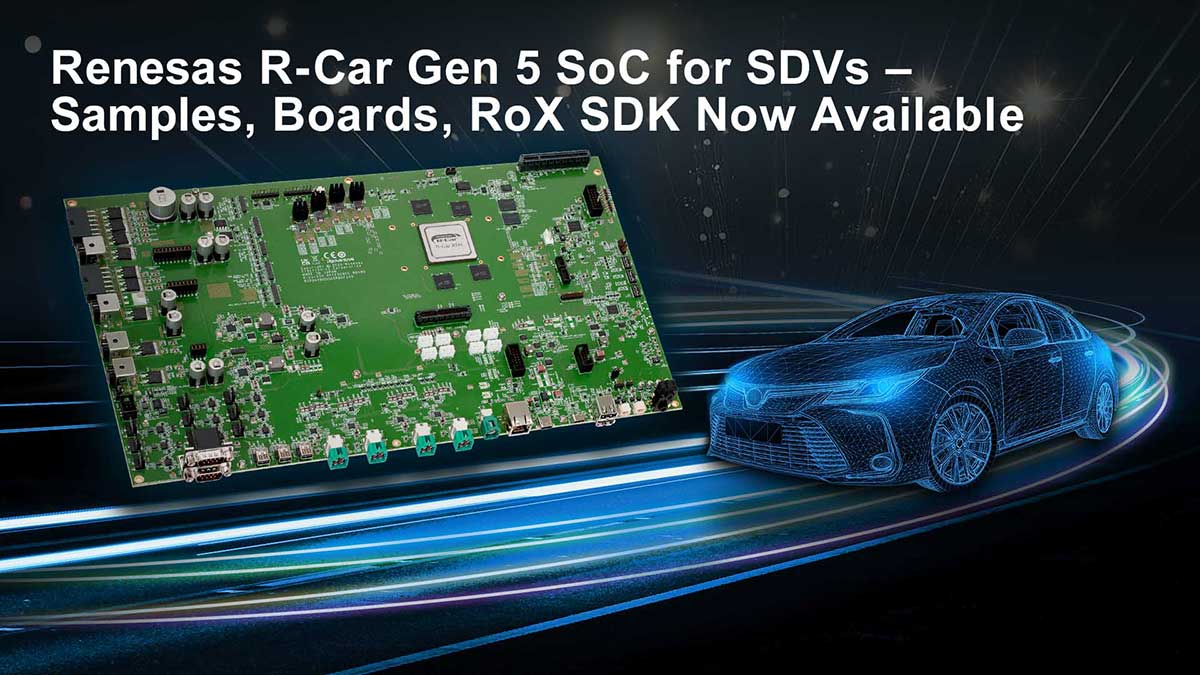
Renesas Electronics has unveiled an expansion of its software-defined vehicle strategy, betting that more powerful, centralised computing will become the backbone of next-generation cars.
The Japanese semiconductor group said today that it had begun sampling its fifth-generation R-Car automotive processors, led by the new R-Car X5H, which it describes as the industry’s first multi-domain automotive system-on-chip built on a 3nm manufacturing process. The chip is designed to run advanced driver assistance systems, in-vehicle infotainment, and vehicle gateway functions simultaneously.
The move underscores intensifying competition among chipmakers to supply the high-performance computing platforms required for increasingly software-driven vehicles, where functions that were once distributed across dozens of electronic control units are consolidated into a smaller number of powerful processors.
Renesas said the R-Car X5H delivers up to 35% lower power consumption than its previous 5nm generation, while significantly increasing computing capability. The processor offers up to 400 TOPS of artificial intelligence performance, with optional chiplet extensions that can increase acceleration by four times or more. Graphics performance reaches an equivalent of 4 TFLOPS, while general-purpose computing exceeds 1,000k DMIPS, supported by 32 Arm Cortex-A720AE cores and six Cortex-R52 lockstep cores designed to meet ASIL D safety requirements.
The company said the chip’s mixed-criticality architecture allows safety-critical and non-critical workloads to run in parallel without compromising functional safety, a key requirement for advanced driver assistance and higher levels of automated driving.
Alongside the hardware, Renesas is broadening its R-Car Open Access, or RoX, development platform, which bundles hardware, operating systems, middleware, and tools intended to shorten vehicle development cycles. The RoX Whitebox Software Development Kit for the X5H supports Linux, Android, and the XEN hypervisor, with additional compatibility for automotive operating systems including AUTOSAR, QNX, and SafeRTOS.
According to Renesas, the software stack enables developers to build systems ranging from intelligent cockpits to L3 and L4 autonomy, combining real-time perception and sensor fusion with generative AI and large language models for human-machine interfaces. The kit also integrates production-ready software from partners such as Candera, Smart Eye, STRADVISION, and ThunderSoft.
“Since introducing our most advanced R-Car device last year, we have focused on delivering market-ready solutions and getting silicon into customers’ hands early,” said Vivek Bhan, Senior Vice President and General Manager of High Performance Computing at Renesas. He added that closer collaboration with vehicle manufacturers, Tier-1 suppliers, and software partners was accelerating adoption of software-defined vehicle architectures.
Automotive suppliers have welcomed the new processor as they seek scalable computing platforms that can support multiple vehicle domains. Christian Koepp, Senior Vice President Compute Performance at Bosch’s Cross-Domain Computing Solutions Division, said integrating the R-Car X5H into Bosch’s portfolio was a “natural next step” and highlighted its ability to fuse data across systems such as video perception for driver assistance.
ZF, the German automotive supplier, also said the chip aligned with its software-defined vehicle strategy. Dr. Christian Brenneke, Head of ZF’s Electronics & ADAS Division, said combining the R-Car X5H with ZF’s own ADAS software would allow the company to offer full-stack systems with high computing power and scalability, including radar localisation and high-definition mapping.
Renesas plans to demonstrate the R-Car X5H publicly for the first time at CES 2026, where it will show multi-domain applications running across ADAS and infotainment workloads using Linux, Android, and virtualisation. The demonstration platform supports up to eight high-resolution cameras and eight displays, with resolutions reaching 8K2K.
There’s plenty of other editorial on our sister site, Electronic Specifier! Or you can always join in the conversation by visiting our LinkedIn page.