
When most people think of IoT, they picture factories, logistics hubs, or smart cities — not aircraft flying at 45,000 feet. Yet information on the latest unmanned aerial vehicles deployed by national defence agencies around the world shows just how much air combat systems are focusing on the same principles of connectivity, autonomous intelligence, and secure Edge computing.
The network: Uncrewed Collaborative Combat Aircraft (UCCA)
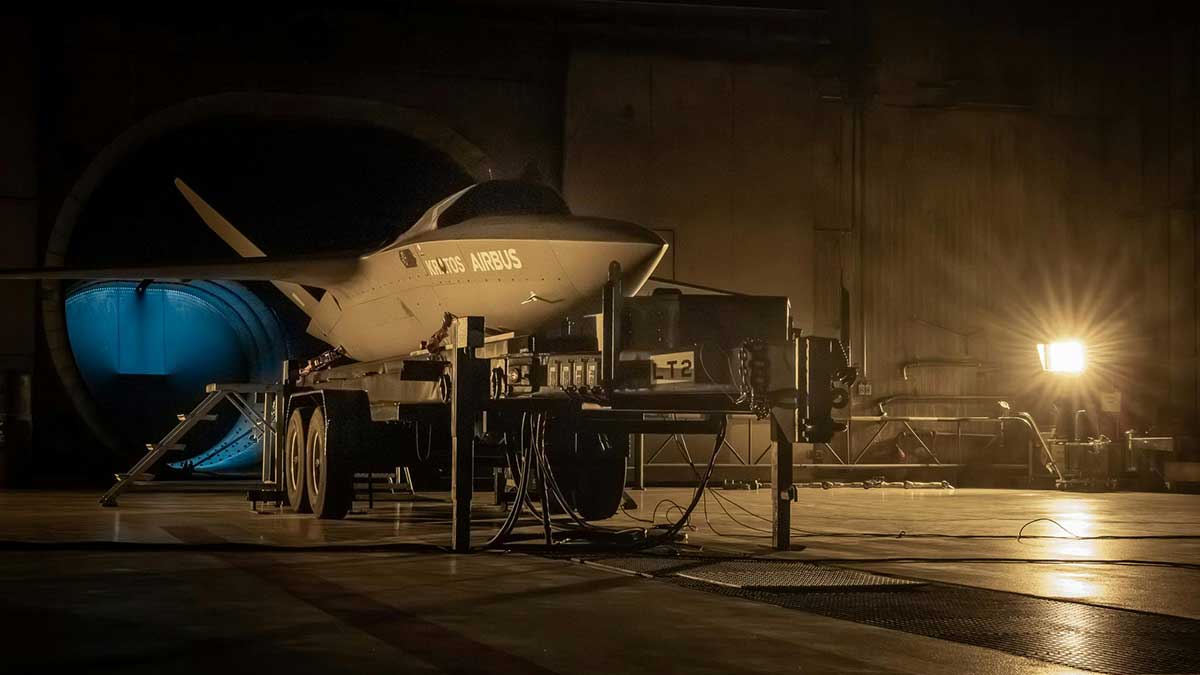
Take, for example, the German Air Force’s new Uncrewed Collaborative Combat Aircraft (UCCA) programme announced by European manufacturer Airbus in partnership with US-based Kratos Defense & Security Solutions.
The programme, unveiled earlier this month, comprises a fleet of Kratos Valkyrie drones, each measuring 9.1 meters in length and with an 8.2 meter wingspan, three-ton maximum take-off weight, 5,000 kilometre range, and a 45,000 feet ceiling.
But, more importantly, each drone forms part of a series of nodes in a connected network, collecting sensor data, processing it locally with AI, and sharing actionable information with other drones or manned aircraft in real time.
MindShare: the AI brain turning drones into IoT nodes
At the heart of the UCCA is MindShare, the AI-driven component of the MARS system. MindShare coordinates multiple drones and manned aircraft, processing mission data at the Edge, making real-time decisions, and distributing command across the fleet. In IoT terms, each drone acts as a smart, autonomous node, contributing data and acting on insights without constant human intervention — an airborne analogue to industrial or smart-city IoT networks.
“By combining the Kratos Valkyrie with our MARS mission system, we are offering the German customer exactly what Germany and Europe urgently need in the current geopolitical situation: a proven flying uncrewed combat aircraft with a sovereign European mission system that does not have to be developed from scratch in a time-consuming and costly manner,” said Marco Gumbrecht, Head of Key Account Germany at Airbus Defence and Space. “Our objective is to deliver credible combat capability in time of relevance, while assuring key sovereign aspects. And we are confident that we can do this at a very affordable price – which is a key driver for UCCAs.”
What’s more, Airbus said that the new drone fleet will also have cross-platform connectivity with the Eurofighter fleet, enabling the Eurofighter to act as a “command aircraft.” To do this Airbus and Rafael are enhancing the Litening 5 Advanced Targeting Pod, already contracted for the Eurofighter fleet, with a connectivity capability. Airbus added that fully autonomous or commanded by a Eurofighter, the Valkyrie will be able to take on sensitive mission tasks that would pose too great a danger to the pilot.
When will it happen?
By 2029, Airbus says it plans to deliver operational UCCAs that function as networked autonomous systems with each UCCA able to operate autonomously, in teams, or in manned-unmanned combinations.
Airbus says it had acquired an initial two Valkyries from Kratos Defense & Security Solutions, and is currently preparing them for their maiden flight later this year with Airbus’ sovereign Multiplatform Autonomous Reconfigurable and Secure (MARS) mission system.
“By taking the flight-proven and in-production Valkyrie and integrating the Airbus MARS mission system, the Airbus-missionised Valkyrie UCCA is a multi-mission, affordable system that can operate independently, in teams of UAS, or in Manned-Unmanned-Teaming operations,” said Steve Fendley, President of Kratos Unmanned Systems Division. “Along with the technical and production backing Airbus and Kratos bring, we are realising an optimal capability system that can be bought and deployed as ‘affordable mass’; the consistent discriminator identified in today’s peer to peer wargames.”
The stealth drone arms race
Of course Airbus’ UCCA is just part of a global arms race in stealth, autonomous, and connected drones, dominated by the US and China. In the US, the Northrop Grumman RQ‑180 and Lockheed Martin’s Vectis are designed for autonomous or collaborative operations alongside manned aircraft. China is making significant strides with its CH‑7 “Rainbow” drone, a tailless, low-observable UAV featuring a flying wing design and advanced sensor payloads. According to the China Academy of Aerospace Aerodynamics, the CH‑7 can fly for up to 16 hours at altitudes of 16 kilometres, with a cruise speed of 612 km/h and a wingspan of 27.3 meters. Its primary mission is reported to include long-endurance reconnaissance, surveillance, and electronic support