
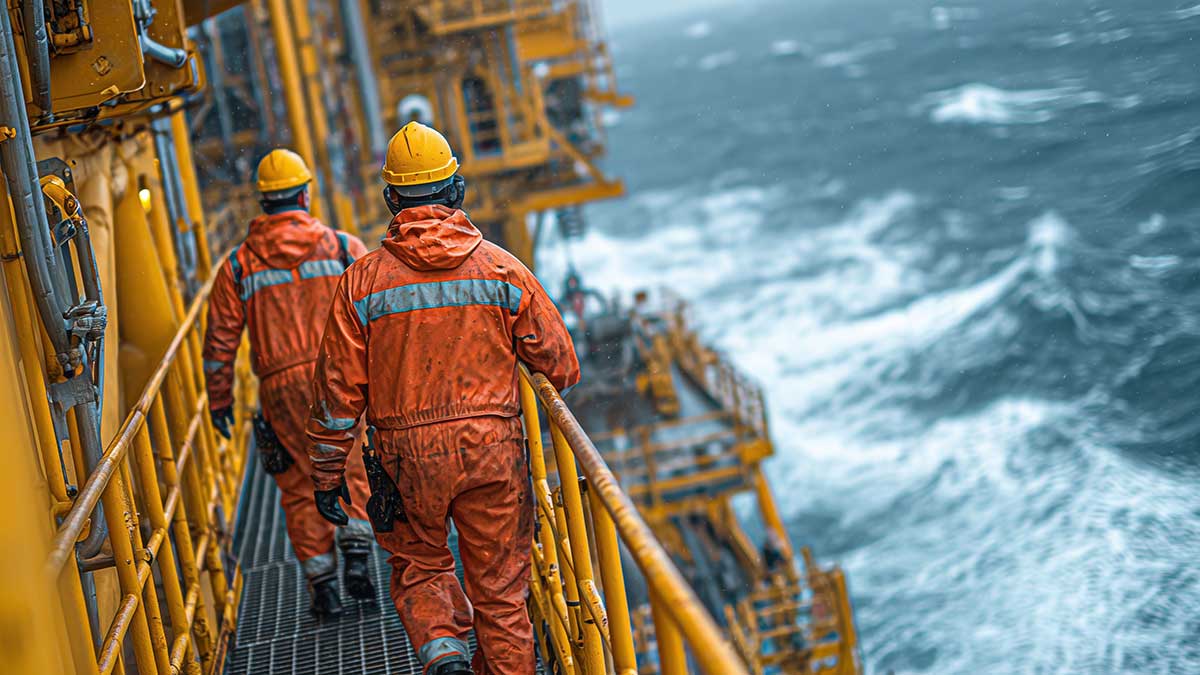
Climate volatility is forcing offshore oil & gas operators to turn to AI as they struggle to plan, crew, and execute field activities in an increasingly volatile climate.
According to weather tech platform, StormGeo, AI-enabled weather intelligence is becoming a critical tool for navigating rapid swings in weather conditions which squeeze operational windows and increase safety risks.
“Offshore operators are seeing a clear trend: more frequent, more intense, and less predictable weather across every major basin,” says Alan Binley, StormGeo’s Global Industry Manager Offshore Oil & Gas. “That variability is reshaping how the industry plans, executes, and safeguards offshore operations.”
Deep-water platforms, drilling units, and offshore fleets face mounting disruption from storm-driven shutdowns, crew transport constraints, high seas, icing, and tropical systems. These conditions, once viewed as periodic challenges, are occurring with greater regularity, tightening budgets and compressing project timelines.
Greater weather variability is also reducing planning horizons for personnel transfers, lifts, construction work, drilling, and maintenance. Rapid shifts in sea state or storm tracks can have immediate implications for evacuation decisions, mooring integrity, and production continuity.
The operational picture is further complicated by the rise of floating installations, FPSOs, walk-to-work gangways, and hybrid fleets, each requiring more granular motion and metocean analysis. At the same time, regulators and investors are demanding clearer evidence of safe operations, transparent decision-making, and lower fuel consumption.
Against this backdrop, StormGeo argues that weather intelligence offers a material performance advantage. The company integrates high-resolution atmospheric and marine data with AI analytics, expert meteorology, and decision-support tools to help offshore teams interpret complex weather patterns and adjust operations proactively.
“Weather intelligence can be transformative,” Binley says. “It supports earlier decisions, tighter operating windows, and lower risk thresholds. It’s an operational multiplier for offshore oil & gas.”
StormGeo provides forecasting and operational guidance to more than 2,500 offshore sites globally, issuing over 2.7 million point forecasts a year from 10 operations centres. Applications range from heavy-lift and cable-laying support during construction phases to vessel-motion forecasting for walk-to-work transfers, helideck compliance, flare management, and mooring integrity.
In the North Sea, one operator increased safe crew-transfer windows by 15–20% using vessel-specific motion forecasts, reducing standby hours and completing maintenance ahead of schedule. In the Gulf of Mexico, early warnings on cyclone intensification allowed a multi-platform operator to carry out a streamlined evacuation and cut restart downtime by roughly 18 hours.
Improved predictability is also contributing to emissions reductions. More precise wave and current forecasts have enabled shuttle tankers to optimise routing and offloading schedules, lowering fuel use and reducing delays.
Inside control rooms and marine coordination hubs, integrated atmospheric and oceanographic data is increasingly feeding into remote operations, AI-driven failure prediction, and digital twin environments.
“The offshore operators of the future will treat weather as a controllable variable,” Binley says. “With the right intelligence, they can turn environmental uncertainty into safer operations, lower emissions, and stronger profitability.”
There’s plenty of other editorial on our sister site, Electronic Specifier! Or you can always join in the conversation by visiting our LinkedIn page.