
State-of-the-art prosthetic limbs can help amputees to regain the use of their arms and legs – but what if they could be imbued with “feeling”?
Scientists at Northwestern University say they have taken a step towards that goal with a wireless implant that uses light to transmit information directly to the brain, bypassing the body’s natural sensory pathways.
The researchers say that a small flexible device, which delivers precisely timed patterns of light through bone to stimulate neurons across the cortex, could one day allow artificial limbs to send sensory feedback to the brain, making them feel more like natural extensions of the body.
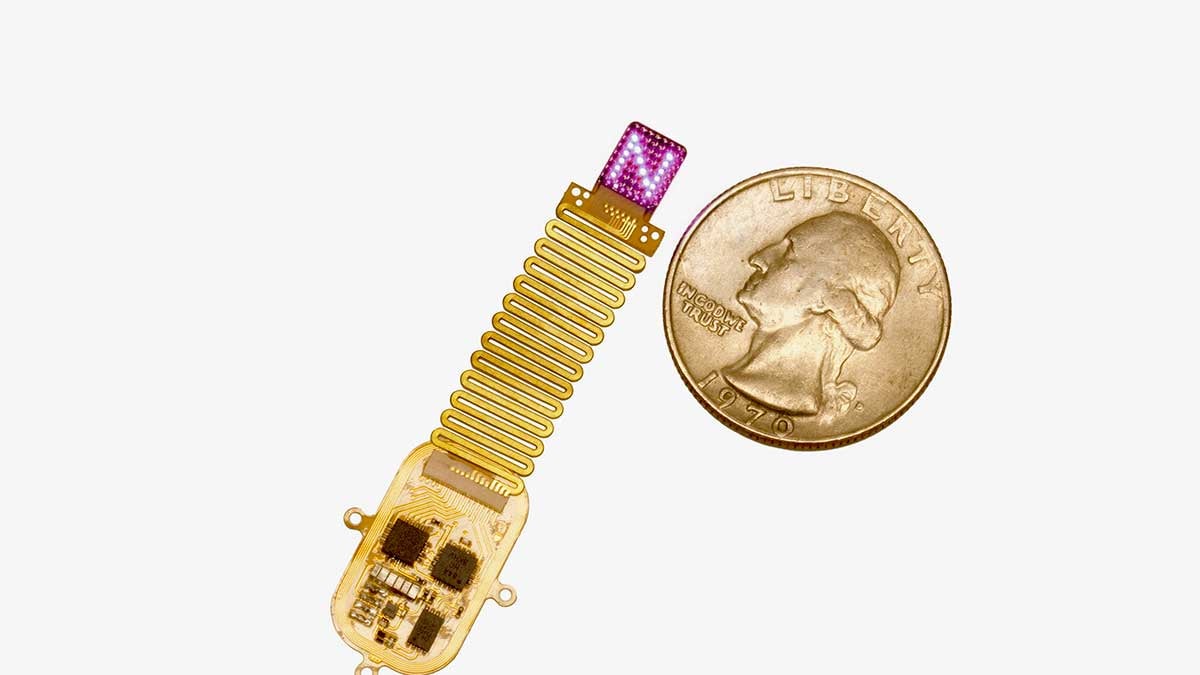
The device, slightly larger in size than a US quarter coin, would be placed beneath the skin of the scalp but on top of the skull, where it uses arrays of microscopic light-emitting diodes, each about the width of a human hair, spread across the skull’s surface.
Researchers say that in laboratory experiments, mice learned to interpret these artificial signals as meaningful information, even though no touch, sound, or vision was involved.
The research, published on 8th December in Nature Neuroscience, highlights growing efforts to develop brain–computer interfaces that are both less invasive and more capable of mimicking the brain’s natural activity patterns.
The study offers a glimpse of how light-based bioelectronics might one day help bridge the gap between machines and the human nervous system.
“Our brains are constantly turning electrical activity into experiences,” said Yevgenia Kozorovitskiy, Irving M. Klotz Professor of Neurobiology at Northwestern University, who led the experimental work.
She said the technology offered a way to create entirely new signals and observe how the brain learns to interpret them, bringing researchers closer to restoring lost senses after injury or disease.
To test the device, the team worked with mice whose cortical neurons had been genetically modified to respond to light. The implant delivered distinct patterns of red light across four brain regions, designed to resemble the distributed neural activity associated with real sensory experiences. The animals were trained to associate a specific pattern with a reward, such as visiting a particular port in a chamber.
The mice quickly learned to distinguish the target pattern from dozens of alternatives, consistently choosing the correct port. “By consistently selecting the correct port, the animal showed that it received the message,” said Mingzheng Wu, a Postdoctoral Fellow and the study’s first author.
Earlier optogenetic approaches relied on fibre-optic cables inserted directly into the brain, tethering animals to external equipment. By contrast, the new implant is fully wireless, battery-free, and programmable in real time.
The device builds on earlier work by the same researchers, published in 2021, which used a single wireless micro-LED to influence social behaviour in mice.
The latest version incorporates up to 64 independently controlled LEDs, allowing researchers to generate complex spatial and temporal patterns of stimulation.
John A. Rogers, Louis Simpson and Kimberly Querrey Professor of Materials Science and Engineering, Biomedical Engineering, and Neurological Surgery at Northwestern University, led the technology development.
He said the multi-LED design better reflects how our brains activate networks of neurons to create sensations rather than isolated points in the brain.
“Real sensory experiences involve distributed cortical activity,” Rogers said. “This system allows us to approach that complexity in a format that remains minimally invasive and fully implantable.”
The researchers added that as well as helping to provide sensory feedback for prosthetic limbs, the research also had implications for other applications ranging from artificial vision or hearing, to pain modulation without drugs, and rehabilitation after stroke.
Future versions could include larger arrays, tighter spacing between LEDs, or light wavelengths that penetrate deeper into brain tissue.
There’s plenty of other editorial on our sister site, Electronic Specifier! Or you can always join in the conversation by visiting our LinkedIn page.