
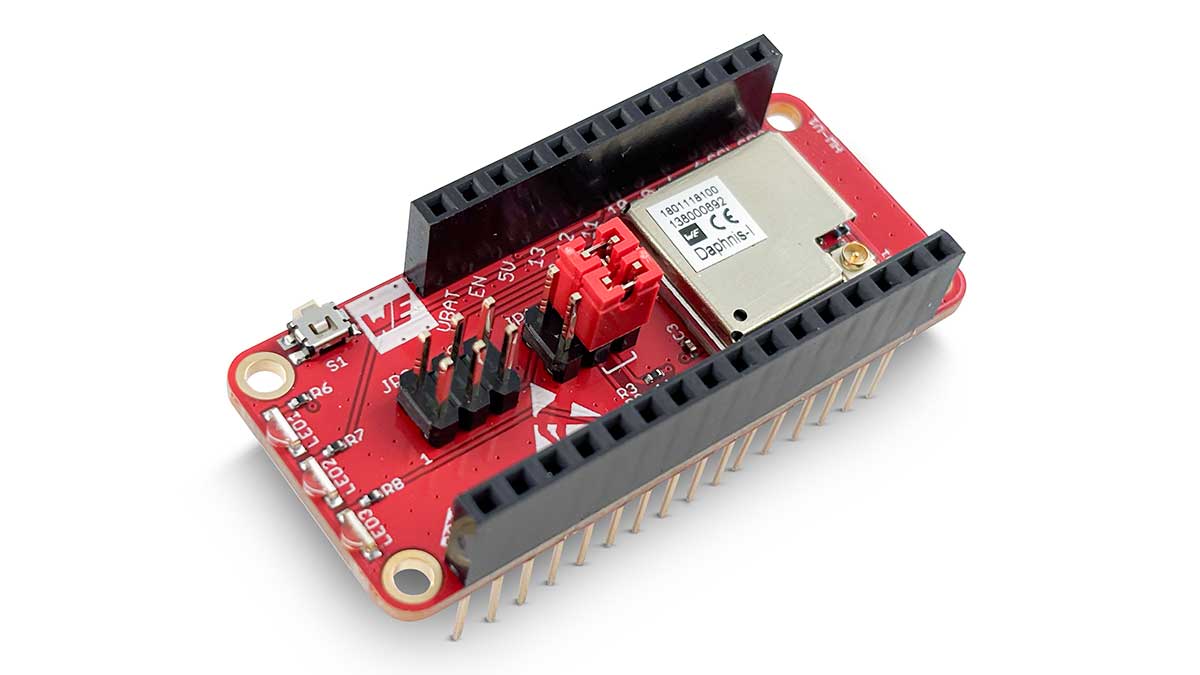
Würth Elektronik has broadened its line-up of Adafruit Feather-compatible development boards with the launch of the Daphnis-I FeatherWing, aiming to simplify rapid prototyping for long-range, low-power IoT applications.
The new board incorporates the company’s Daphnis-I radio module, which supports the LoRaWAN 1.0.4 protocol in the EU868 band. The technology enables battery-powered devices to communicate with gateways more than ten kilometres away, targeting use cases in smart factories, smart homes, smart cities, agriculture, and logistics.
Designed for the widely used Feather ecosystem, the module allows developers to combine Würth Elektronik’s expanding FeatherWing portfolio with hundreds of third-party boards.
The module is built around STMicroelectronics’ STM32WLE5CCU6 chip and offers exceptionally low sleep-mode current consumption of 63.9 nA, making it suitable for long-life sensor networks and other constrained-power deployments. Each board ships with an external 868 MHz Hyperion-I antenna and a UMRF-to-SMA RF cable.
LoRaWAN networks use a star topology, with end devices connecting to gateways that route encrypted data to central servers. The Daphnis-I FeatherWing supports LoRaWAN classes A, B, and C, allowing a range of downlink modes. Configuration is handled over a UART interface through an AT command set, and devices can be activated via OTAA or ABP.
Würth Elektronik provides an evaluation kit, a PC configuration tool, and a software development kit for its FeatherWing range. The company also maintains a GitHub repository featuring sample projects, including secure data-path examples for cloud platforms such as The Things Network, AWS, Microsoft Azure IoT Hub, and Kaa IoT.
The Daphnis-I FeatherWing is available immediately from stock, and the underlying radio modules can be purchased without a minimum order quantity.
There’s plenty of other editorial on our sister site, Electronic Specifier! Or you can always join in the conversation by visiting our LinkedIn page.