
Researchers at Rice University have developed a method to dramatically speed up and sharpen wireless connections in future 6G networks by harnessing what they describe as “engineered randomness.”
The technique, published this week in Nature Communications Engineering, enables wireless systems to identify a signal’s direction within one-tenth of a degree — roughly ten times more accurate than existing technologies. The advance could allow devices to establish or recover high-speed data links almost instantly, a critical requirement for applications such as untethered virtual reality and real-time sensing.
The research addresses one of the central challenges of next-generation wireless systems, which are expected to operate at far higher frequencies than today’s 5G networks. While these bands can carry far more data, they also suffer from rapid signal fading and cannot penetrate physical barriers, requiring transmitters and receivers to align precisely along narrow, line-of-sight paths.
“The method we introduce unlocks extremely rapid angle estimation with unprecedented accuracy,” said Burak Bilgin, a Rice doctoral student and first author of the study. “This allows wireless devices to rapidly find each other, which is essential to unlock unprecedented data rates in the next generation of wireless networks.”
Bilgin likened the approach to a lighthouse emitting multiple, randomly changing colours of light in all directions. Ships — representing wireless receivers — can determine their position relative to the lighthouse by analysing the unique combination of colours and intensities they observe.
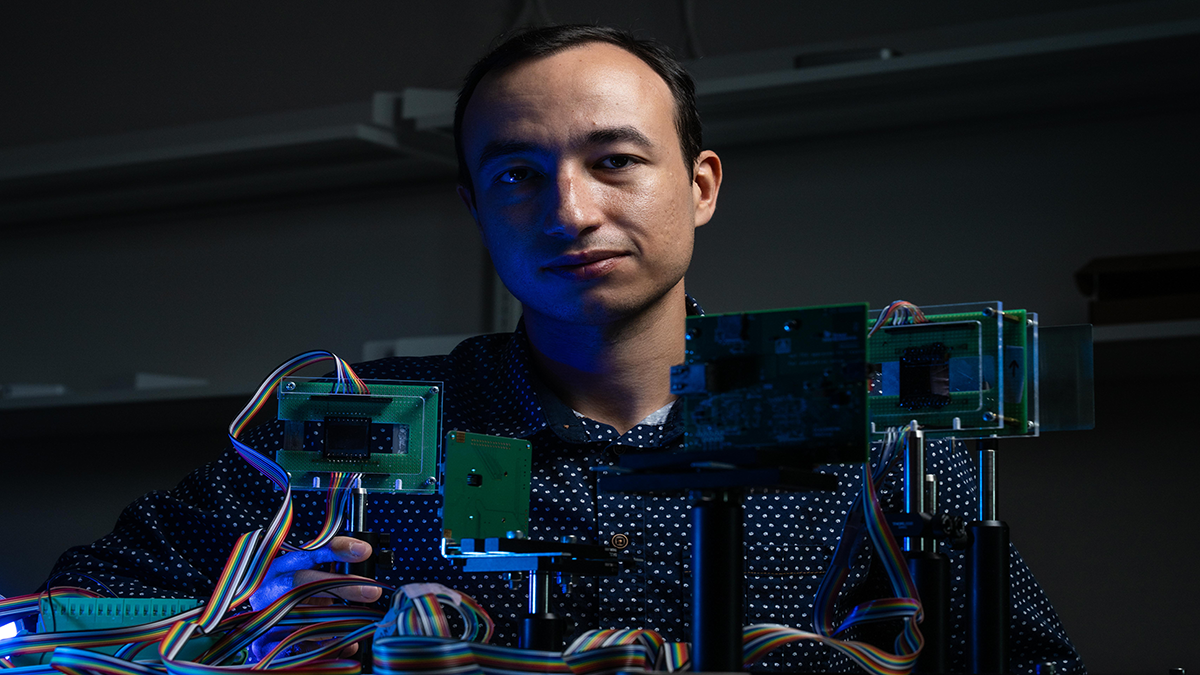
To demonstrate the principle, the researchers used a thin, electronically tunable surface known as a metasurface, fabricated by collaborators at Los Alamos and Sandia national laboratories. When struck by a broadband signal, the metasurface scatters it into a distinct pattern determined by both direction and frequency. Each direction produces its own electromagnetic “fingerprint,” which receivers can match against a reference library to locate the source in mere picoseconds.
Previous systems could vary a signal across either frequency or time, but not both. The Rice-led team combined the two dimensions of variation, enhancing precision even under noisy conditions or limited bandwidth.
Collaborators at Brown University contributed to the modelling and analysis of the electromagnetic behaviour, which required processing large volumes of data. “It is a study of programmed randomness,” Bilgin said, describing a process that involved “a lot of data, careful scheduling, and some unexpected setbacks — like the power going out during an experiment.”
Edward Knightly, the Sheafor-Lindsay Professor of Electrical and Computer Engineering at Rice, said the findings hint at how wireless technology will evolve as data demands escalate. “The physics of the signal itself shape what networks can do,” he said. “This study shows that randomness — when engineered correctly — can make wireless networks faster, smarter and more reliable.”
The research was supported by Cisco, Intel, the US National Science Foundation, the Army Research Office, and the US Department of Energy’s Los Alamos and Sandia national laboratories.
There’s plenty of other editorial on our sister site, Electronic Specifier! Or you can always join in the conversation by visiting our LinkedIn page.