
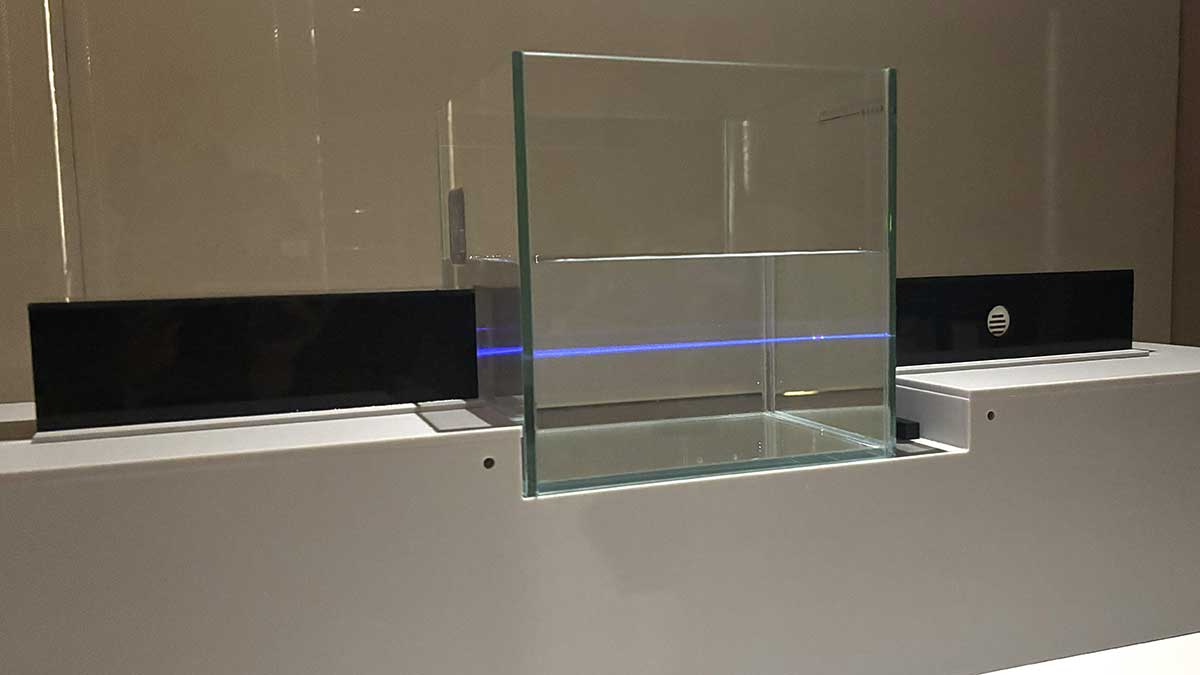
Kyocera has unveiled what it describes as a breakthrough in underwater wireless optical communication, a technology it claims could sharply accelerate real-time data transfer for marine research, subsea industrial work, and autonomous underwater vehicles.
The Japanese technology group said on 27th November in Kyoto and London that it had achieved short-range transmission speeds of up to 5.2 Gbps in freshwater laboratory tests — one of the fastest fibreless underwater optical systems demonstrated to date. The company argues that the advance could remove a long-standing bottleneck in subsea operations, where conventional acoustic communication is typically limited to only a few Mbps.
Kyocera plans to showcase the technology at CES 2026 in Las Vegas from 6th to 9th January, where it will demonstrate how the system can deliver high-resolution imagery, live video, and sensor data from underwater robots in near real time.
The company said the performance gains stem from a proprietary physical layer designed specifically for underwater optical transmission, rather than adapted from terrestrial wired or wireless standards, which often struggle in aquatic environments. It has also developed an optical front-end circuit with more than 1 GHz of bandwidth, allowing significantly higher data throughput in the same time period. Kyocera said this equates to roughly two and a half times the speed of existing underwater optical communication systems.
The group sees broad commercial potential for the technology, from high-definition video sharing by autonomous underwater vehicles to faster inspection of subsea infrastructure and simultaneous data collection from multiple sensors. It is now working to extend both range and capacity, a development it says could support next-generation marine ICT infrastructure.
Alongside the UWOC system, Kyocera will use CES to exhibit other technologies, including AI-based depth sensors, millimetre-wave sensors, and phased-array antenna modules for autonomous mobility.
Kyocera, which has operated in Europe for more than five decades, employs about 77,200 people globally and reported sales of roughly EUR 12.43 billion in the 2024 to 2025 financial year. The group, headquartered in Kyoto, has 288 subsidiaries and a diversified portfolio spanning fine ceramics, automotive and semiconductor components, industrial tools, and consumer products.
There’s plenty of other editorial on our sister site, Electronic Specifier! Or you can always join in the conversation by visiting our LinkedIn page.