
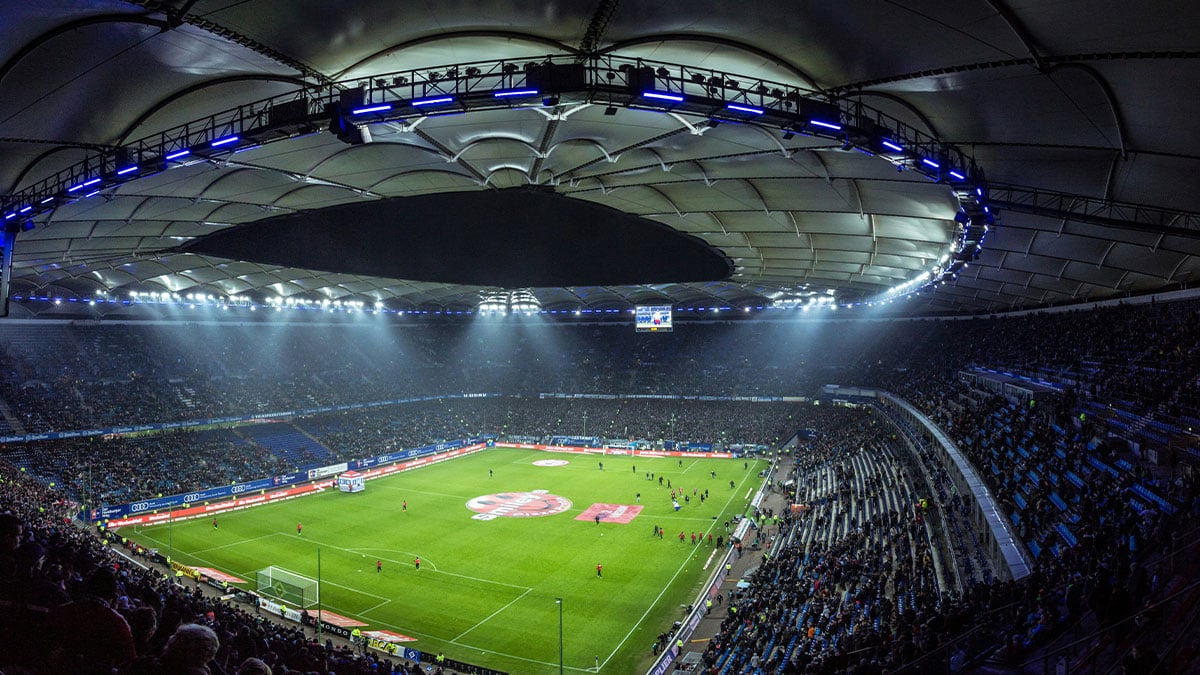
Stable connectivity at live events is now essential, so much so that reliable Wi-Fi is as important to modern sports venues as the game itself. From live streaming the winning moment, to placing mobile food orders, fans expect uninterrupted connectivity no matter where they are seated.
For instance, at Southampton’s St Mary’s Stadium, matchday and event connectivity has struggled under fan demand – prompting management to acknowledge that mobile and Wi-Fi access were unreliable during games.
This scenario highlights how even state-of-the-art venues can struggle to meet today’s fan expectations. To deliver the modern fan experience, major event venues must continue to evolve their networks – or risk falling short of their ever-evolving fan expectations.
The Density Dilemma
Providing Wi-Fi in stadiums presents a unique set of challenges, driven by extreme user density and unpredictable traffic patterns. Tens of thousands of fans often attempt to connect simultaneously, especially in high-traffic zones like seating bowls and concourses.
One event in the USA saw 78% concurrent Wi-Fi usage – that’s over 54,000 devices connected simultaneously. This concentrated demand creates intense radio frequency (RF) interference, bandwidth congestion, and coverage obstacles – all of which degrade network quality. The challenge is further complicated by the presence of Bluetooth accessories, and even rogue access points, which contribute additional RF interference.
Balancing Performance, Security and Design
Often forgotten is that stadium networks support more than just public access. Ticketing, security, broadcasting, and other critical operations rely on wireless infrastructure. These systems must coexist without interference. They require precise network segmentation to ensure operational traffic isn’t bogged down by social media uploads or streaming.
Wireless connectivity in stadiums is further complicated by physical obstructions like steel and concrete, unpredictable traffic patterns and aesthetic constraints. Fans are constantly on the move – roaming between seats, concourses, and amenities – which demands seamless handoffs between access points (APs) to prevent dropped connections and degraded network quality. However, inconsistent AP placement can cause devices to “stick” to distant APs, resulting in sluggish speeds and poor user experiences. Compounding the issue, many venues require APs and antennas to be discreetly integrated into the architecture for aesthetic or preservation reasons, especially in historic stadiums, limiting optimal placement and further impacting network reliability.
Bringing Wi-Fi Closer to the Action
To address these challenges, innovations like under-seat APs offer stadiums a robust, scalable, and visually discreet way to deliver high-density, high-performance Wi-Fi – ensuring both fan satisfaction and operational efficiency. Open-roof venues or deployments with demanding performance requirements, require even greater strategic thinking. In these venues placing APs closer to users is essential. Proximity helps overcome signal degradation caused by obstructions, while also enabling a more controlled and predictable RF environment. This allows for more focused cell sizes and less co-channel interference.
While every venue is unique, typical under-seat deployments require one AP for every 50 to 100 seats. This usually translates to one AP every two to three rows, depending on the section layout and overall stadium capacity. Hyper-directional AP deployments, by comparison, typically serve 200 to 300 seats per AP. The approach delivers a wide range of benefits, including enhanced coverage, increased capacity, faster speeds, lower latency, seamless connectivity, and consistent performance across seating areas. Their casings are also durable enough to withstand drink spills, cleaning products, and even harsh weather conditions. Most importantly, it offers future-readiness with Wi-Fi 7 scalability, ensuring stadiums can meet evolving digital demands and deliver a superior fan experience.
Wi-Fi 7: Reinventing Stadium Connectivity
Managing bandwidth effectively in high-density stadium settings calls for a strategic blend of advanced technology, policy enforcement, and operational best practices. When implemented effectively the result is reliable, high-quality connections, even during the busiest moments of an event. Fortunately, Wi-Fi 7 introduces a range of features that help address the complex connectivity challenges in stadium environments.
Innovations like AI-driven network optimisation and BeamFlex adaptive antenna technologies help enhance RF performance while quality of service (QoS) mechanisms allow for prioritisation of mission-critical applications such as ticketing and security over general browsing. In some cases, client rate limiting is necessary to ensure fair bandwidth distribution across thousands of users.
A well-designed stadium network further incorporates segmentation strategies, separating traffic for fans, operations, media, and other stakeholders to improve performance and security. Real-time monitoring enables dynamic adjustments based on usage patterns, while technologies like band steering help guide devices to the most appropriate frequency bands.
With 320 MHz channels, 4096-QAM modulation, and spectrum puncturing, Wi-Fi 7 delivers fast speeds, ultra-low latency, and superior interference management. Even if device uptake happens slowly, older devices can still benefit from Wi-Fi 7 capable access points, as the chipsets evolve and enable better signal quality. In many cases, legacy devices can see up to 30% performance improvement when connected to Wi-Fi 7-enabled APs.
As the bandwidth for digital fan engagement grows, the ability to provide stable, fast, and reliable connectivity won’t just be about convenience. It will define the fan experience. With innovative infrastructure, AI-driven management, and future-ready technologies, today’s stadiums can lay the groundwork for a connected future that thrills both on and off the field.

By: Alessandro Feitosa, Vice President, Market Development, RUCKUS Networks (part of CommScope)
This article originally appeared in the February issue of IoT Insider.