
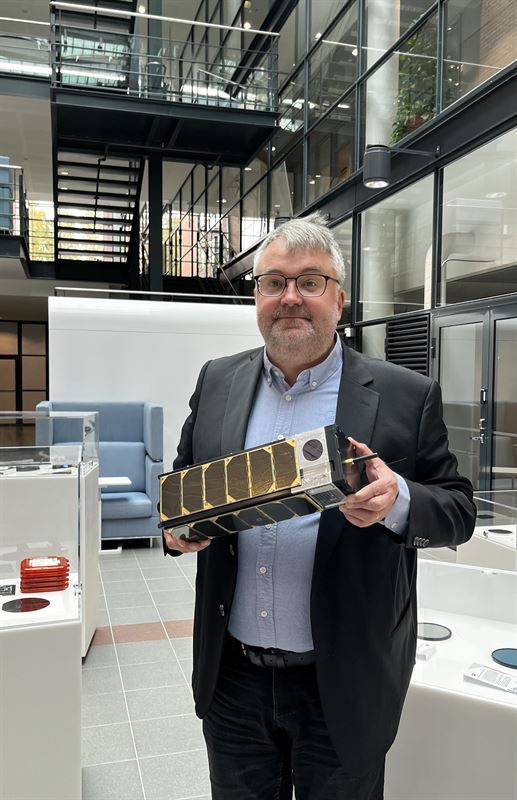
The European Space Agency’s Finnish-built W-Cube nanosatellite is set to burn up in the Earth’s atmosphere in the coming days, marking the end of a four-year mission that demonstrated the viability of ultra-high frequency bands for satellite communications.
The satellite, built by Finnish company Kuva Space and launched in June 2021, was the first commissioned by ESA from Finland. Roughly the size of a large milk carton, W-Cube carried a radio beacon system developed by Finland’s VTT Technical Research Centre and Germany’s Fraunhofer IAF.
Its mission was to test whether extremely high frequency bands—up to 75 GHz, far beyond those currently in commercial use—could be used in future satellite systems. Scientists said the experiment proved successful, with signals received at ground stations in Finland, Austria and the Netherlands.
“This marks the end of a very successful space mission,” said Jussi Säily, Principal Scientist at VTT and Project Manager for W-Cube. “We showed that much higher frequency bands than those used today can deliver high-performance communications. This opens possibilities for faster data connections in Europe—even directly to smartphones.”
The nanosatellite has been steadily descending and is currently orbiting at around 200km above the Earth’s surface. ESA expects the craft to lose connection and disintegrate soon as friction with the atmosphere increases.
For Finland, the €1million project was a milestone in space research, with VTT responsible for roughly half of the budget. The centre developed the payload and mechanics, including control electronics, antennas and a frequency synthesiser. Kuva Space provided the platform, attitude control, solar panels, and operational management.
The W-Cube mission focused on measuring how atmospheric conditions, particularly rain and cloud cover, affect high-frequency radio signals. Data gathered has allowed researchers to build attenuation models that will inform the design of next-generation telecommunications satellites.
Nanosatellites typically operate for five to six years, making W-Cube’s four-year lifespan notable. VTT has already been invited to collaborate on ESA’s next project, the larger 6G-Lino satellite, due for launch next year.
Säily said the project underscored Europe’s strategic need for independent space infrastructure. “Societies are dependent on reliable telecommunications. Satellite-based systems are harder to disrupt than terrestrial ones. EU decision-makers also understand that the US could restrict access to the satellite networks it controls, which motivates investment in European alternatives.”
The success of W-Cube has bolstered Kuva Space’s reputation. “Thanks to our experience, we’ve developed fully automated satellite operations. We’ve now launched five nanosatellites with a 100% success rate,” said Janne Kuhno, the company’s Chief Engineer and co-founder.
VTT’s ground station in Otaniemi, Espoo—commissioned in 2024 to track W-Cube—will continue to play a role in future ESA projects, including receiving signals from the Alphasat satellite. Researchers also plan to test millimetre wave communications for drones using the facility.