As agentic AI moves from experimentation to deployment, business leaders are being urged to think less about whether to adopt the technology, and more about how they do so.
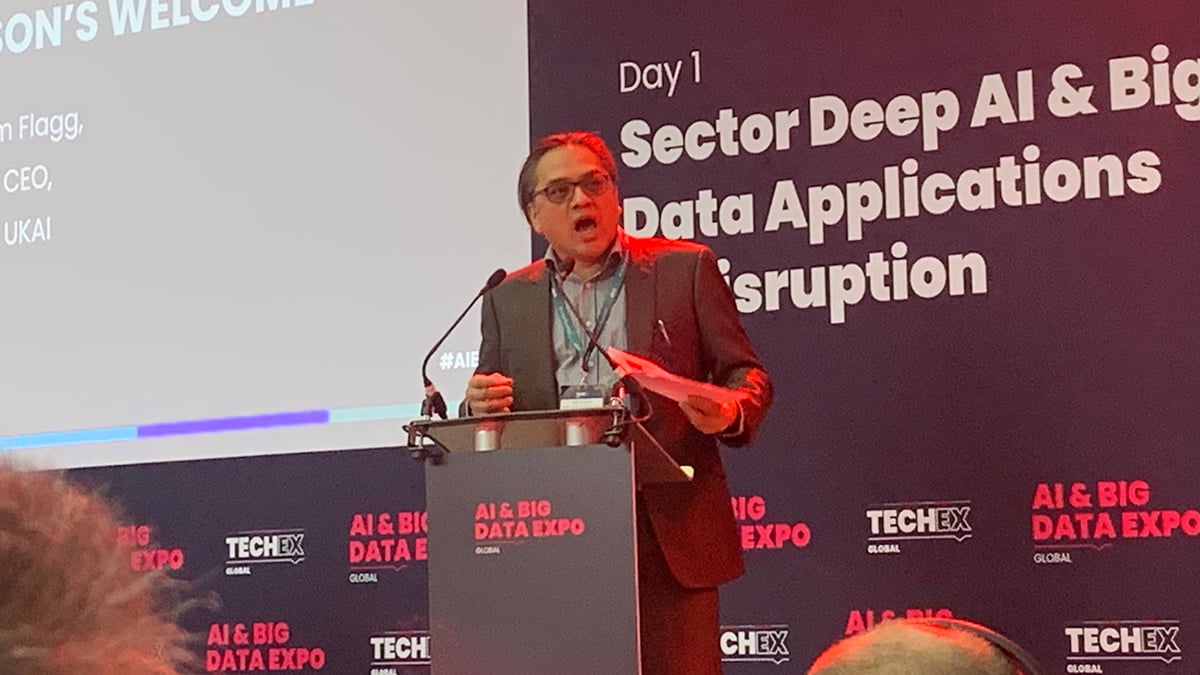
Speaking at the AI and Big Data Expo, part of the IOT Tech Expo in London this week, Tim Flagg, Chief Executive of UKAI, the trade body representing Britain’s AI companies, said that while agentic AI is already reshaping business models and competitive dynamics, organisations must take greater care in how they introduce systems capable of acting with a high degree of autonomy.
Agentic AI, which can initiate actions and pursue goals with limited human oversight, is increasingly being framed as essential to future competitiveness. Flagg acknowledged the momentum behind adoption but warned that responsible deployment requires clearer thinking about purpose, governance, and education.
“Agentic AI is already transforming business models,” he said. “But we also have to think carefully about doing this responsibly.”
As head of a trade body that sits between policymakers, technology providers, and end users, Flagg said he was hearing similar concerns across the country. In many cases, organisations are racing to deploy tools before clearly defining the problem they are trying to solve.
Those consequences are becoming more acute as agentic systems move beyond narrow automation into roles that involve decision-making, customer interaction, and coordination across multiple systems. Unlike earlier waves of enterprise software, agentic AI can initiate actions, trigger workflows, and interact with users with limited human oversight, making failures harder to predict and unwind.
Responsibility, Flagg argued, cannot sit solely with technical teams or senior executives. Instead, he called for a broader culture of education and accountability that extends beyond the workplace.
“It is our responsibility together to educate our colleagues, our teams, our companies, our families,” he said. “That’s how we build confidence in this area.”
The warning comes as the UK continues to pursue a principles-based approach to AI regulation, placing significant emphasis on voluntary standards and industry self-governance. While that approach is intended to preserve innovation, it also assumes a level of maturity that some organisations may not yet possess.
Speaking immediately after Flagg at the same event, Matthew O’Neil, Field CTO at software company Salesforce, described how agentic AI is already reshaping large enterprises in practice.
O’Neil argued that agentic AI is not simply a new feature to be added to existing software, but a fundamental shift in how applications are designed, built, and used, effectively making AI agents extra members of staff.
The emergence of what he described as “digital labour” requires companies to rethink enterprise architecture from the ground up.
“Becoming a data enterprise is about looking for opportunities to work with digital labour across all business functions,” he said.
In O’Neil’s view, agentic AI breaks the logic that has governed enterprise software for decades. Conversations with customers are no longer confined to a single application or screen, but move fluidly across sales, service, marketing, and operations. As a result, organisations must dismantle the barriers between systems and invest in platforms that combine reasoning, learning, and secure access to data.
He outlined three priorities for organisations deploying agentic AI at scale. The first is enterprise architecture: clearly defining the scope of AI agents, the jobs they are allowed to perform, and the actions and data they can and cannot access. The second is context engineering and data, ensuring agents can draw information from across the organisation while preserving privacy and control. The third is agent excellence and integration, allowing agents to trigger real work inside existing systems rather than operating as standalone conversational tools.
For Salesforce, O’Neil said, this has required rebuilding the way applications are created. Logic can now be expressed in plain language as well as code, and agents can be embedded directly into workflows used by employees and customers.
In sales, virtual agents can engage prospects, ask qualifying questions, and schedule meetings before handing over to human sellers. In field service, agents can coordinate bookings and customer communications. In marketing, two-way email agents can turn one-off outreach into ongoing conversations.
“These things wouldn’t be possible without agents being deeply integrated into existing applications,” O’Neil said.